Timkat: Ethiopia's Epiphany Festival of Water, Processions and White
Every January, Ethiopian Orthodox Christians carry sacred tabots to the water, sing through the night and bless the crowds. Timkat is one of Africa's great festivals.
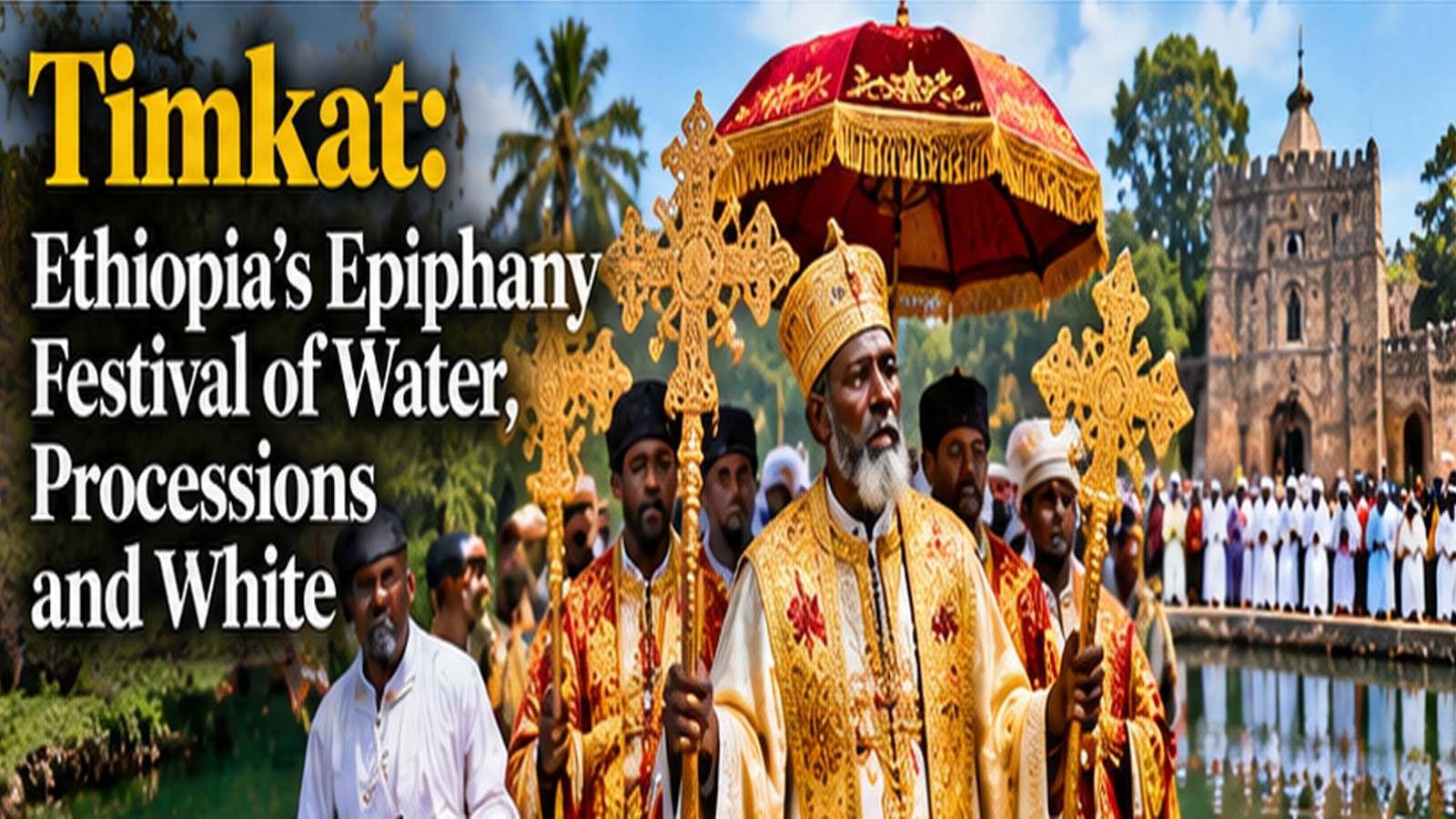
On the eve of Timkat, the sound of chanting rises over Ethiopia's towns. Priests in embroidered robes walk slowly beneath fringed velvet umbrellas of red, gold and green. On their heads they carry wrapped bundles, the most sacred objects of their churches. Around them, thousands of people dressed in white sing, clap, drum and dance as the procession makes its way towards the water.
This is Timkat (also spelled Timket), the Ethiopian Orthodox celebration of Epiphany, which marks the baptism of Jesus in the River Jordan. It is the most colourful festival of the Ethiopian year, and in 2019 it was inscribed by UNESCO as part of humanity's living heritage.
When it happens
Timkat falls on 19 January in most years, and on 20 January in leap years, such as 2028. That is because the Ethiopian church follows its own Ethiopian calendar, whose dates differ from the Gregorian calendar familiar elsewhere.
The celebration lasts about three days:
- Ketera, the eve, when the processions go out to the water;
- Timkat itself, the main day of blessing;
- the following day, the feast of Saint Michael, when the last processions return home.
The tabot: heart of the festival
Every Ethiopian Orthodox church holds a tabot, a consecrated tablet that represents the Ark of the Covenant and the tablets of the Law. It is kept hidden in the innermost sanctuary of the church and is never shown uncovered to the public. Without a tabot, a building cannot serve as a church.
At Timkat, the tabots are wrapped in rich cloth and carried out on the heads of priests. This public procession is the high point of the festival, and it connects to Ethiopia's ancient traditions about the Ark, told in the Kebra Nagast and treasured in the holy city of Aksum.
Ketera: the night by the water
On the afternoon of the eve, the tabots leave their churches and travel to a nearby river, lake or specially prepared pool. Clergy chant ancient hymns in Ge'ez, the church's classical language, while deacons ring bells and swing incense.
Crowds follow with drums, horns and songs. Young men leap and dance, women ululate, and children run alongside. At the water, the tabots are placed in tents for the night. Many worshippers stay awake, praying and singing until dawn, wrapped in white shawls against the highland cold.
The blessing of the water
Before sunrise on Timkat morning, priests lead prayers and a long service by the water. Then comes the moment many people wait for: the water is blessed and sprinkled over the crowds. In some places, people jump in to renew their baptismal vows, splashing and cheering.
Later in the day, most tabots begin the long, joyful journey back to their churches, again accompanied by singing, dancing and drumming. Elders in their best clothes, young people in matching outfits and families with small children fill the streets.
Where to see Timkat
Timkat is celebrated across Ethiopia, but some places are especially famous:
- Gondar, where crowds gather around the Bath of Fasilides, a seventeenth-century royal pool that is filled with water for the festival. Its stone walls and old trees make it one of the most beautiful Timkat settings.
- Lalibela, home of the famous rock-hewn churches, where processions wind through the town.
- Addis Ababa, where huge crowds gather at open grounds across the capital.
- Aksum, where the faithful gather at the ancient reservoir known as the Queen of Sheba's bath.
Hotels in Gondar and Lalibela fill up weeks ahead, so travellers usually book early. Visitors are welcome, but it is a religious event. Dress modestly, follow local guidance, and ask before photographing priests or worshippers up close. UNESCO's entry on the Ethiopian epiphany describes its importance to communities.
A festival of white
Timkat is also a feast for the eyes. Most people wear white, often the handwoven habesha kemis for women and white cotton outfits for men, set off by the bright colours of the priests' robes and umbrellas. For many young people it is also a social highlight of the year, a time to meet friends and show off new clothes. Many Ethiopians say Timkat was traditionally a day when young men and women might first notice a future partner in the crowd, and songs and games along the procession route still carry that playful spirit.
Timkat sits in a calendar rich with festivals, from Meskel in September to Fasika, the Ethiopian Easter.
Why it matters
Timkat shows the depth of Ethiopia's Christian heritage, one of the oldest in the world, and how faith can bring entire towns into the streets together. It joins worship, music, dance and community in one great public celebration.
For visitors, it is an unforgettable sight. For Ethiopians, it is a renewal of faith and belonging, carried out each year by the water, just as their ancestors did.