The Obelisks of Aksum: Stone Giants of an Ancient African Empire
Seventeen centuries ago, the kingdom of Aksum raised carved stone towers taller than most buildings of its time. One was taken to Rome, and came home after 68 years.
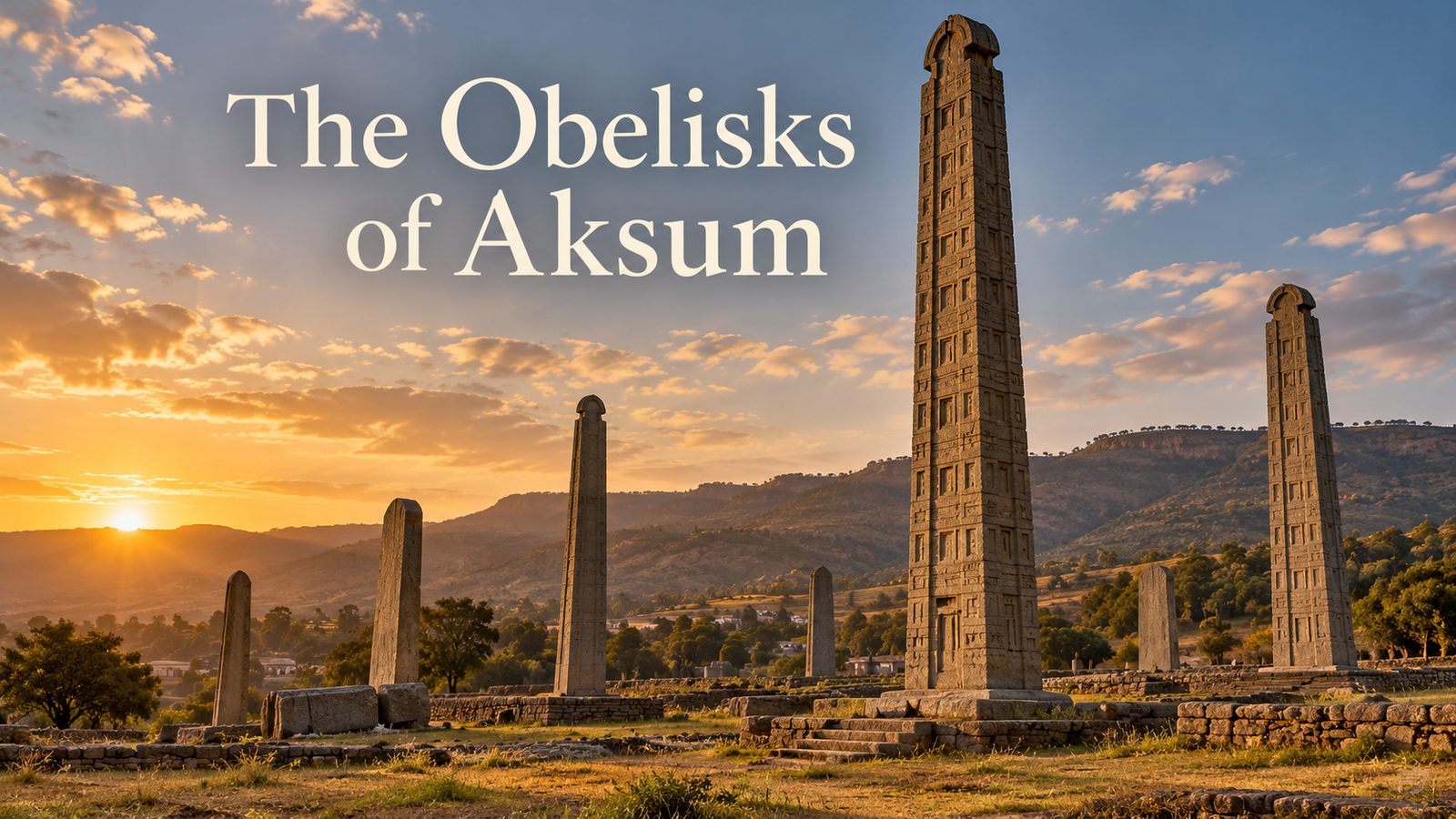
In a field at the edge of the town of Aksum, in northern Ethiopia, stands a forest of stone. Tall, slender monuments rise from the ground, their faces carved to look like multi-storey buildings, with false doors at the base and rows of false windows climbing upward. The largest of them lies broken on the ground, where it fell perhaps as it was being raised. These are the stelae of Aksum, and they belong to one of the great empires of the ancient world.
An empire between continents
From roughly the 1st to the 7th century CE, the Kingdom of Aksum controlled the highlands of what is now northern Ethiopia and Eritrea, with its port at Adulis on the Red Sea. Its merchants traded ivory, gold and incense with Rome, Arabia, Persia and India. A Persian writer of the 3rd century reportedly listed Aksum among the four great powers of the world, alongside Rome, Persia and China.
Aksum minted its own gold, silver and bronze coins, carrying the names of its kings in Greek and later in Ge'ez, the local script. In the 4th century, under King Ezana, the kingdom adopted Christianity, making it one of the first states anywhere to do so.
The stelae
The stelae were probably raised as grave markers for Aksumite rulers and nobles, with underground tombs nearby. Scholars count more than a hundred in the main field, from rough, unworked stones to a handful of enormous carved masterpieces. The most famous three:
- The Great Stele — around 33 metres long and estimated at over 500 tonnes, it is often described as the largest single block of stone that humans have ever tried to stand upright. It lies shattered, and many archaeologists think it fell during its erection.
- King Ezana's Stele — around 21 metres high, still standing, with a slight lean that engineers have worked to stabilise.
- The "Rome" Obelisk — around 24 metres high and roughly 150 tonnes, carved on all sides with the building-like design. Its story is the most dramatic of all.
Each carved stele was cut from a single block of granite-like rock, dragged from quarries a few kilometres away, and raised without modern machinery — an achievement that still impresses engineers.
Taken to Rome, and returned
In 1937, during Italy's occupation of Ethiopia under Mussolini, Italian soldiers took the second-largest stele, cut it into pieces and shipped it to Rome, where it was set up near the headquarters of the Fascist government's colonial ministry. After the Second World War, Italy agreed in principle to return it — but decades passed.
Ethiopian campaigners never gave up. In April 2005, Italy finally dismantled the obelisk and flew it back to Aksum in three sections. With UNESCO's help, and after careful engineering work on the ground, the last block was set in place in 2008, and the obelisk was formally re-inaugurated that September. People in Aksum celebrated with music in the streets. After 68 years, the stone had come home.
Faith and legend
Aksum is also a holy city. The Church of Our Lady Mary of Zion stands near the stelae field, and Ethiopian Orthodox tradition holds that a chapel beside it houses the Ark of the Covenant, brought to Ethiopia, according to the national epic, by Menelik I, son of King Solomon and the Queen of Sheba. The Ark is guarded by a single monk, and no one else is allowed to see it. Whether or not one accepts the tradition, it shows how deeply Aksum is woven into Ethiopia's sense of itself.
Why it matters
Aksum was added to the UNESCO World Heritage List in 1980, and its stelae remain a symbol of Ethiopian identity. They are a reminder that one of the most sophisticated states of the ancient world — with its own coinage, script, architecture and international trade — stood in the highlands of Africa. And the long campaign to bring one obelisk home shows how much that history still means today.
Further reading
- UN News — UNESCO teams successfully reinstall Ethiopian obelisk (2008)
- UNESCO World Heritage Centre — Aksum
- Stuart Munro-Hay, Aksum: An African Civilisation of Late Antiquity (Edinburgh University Press, 1991)