Vodun Days in Ouidah: Benin's Celebration of an Old Religion
Every January, drums, masquerades and pilgrims fill the coastal town of Ouidah. Benin's Vodun Days honour a religion that is often misunderstood, and show what it really means to its followers.
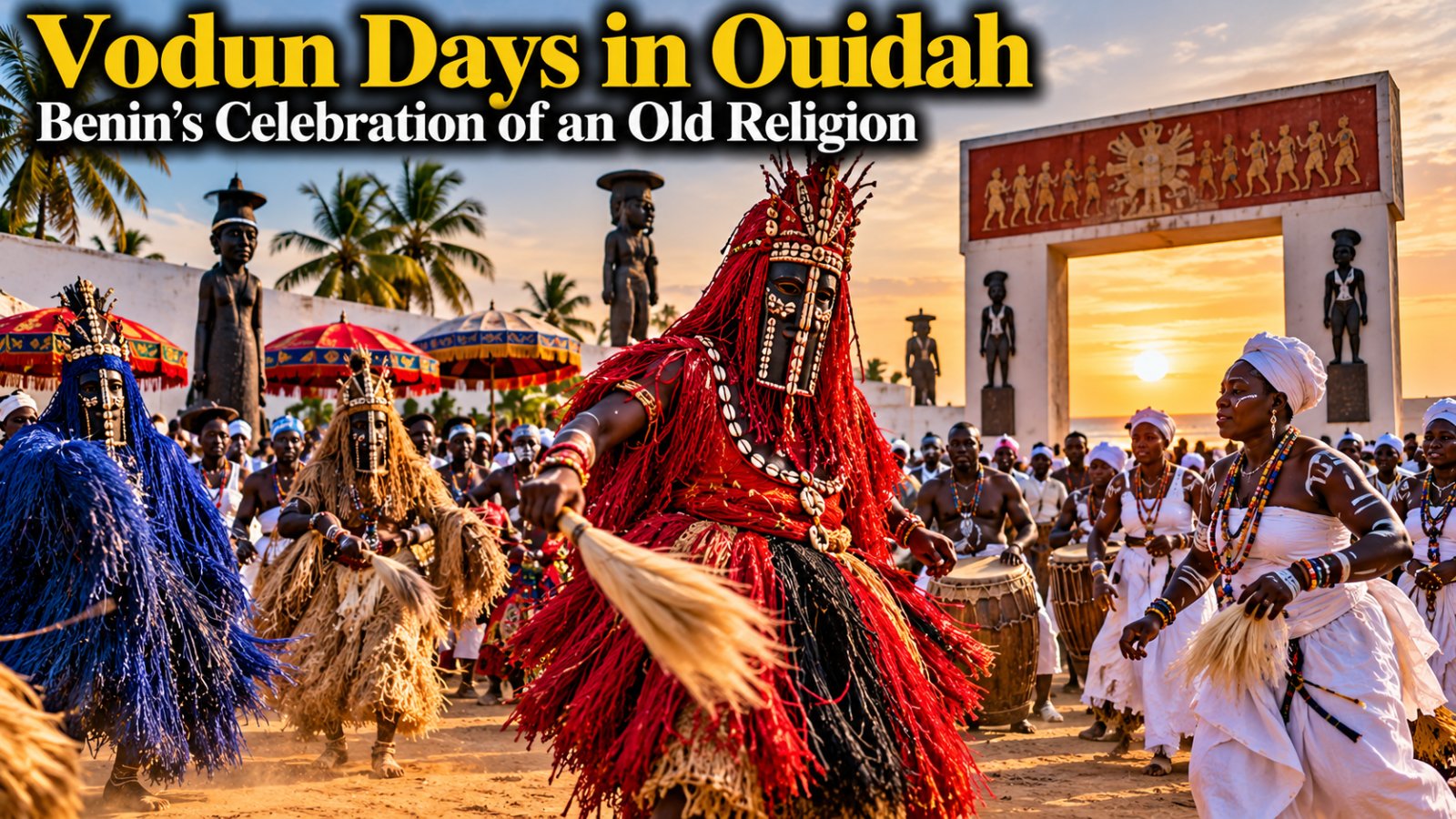
Mention "voodoo" to most people outside Africa and they think of pins stuck in dolls, zombies and horror films. Spend a morning in Ouidah, a small town on the coast of Benin, in the second week of January, and you see something completely different: grandmothers in white cloth, drummers who have played since dawn, dancers spinning in raffia costumes, and families who have travelled from Lagos, Lomé, Salvador and New Orleans to stand on the beach together.
This is Vodun Days, Benin's national celebration of the religion it gave the world.
What Vodun actually is
In the Fon language of southern Benin, vodun means a spirit or a divine force. Vodun is not one god but a whole family of them, each linked to a part of life. There is a vodun of thunder, one of the sea, one of iron and work, one of smallpox and healing, and many more. Above them all stands a distant creator. People honour the vodun, and their own ancestors, through prayer, song, dance, offerings and the advice of priests and diviners.
Vodun is practised mainly by Fon, Ewe, Mina and related peoples in Benin, Togo and parts of Ghana and Nigeria, and it shares much with the Yoruba religion next door. Its system of divination, called Fa, is a close cousin of the Yoruba Ifá.
The religion also crossed the Atlantic. Millions of people were taken from this coast during the slave trade, and they carried their gods with them. Haitian Vodou, parts of Brazilian Candomblé and the Vodou of Louisiana all have roots here. That is one reason so many visitors from the Americas come to Ouidah each January: for them it feels like a homecoming.
From a quiet faith to a national holiday
For much of the twentieth century, Vodun was pushed into the background. Missionaries called it superstition. Later, the Marxist-Leninist government that ruled the country in the 1970s and 1980s treated traditional religion as backward and discouraged it in public life.
That changed when democracy returned in the early 1990s. Under President Nicéphore Soglo, the state began to honour Vodun openly, and 10 January became a national holiday for traditional religions. For three decades, the day was marked with ceremonies across the south of the country, with the biggest gathering in Ouidah.
In 2024, the government renamed the festival Vodun Days and stretched it over two days, 9 and 10 January. The spelling Vodun was kept on purpose, as an African word rather than the Hollywood "voodoo". The English word "Days" was added to welcome international visitors. Concerts were added to the programme, with musicians from Benin, elsewhere in Africa and Haiti, and some events moved to the beaches of Grand-Popo near the Togolese border.
What you see during the festival
Every family and every shrine celebrates in its own way, but some things are almost always there:
- Drums and songs. Each vodun has its own rhythms. Drummers can play for hours, and the right rhythm is believed to call the spirit close.
- Egungun masquerades. Figures covered from head to foot in layers of shimmering cloth represent returning ancestors. Spectators keep a careful distance, because the cloth must not be touched. (We told the story of these masks in our piece on the Egungun masquerade.)
- Zangbeto. Tall, spinning cones of dried raffia are the "night watchmen" of Vodun. Nobody is supposed to be inside them, say their followers; the spirit moves the costume itself.
- Offerings and blessings. Priests pour libations of gin or palm wine, and people kneel to receive blessings from the high priests, who sit in state on the beach.
The places that give the festival its meaning
Ouidah was chosen for a reason. Its streets hold some of the most important sites of Vodun, and some of the most painful sites of African history.
In the centre of town is the Temple of Pythons, where royal pythons, sacred to the vodun Dangbe, are kept and honoured. Directly across the square stands Ouidah's Catholic basilica. The two buildings face each other, a reminder that many Beninese see no contradiction in visiting both.
From the town, a road of about four kilometres runs down to the sea. This is the Route des Esclaves, the path enslaved Africans were forced to walk to the ships. It ends at the Door of No Return, a monumental arch on the beach. During Vodun Days, the crowds that gather here are not only celebrating. They are remembering, and for many visitors from the diaspora it is the most emotional moment of the trip.
How many people follow Vodun?
The answer depends on who you ask. Benin's 2013 census counted about 14 percent of the population as Vodun followers, compared with roughly half who were Christian and over a quarter who were Muslim. Many Vodun leaders say the real figure is far higher, because large numbers of Christians and Muslims also consult Vodun priests, honour family shrines, or take part in ceremonies. A census form has room for only one answer, but daily life in southern Benin is more flexible than that.
Why it matters
Vodun Days is partly about tourism, and some critics worry that a sacred practice could become a show for cameras. The priests themselves are divided on how much should be shared with outsiders. But the festival has also done something important. It has given an old African religion public dignity in its own homeland, after centuries of being mocked abroad and pushed aside at home.
For a few days in January, the people of Ouidah tell their own story about Vodun: not as a horror film, but as a faith about ancestors, community, healing and memory.
Further reading
- Global Voices — Benin: The National Vodun Festival is now 'Vodun Days' (January 2024)
- Government of Benin — Ouidah hosts the Vodun Days, 9 and 10 January 2024
- Suzanne Preston Blier, African Vodun: Art, Psychology, and Power (University of Chicago Press, 1995)