Ge'ez: Africa's Own Ancient Script, Still Written Every Day
Ethiopia and Eritrea write with a script that has developed on African soil for around two thousand years. Here is how Ge'ez works and why it is unique.
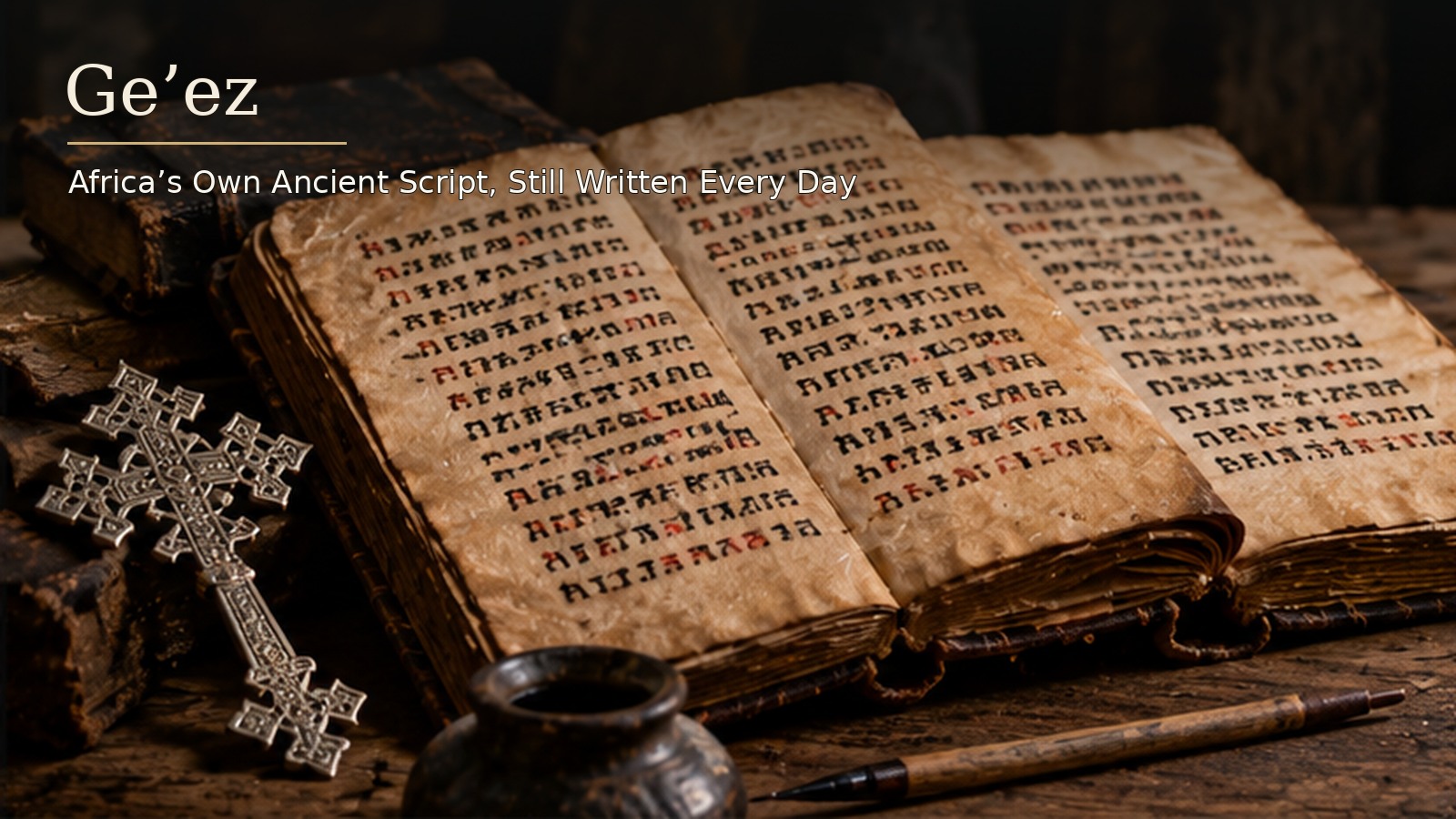
Pick up a newspaper in Addis Ababa or Asmara, look at a shop sign or a smartphone screen, and you will see a script unlike any other: rows of rounded, elegant characters with small loops and strokes attached. This is Ge'ez — also called Ethiopic — one of the oldest writing systems still in daily use, and one of the very few that developed and continues to thrive in Africa.
Where it comes from
The script takes its name from the Ge'ez language, the classical language of the ancient kingdom of Aksum, which ruled much of what is now northern Ethiopia and Eritrea from roughly the first to the seventh centuries CE. Aksum was a major trading power, minting its own coins and linking Africa with Arabia, India and the Roman world.
The script grew out of writing used in southern Arabia and the Horn of Africa. At first, like Arabic or Hebrew, it wrote only consonants. One of the oldest known examples is an inscription on the Hawulti obelisk at Matara in Eritrea.
The big innovation: adding vowels
In the 4th century, something remarkable happened. Around the reign of King Ezana of Aksum — the ruler who adopted Christianity — writers began marking vowels by changing the shape of each consonant: adding a small stroke, a loop, or changing the length of a leg.
The result is a type of writing system called an abugida. Each character stands for a consonant plus a vowel. Instead of an alphabet of around 26 letters, you have a grid.
How it works
The script has about 26 basic consonants in its classical form. Each one comes in seven forms, called "orders," one for each vowel sound. For example, the consonant l appears as:
- ለ — lä
- ሉ — lu
- ሊ — li
- ላ — la
- ሌ — le
- ል — lə (or just l)
- ሎ — lo
Once you know the pattern of small changes, you can read many characters you have never seen before. Learners in Ethiopia and Eritrea memorise the whole table, chanting it row by row, as children elsewhere might recite the ABCs. In Amharic and Tigrinya, the script is called the fidel (ፊደል), meaning "letter" or "script."
Many languages, one script
The Ge'ez language itself is no longer spoken as a mother tongue, but its script lives on. It is used to write:
- Amharic, the working language of Ethiopia's federal government
- Tigrinya, widely spoken in Eritrea and northern Ethiopia
- Tigre, Bilen, Harari and several Gurage languages, among others
New characters were added over time to represent sounds in these languages that classical Ge'ez did not have. Today the script includes hundreds of characters, and it is fully supported on computers and phones through the Unicode standard.
A sacred language
Ge'ez remains the liturgical language of the Ethiopian Orthodox Tewahedo Church and the Eritrean Orthodox Tewahedo Church, much as Latin was used in the Catholic Church. Priests and deacons study it, and centuries of religious texts, chronicles and poetry were written in Ge'ez on parchment, often with brilliant painted illustrations. Ethiopia has one of the richest traditions of illuminated manuscripts in the world. Alongside the Timbuktu manuscripts of Mali, they are among the great treasures of African written culture.
Numbers too
Ge'ez even has its own numerals, such as ፩ (1), ፪ (2), ፲ (10) and ፻ (100). Like Greek and Hebrew numerals, they are based on letters. Arabic numerals are more common in everyday life now, but you can still see Ge'ez numbers on calendars, church documents and some official papers.
Why it matters
Ge'ez challenges the old, wrong idea that Africa had no writing of its own. Here is a script that was invented and developed on the continent, adapted for many languages over two thousand years, and still used by tens of millions of people every day — on paper, in churches and on the latest phones. Learn just one row of the fidel, and you will be reading a little piece of African history.
Further reading
- Peter T. Daniels and William Bright (eds.), The World's Writing Systems (Oxford University Press, 1996)
- Unicode Consortium — Ethiopic script charts