Meskel: Ethiopia's Festival of the True Cross
Tonight, across Ethiopia, great bonfires called demera will be lit to celebrate the finding of the True Cross. Meskel, recognised by UNESCO, is one of the most spectacular festivals in Africa.
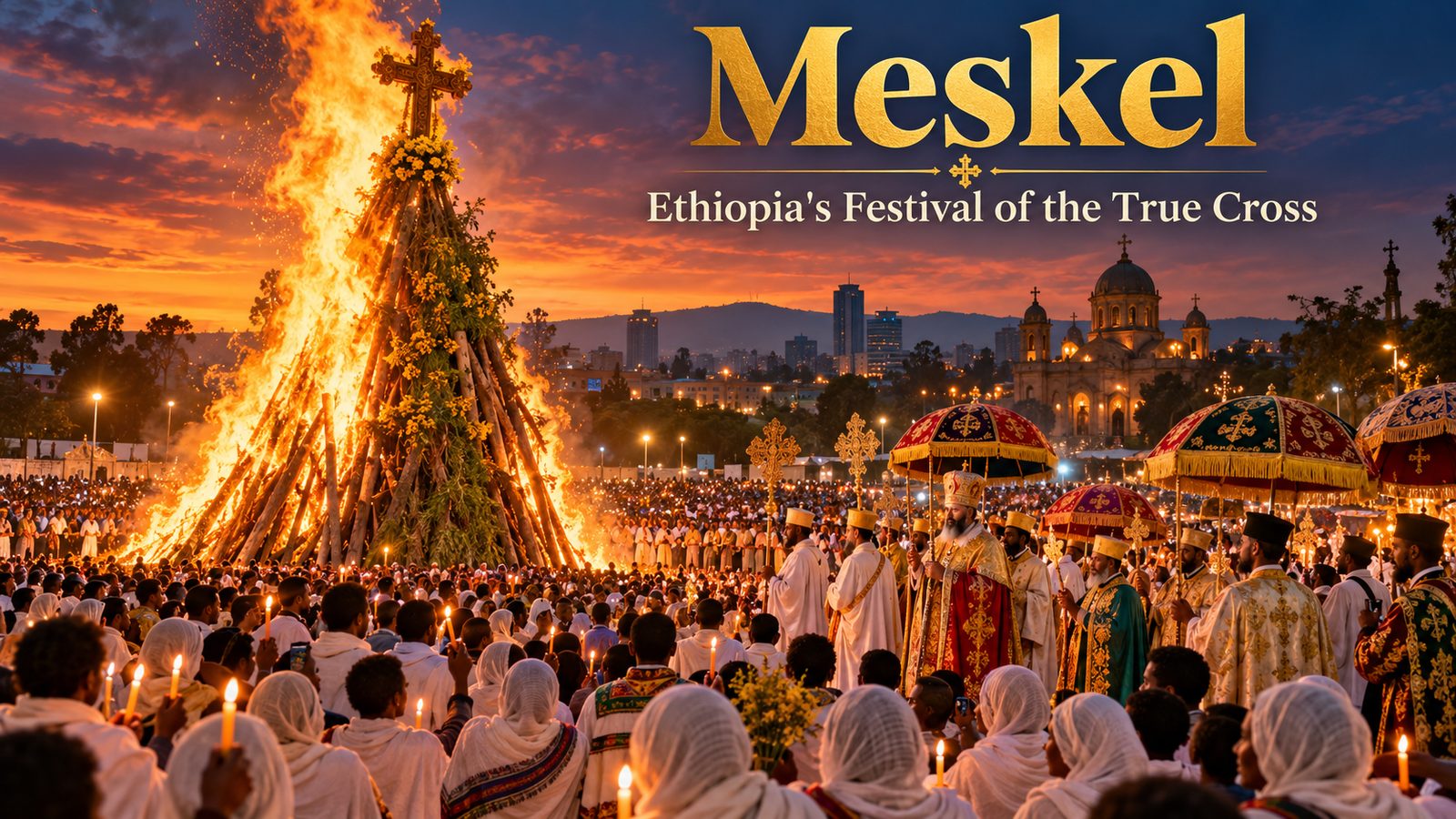
As the sun sets over Addis Ababa, crowds pour into Meskel Square, the vast open space in the heart of the city. In the centre stands a tall conical stack of wooden poles, decorated with yellow flowers and topped with a cross. Priests in embroidered robes and colourful umbrellas chant and pray. Young people in white sing and dance. Then, as night falls, the great pile is set alight, and flames leap high into the dark sky. The same scene is repeated in towns and villages across Ethiopia. Tonight is the eve of Meskel, the Finding of the True Cross.
What is Meskel?
Meskel (or Mesqel) means "cross" in Ge'ez, the ancient liturgical language of the Ethiopian Orthodox Church, and in Amharic. The festival commemorates the finding of the True Cross, the cross on which, according to Christian tradition, Jesus was crucified.
It is celebrated on Meskerem 17 in the Ethiopian calendar, which usually falls on 27 September in the Gregorian calendar (28 September in a leap year). The great bonfire, the Demera, is lit on the eve of the feast, on 26 September.
The story of Empress Helena
According to tradition, in the 4th century, Empress Helena (known in Ethiopia as Eleni), the mother of the Roman emperor Constantine the Great, travelled to Jerusalem to search for the cross. Unable to find it, she prayed for guidance. She was told to light a fire, and the smoke rose into the sky and then bent back down to the ground, pointing to the place where the cross was buried. She dug there and found it.
The bonfires of Meskel recall Helena's fire. Many Ethiopians watch carefully to see which way the Demera collapses when it burns, believing that the direction of its fall may foretell the coming year.
A piece of the cross in Ethiopia?
Ethiopian tradition also holds that a fragment of the True Cross was brought to Ethiopia in the Middle Ages, during the reign of Emperor Dawit I or Zara Yaqob in the 14th and 15th centuries. According to this tradition, it is kept at the monastery of Gishen Mariam, in the Amhara region, on a mountain said to be shaped like a cross. This is a matter of faith and tradition, not something that can be verified historically, but Gishen Mariam is an important place of pilgrimage, especially at Meskel.
The Meskel season
Meskel comes at a special time of year. It falls soon after the Ethiopian New Year, Enkutatash, at the end of the long rainy season. The highlands are green, the sky clears, and the hills are covered in small yellow flowers called adey abeba, the Meskel daisy. These flowers are used to decorate the Demera and are a symbol of the season.
The festival also marks a time of renewal and of the coming harvest. In some regions, it is a time when people return to their home villages, as with the Gurage people of southern Ethiopia, for whom Meskel is the greatest festival of the year, celebrated with feasting and family reunions. In other regions, local traditions of song and dance add their own character.
The celebrations
The main features of Meskel include:
- The Demera. Bonfires are built in public squares, churchyards and villages. Families and neighbourhoods often build their own smaller bonfires. People bring sticks decorated with Meskel daisies to add to the fire.
- Processions. Priests, deacons and choirs process with crosses, umbrellas, incense and drums, chanting hymns, some in Ge'ez.
- Marks of ash. After the fire burns down, some people use the ash or charcoal to mark a cross on their foreheads.
- Feasting. Families gather to eat and drink, often sharing injera, meat dishes and tella (home-brewed beer) or tej (honey wine), and the traditional coffee ceremony.
The grand ceremony in Meskel Square in Addis Ababa, attended by church leaders, government officials and huge crowds, is broadcast nationally and attracts many visitors.
UNESCO recognition
In 2013, UNESCO inscribed the Commemoration feast of the finding of the True Holy Cross of Christ on its Representative List of the Intangible Cultural Heritage of Humanity. It recognised Meskel as a celebration that brings communities together and expresses social cohesion and shared identity, across different groups and regions.
The cross in Ethiopian culture
The cross is everywhere in Ethiopian Christianity: carried by priests, worn as jewellery, carved into churches, painted in icons, tattooed on foreheads. Ethiopian crosses, with their intricate lattice designs, are among the most beautiful religious objects in the world, as we explored in our story on Ethiopian crosses. Meskel is, in a sense, the great festival of that symbol.
Why it matters
Meskel combines faith, history, legend and the natural rhythm of the seasons. It recalls a story from the 4th century, celebrates the end of the rains and the blooming of the highlands, and brings families and communities together around a shared fire. On this night, as the Demera blazes across Ethiopia, an ancient tradition lights up the sky once again.
Further reading
- UNESCO Intangible Cultural Heritage — Commemoration feast of the finding of the True Holy Cross of Christ (2013)
- Taddesse Tamrat, Church and State in Ethiopia, 1270–1527 (Clarendon Press, 1972)