Cheikh Anta Diop: The Scientist Who Rewrote Africa's Place in History
Physicist, historian, linguist and politician, Senegal's Cheikh Anta Diop argued that Africa was central to world history. His ideas still inspire, and still spark debate.
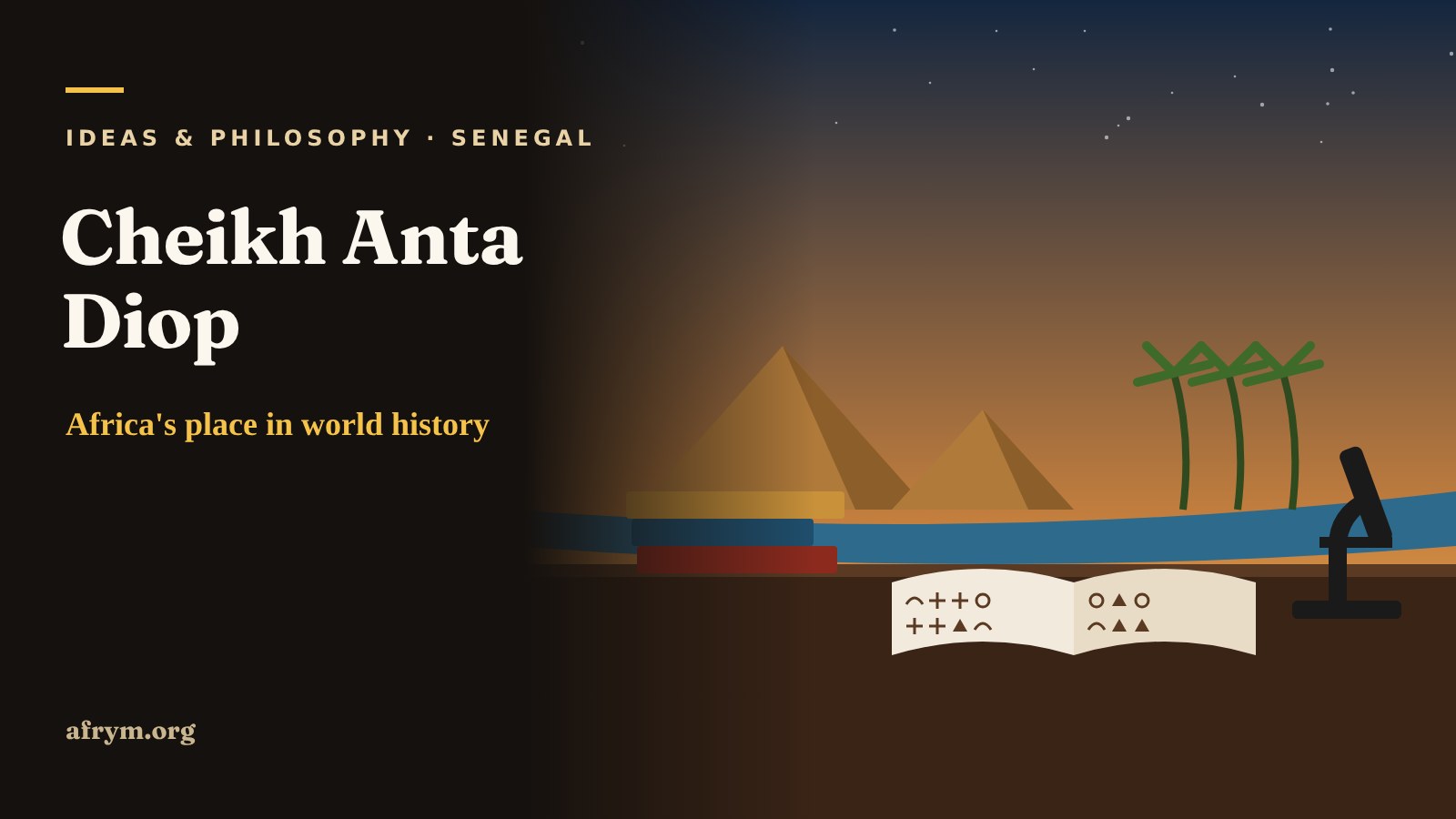
Quick answer: Cheikh Anta Diop (1923–1986) was a Senegalese historian, physicist and politician who argued that ancient Egypt was an African civilisation closely linked to the rest of the continent. He set up Africa's first radiocarbon dating laboratory in Dakar in 1966, and the University of Dakar was renamed after him in 1987.
In 1951, a young Senegalese student in Paris submitted a doctoral thesis that set out to prove something many European scholars of his day refused to accept: that Africans had been central to the making of world civilisation. The thesis was turned down. Nine years later, after a long fight, he earned his doctorate anyway.
That student was Cheikh Anta Diop. Over the next quarter of a century he became one of the most influential African thinkers of the twentieth century, and today Senegal's biggest university carries his name.
Early life
Diop was born in 1923 in the Diourbel region of central Senegal, into a Wolof Muslim family. He studied in Senegal before moving to Paris in 1946, where he threw himself into an unusually wide range of subjects: physics and chemistry, but also history, linguistics, philosophy and anthropology.
Paris in those years was full of African and Caribbean students debating colonialism, culture and independence. Writers of the Négritude movement were celebrating Black identity in poetry, and political thinkers were planning the end of empire. Diop joined these debates, but he wanted something more than poetry: he wanted evidence.
The big argument
Diop's central claim was that ancient Egypt was an African civilisation, created by African peoples and closely connected to the rest of the continent, rather than an outpost of the Middle East or the Mediterranean. He argued that Egypt's language, religion, kingship and customs shared deep links with cultures south of the Sahara, from the kingdoms of the Nile such as Kush to West Africa.
He set out these ideas in a landmark book, Nations nègres et culture, published in Paris in the mid-1950s. Its English translation, The African Origin of Civilization: Myth or Reality, appeared in 1974 and found a large readership in the United States and the Caribbean.
His purpose went beyond Egypt. Colonial schooling taught that Africa had no history worth studying. Diop wanted Africans to see their past as part of humanity's great story, and to draw confidence from it for the future.
Science in the service of history
Diop was trained in the sciences, and he used them in his work. In 1966, he founded a radiocarbon dating laboratory at the Institut Fondamental d'Afrique Noire (IFAN) in Dakar, the first of its kind in Africa. It allowed African researchers to date archaeological finds themselves, instead of sending samples abroad.
He also studied ancient Egyptian alongside Wolof and other African languages, arguing that they shared words and grammar. And he insisted that African languages could carry modern science: to prove it, he translated passages of scientific writing, including ideas from physics, into Wolof. That conviction links him to the scholars celebrated in our story on Africa's languages.
Recognition and debate
At the 1966 World Festival of Black Arts in Dakar, Diop was honoured as one of the twentieth century's most influential Black intellectuals. In 1974, he took part in a UNESCO symposium in Cairo on the peopling of ancient Egypt, where he and the Congolese scholar Théophile Obenga presented their case to Egyptologists from around the world.
His work has always been controversial. Many Egyptologists agree that ancient Egypt was an African civilisation with deep connections to the Nile Valley and beyond, but they disagree with parts of Diop's method, especially his focus on race, which modern science treats as a weak way to describe human populations. Others have questioned some of his linguistic comparisons.
Supporters, in turn, point out that Diop was writing against a scholarship that often denied Africa any role at all, and that he opened questions others had refused to ask. Readers today can value his courage and influence while still weighing his conclusions critically. The Musée des Civilisations noires in Dakar offers a short profile of his life and work.
A political life
Diop was not only a scholar. He believed that Africa's future depended on unity, and he was a committed supporter of Pan-Africanism, arguing for a federal African state with shared institutions, languages and energy projects.
In Senegal, he founded opposition parties and became one of the main political rivals of the country's first president, Léopold Sédar Senghor. His ideas about economic independence and African self-confidence echo those of other radical thinkers of his generation, such as Frantz Fanon and, later, Thomas Sankara.
Legacy
Cheikh Anta Diop died in Dakar in February 1986. The following year, the University of Dakar was renamed Université Cheikh Anta Diop (UCAD) in his honour. His books continue to be read across Africa and its diaspora, and his name appears on streets, schools and study circles from Senegal to the Caribbean.
His influence can be seen in the movement to teach African history from African perspectives, in the push for African languages in education and science, and in the wider effort to recover the continent's past, from its oral traditions to its written archives.
Frequently asked questions
What is Cheikh Anta Diop best known for?
He is best known for arguing that ancient Egypt was created by African peoples and shared deep links with cultures south of the Sahara, and for insisting that Africans should study their own history with scientific tools.
What books did Cheikh Anta Diop write?
His most famous book is Nations nègres et culture, published in Paris in the mid-1950s. A translation of his work, The African Origin of Civilization: Myth or Reality, appeared in English in 1974.
Why is his work controversial?
Many Egyptologists accept that ancient Egypt was an African civilisation, but they question parts of Diop's method, especially his focus on race, and some of his language comparisons. Supporters point out that he was challenging scholarship that denied Africa any place in history.
Which university is named after Cheikh Anta Diop?
The University of Dakar in Senegal was renamed Université Cheikh Anta Diop (UCAD) in 1987, the year after his death.
Why it matters
Diop asked a simple but powerful question: who gets to tell Africa's story? His answer was that Africans must study their own past with the best tools available, from linguistics to laboratory science.
Not every scholar accepts all his conclusions, and that debate is part of his legacy. But few individuals did more to convince a generation of Africans that their history was worth knowing, defending and building upon.
Further reading
- Musée des Civilisations noires — Cheikh Anta Diop (1923–1986)
- Encyclopedia.com — Diop, Cheikh Anta 1923–1986
- BlackPast — Cheikh Anta Diop
- Cheikh Anta Diop, The African Origin of Civilization: Myth or Reality (Lawrence Hill, 1974)