Sankofa: The Akan Idea of Going Back to Fetch What Matters
A bird looking backwards with an egg in its beak. Sankofa, from Ghana's Akan people, teaches that there is no shame in returning to the past to learn from it.
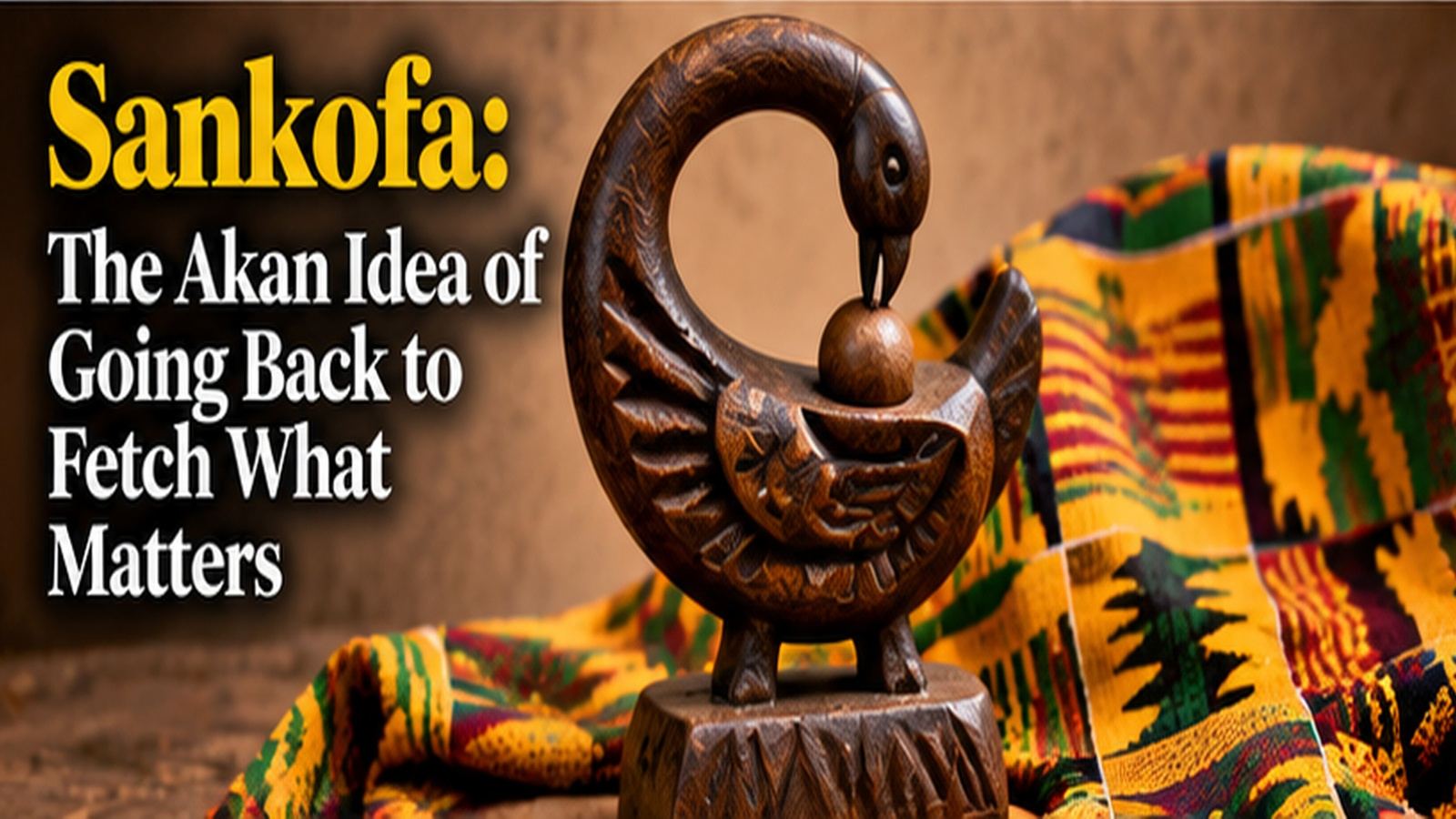
Picture a bird standing firmly with its feet facing forward, but its long neck curved all the way back over its body. In its beak it holds an egg. It is going somewhere, yet it has turned to pick up something precious it left behind.
This is Sankofa, one of the best-known symbols and ideas to come from West Africa. Created by the Akan people of Ghana and Côte d'Ivoire, it has become a worldwide emblem of learning from history and reclaiming heritage.
What the word means
Sankofa comes from the Twi language of the Akan. It is usually broken down into three parts:
- san: to return or go back;
- ko: to go;
- fa: to fetch or take.
Put together, it means roughly "go back and get it".
The word is linked to a well-known Akan proverb: Se wo were fi na wosankofa a yenkyi. A common English rendering is "There is nothing wrong with returning to fetch what you forgot." In other words, there is no shame in returning to the past to recover something valuable, whether it is knowledge, a tradition or a lesson.
Like many African proverbs, it is short, practical and full of wisdom about how to live.
Two symbols, one idea
Sankofa belongs to the family of Adinkra symbols, the visual language of the Akan, explained in our guide to Adinkra symbols. Adinkra designs were traditionally stamped onto cloth using carved calabash stamps and a dark dye, especially for funerals and important occasions.
Sankofa appears in two main forms:
- The Sankofa bird: a bird looking backwards, often with an egg in its beak. The egg stands for the future or for something precious that must be carried forward.
- The Sankofa heart: a stylised heart shape with curled spirals, simpler to draw and widely used in ironwork, jewellery and decoration.
Both carry the same message: look back, learn and bring the best of the past into the future. The site Adinkra Symbols & Meanings shows both versions side by side.
A philosophy of history
Sankofa is more than a pretty image. It expresses an attitude toward time and memory that runs through many African cultures. The past is not something dead and finished; it is a store of knowledge that the living can draw on.
In Akan society, history was kept by elders, chiefs, drummers and storytellers, through the oral tradition and through objects such as royal stools and kente cloth, whose patterns carry names and meanings. Sankofa reminds people that this inheritance matters.
At the same time, Sankofa is not about living in the past. The bird's feet still point forward. The idea is to move ahead, carrying the right lessons, so that mistakes are not repeated and good traditions are not lost.
Sankofa in the African diaspora
In the twentieth century, Sankofa travelled far beyond Ghana. For many people of African descent in the Americas and Europe, whose ancestors were taken by the transatlantic slave trade, the symbol became a powerful way to talk about reclaiming a history that had been stolen or erased.
Some notable examples:
- In New York, the African Burial Ground National Monument honours thousands of free and enslaved Africans buried in colonial Manhattan. A heart-shaped design resembling the Sankofa symbol was found on one of the coffins, and the symbol is used at the memorial today.
- The Ethiopian-born filmmaker Haile Gerima named his 1993 film about slavery and memory Sankofa.
- Universities, schools, publishers and community groups across the diaspora use the name for programmes on African history and identity.
In Ghana, heritage events such as PANAFEST and the 2019 "Year of Return" invited people of African descent to visit the land of their ancestors, an invitation that Sankofa sums up perfectly. Many visitors also make the journey to former slave-trading sites such as Gorée Island in Senegal.
Sankofa today
The symbol is everywhere: on buildings, gates and fences in Ghana, on fabric, logos, tattoos and jewellery, and in art galleries. It is closely tied to the ideals of Pan-Africanism, which call on Africans and the diaspora to learn from shared history and build a common future.
For teachers, Sankofa is a simple way to explain why history matters. For families, it can be a reminder to keep up languages, recipes, names and customs, such as the Akan day names given to children according to the day they were born.
Why it matters
Sankofa offers a gentle but powerful idea: you do not have to choose between the past and the future. By turning back to collect what is valuable, people and nations can move forward more wisely.
In a world that often rushes ahead, the bird with its head turned backwards is a reminder to pause, remember and carry the best of what came before.
Further reading
- Adinkra Symbols & Meanings — Sankofa
- National Park Service — African Burial Ground National Monument
- W. Bruce Willis, The Adinkra Dictionary: A Visual Primer on the Language of Adinkra (Pyramid Complex, 1998)
- Kwame Gyekye, African Cultural Values: An Introduction (Sankofa Publishing, 1996)