Ibn Khaldun: The Tunis-Born Thinker Who Explained the Rise and Fall of Empires
Born in Tunis in 1332, Ibn Khaldun wrote the Muqaddimah, a bold theory of why dynasties rise and fall. Meet one of Africa's greatest historians.
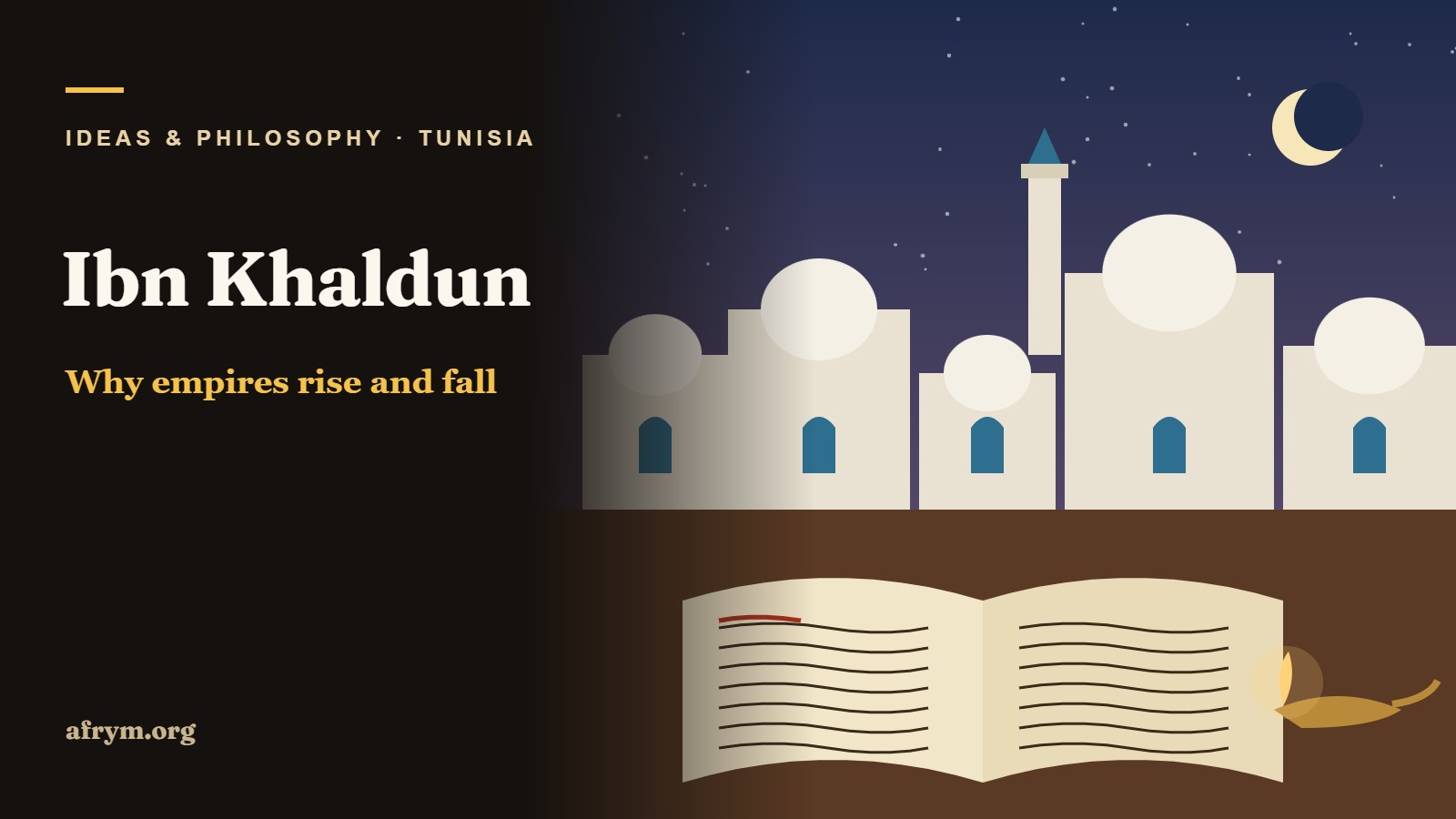
Quick answer: Ibn Khaldun (1332–1406) was a historian, judge and statesman born in Tunis. His most famous book, the Muqaddimah ("Introduction"), finished in 1377, explains how groups held together by strong solidarity, called asabiyya, build dynasties that weaken over a few generations. He is often described as a founder of sociology and one of the greatest historians of the medieval world.
Imagine a man who has served kings, been jailed by them, carried peace offers between rivals and watched powerful families rise and collapse in his own lifetime. One day he steps away from it all to ask a simple question: why does this keep happening?
That man was Ibn Khaldun, and the answer he wrote down still shapes how people think about history.
Roots in Seville, childhood in Tunis
Abd al-Rahman Ibn Khaldun was born in Tunis on 27 May 1332. His family traced its ancestry to Arabs who had settled in Spain, and for generations they were among the leading families of Seville. As Christian kingdoms pushed south in the 13th century, the family moved to North Africa and took up important posts in Tunis.
The young Ibn Khaldun studied the Qur'an, Islamic law, Arabic language and poetry, philosophy and mathematics. Then disaster struck. In 1348–1349, the Black Death reached Tunis, killing both his parents and many of his teachers. The memory of how plague could shake a whole society stayed with him.
A life in and out of power
His career moved fast and often dangerously. Over some thirty years he:
- took a court post in Tunis while barely an adult;
- became a secretary to the sultan of Fez, in Morocco, and was later jailed there on suspicion of plotting;
- travelled to Granada in Muslim Spain, which sent him to Seville as an envoy to Pedro I of Castile;
- served as a chief minister and in other senior roles at several North African courts;
- led expeditions to collect taxes and win over desert tribes.
All of this gave him something few scholars had: first-hand knowledge of how power is gained, used and lost.
The fortress where it all came together
In 1375 he withdrew to Qal'at Ibn Salama, a fortress in the hills of what is now Algeria. There, in relative quiet, he began writing. By 1377 he had finished a first draft of the Muqaddimah.
It was planned as the opening volume of a vast world history, the Kitab al-'Ibar, or "Book of Lessons". But the introduction grew into a masterpiece of its own, and he kept revising it for the rest of his life.
Asabiyya: what holds a group together
The central idea of the Muqaddimah is asabiyya, often translated as "group feeling" or "solidarity". It is the fierce loyalty that binds people who depend on each other, especially tribes living hard lives in deserts and mountains.
In his view, history moves in cycles:
- A group with strong asabiyya conquers a weaker, settled state and founds a dynasty.
- Its leaders settle in cities, grow wealthy and enjoy comfort.
- They begin to rely on paid soldiers and officials rather than loyal kin.
- Solidarity fades, and by around the fourth generation the dynasty is worn out, ready to be replaced by a new group with stronger bonds.
He described two ways of life, badawa (rural and nomadic) and hadara (settled and urban). Each had strengths and weaknesses, and history swung between them.
A historian who checked his facts
Ibn Khaldun also took aim at careless historians. Too many, he said, repeated stories without asking whether they were even possible. He urged writers to test each report against what was known about geography, society and human nature. If a chronicle claimed an impossibly huge army, it should be doubted.
He had sharp ideas about economics, too. He argued that human labour is what creates value, and that heavy taxation can discourage people from working and producing, until rulers end up collecting less. Modern economists often point to these ideas.
Cairo, tragedy and a meeting with Timur
In 1382 he settled in Cairo, one of the great cities of the Islamic world. He taught and served several times as a judge of the Maliki school of law. Two years later, tragedy struck again: his family drowned in a shipwreck while travelling to join him.
In early 1401, while in Damascus with the Egyptian sultan's forces, he met Timur (Tamerlane), the Central Asian conqueror who was besieging the city. Ibn Khaldun wrote an account of their conversations, a remarkable encounter between a historian and one of the most feared rulers of the age.
He died in Cairo on 17 March 1406.
His legacy
Ottoman scholars studied his work, and in the 19th century European translations brought him wide fame as a pioneer of sociology and the philosophy of history. Britannica describes him as the greatest Arab historian.
Ibn Khaldun belongs to Africa's long tradition of scholarship, alongside the manuscript collections of Timbuktu and the written heritage explored in our story on Africa's hidden archives. He wrote about the rulers of the West African empire of Mali, and his theory of rising and falling powers fits a region that had seen everything from Carthage onward. Later African thinkers, such as Cheikh Anta Diop, would also ask how Africa's history should be told, and like the Ethiopian author of the Hatata, Ibn Khaldun put reason and evidence first.
Frequently asked questions
Who was Ibn Khaldun?
A North African historian, judge and statesman, born in Tunis in 1332 and died in Cairo in 1406, best known for the Muqaddimah.
What is the Muqaddimah about?
It explains how societies, economies and dynasties work, and why ruling families rise and fall, using the idea of asabiyya, or group solidarity.
What does asabiyya mean?
It means group feeling or social solidarity: the loyalty that binds a group and gives it the strength to win and keep power.
Why is Ibn Khaldun called a founder of sociology?
Because he studied society itself, its customs, economy and forms of power, and looked for patterns behind historical events rather than simply listing them.
Why it matters
Ibn Khaldun showed that history is more than a list of kings and wars. It has patterns, shaped by how people live, work and stay loyal to each other. The question he asked, what holds a society together and what pulls it apart, is still asked today by historians, economists and leaders. And it was first asked in North Africa, in a quiet fortress in the hills, more than six hundred years ago.
Further reading
- Britannica — Ibn Khaldūn
- EBSCO Research Starters — Ibn Khaldūn
- Encyclopedia.com — Ibn Khaldūn
- Robert Irwin, Ibn Khaldun: An Intellectual Biography (Princeton University Press, 2018)