Wolof: The Language That Binds Senegal Together
From the markets of Dakar to the wrestling arenas and the sabar drum circles, Wolof is the language most Senegalese share. Here is its history, how it works and a few words to start with.
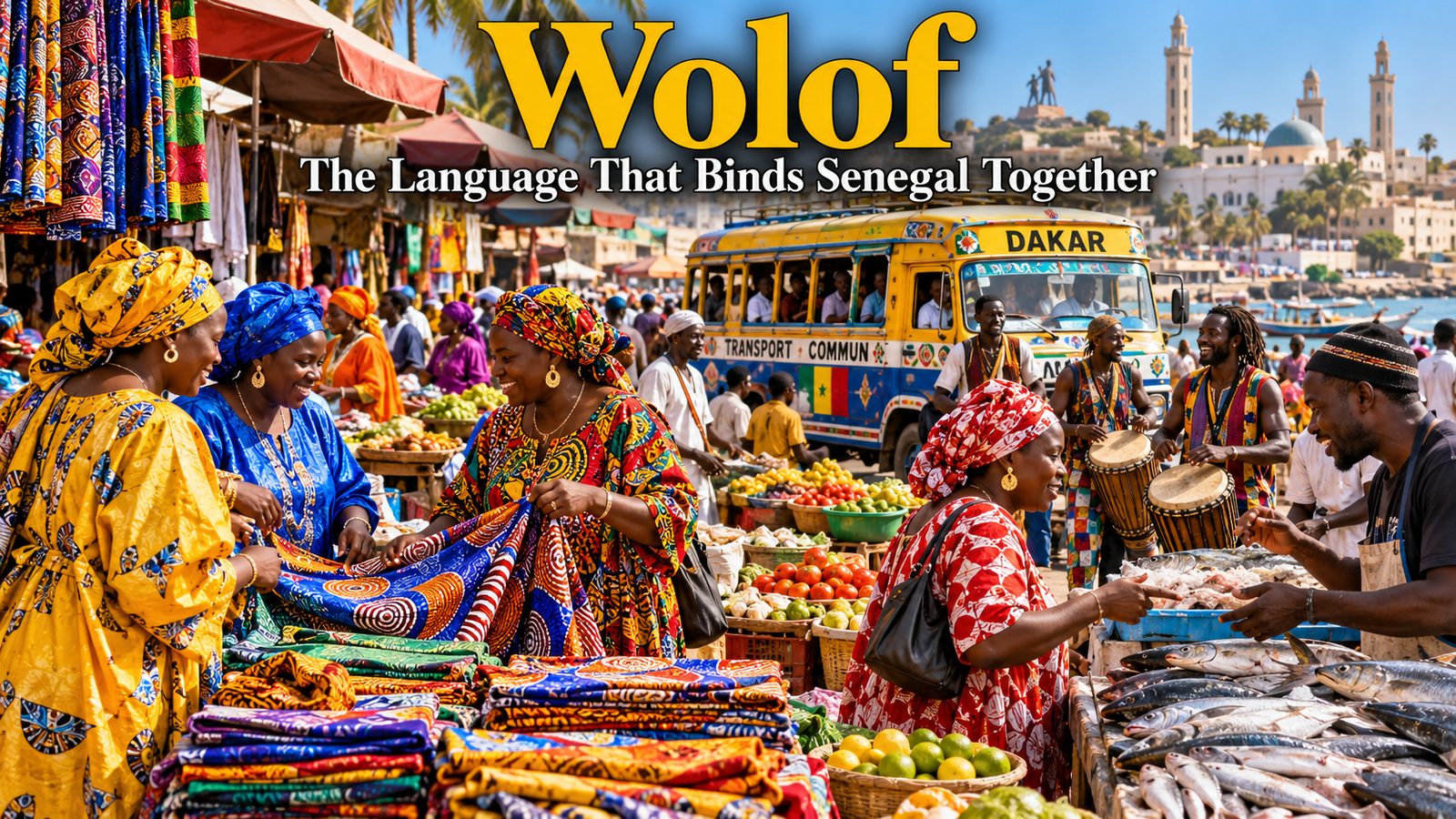
"Na nga def?" — How are you? "Maa ngi fi rekk" — I'm here, just fine. These are the first words you exchange with almost anyone in Senegal, whether a taxi driver in Dakar, a fruit seller in Thiès or a fisherman on the beach at Saint-Louis. They are in Wolof, the language that the great majority of Senegalese speak, even when it is not the language they first learned at home. Few African countries have a single local language that has spread so widely, and the story of how Wolof came to bind a nation is a fascinating one.
Who speaks Wolof?
Wolof is spoken mainly in Senegal, the Gambia and southern Mauritania, and by large diaspora communities in France, Italy, Spain and the United States. The Wolof people form Senegal's largest ethnic group, but the language goes far beyond them. Linguists estimate that around four in ten Senegalese speak it as a first language, and that the great majority, by many estimates more than eight in ten, can use it.
In Senegal, French is the official language, used in government and much of formal education, but Wolof is one of several national languages and the real language of daily life: of markets, transport, radio, television, music and politics. In the Gambia, it is widely spoken in the capital, Banjul, alongside Mandinka and English.
An Atlantic language
Wolof belongs to the Atlantic branch of the vast Niger-Congo family, related to Fula (Pulaar) and Serer. Unlike many of its relatives, it is not a tonal language.
Wolof has an interesting system of noun classes. Instead of marking nouns with prefixes, as Bantu languages such as Kiswahili do, Wolof marks them with consonants that appear in the words attached to them, such as "the", "this" or "which". For example:
- xale bi — the child
- jigéen ji — the woman
- nit ki — the person
- ndox mi — the water
Each class has its own consonant (b-, j-, k-, m- and others), and choosing the right one is part of speaking Wolof well.
Another striking feature is how Wolof marks focus: the verb form changes depending on whether you want to emphasise the subject, the action or another part of the sentence. Learners often find this the hardest, and most elegant, part of the language.
A history of kingdoms
The name Wolof is linked to the medieval Jolof Empire, which, according to oral tradition, was founded by the legendary ruler Ndiadiane Ndiaye in the 13th or 14th century. Jolof later broke up into kingdoms such as Kajoor, Bawol, Waalo and Jolof itself. Their rulers, nobles and griots used Wolof, and the language spread through trade and political power.
Under French colonial rule, Wolof spread further. The colonial capital, Saint-Louis, and later Dakar were Wolof-speaking towns, and people who moved there from other regions learned Wolof to work and trade. The colonial army and the railway, which ran through Wolof-speaking areas, also helped. After independence in 1960, urbanisation turned Wolof into the shared language of a whole nation.
Wolof in Ajami
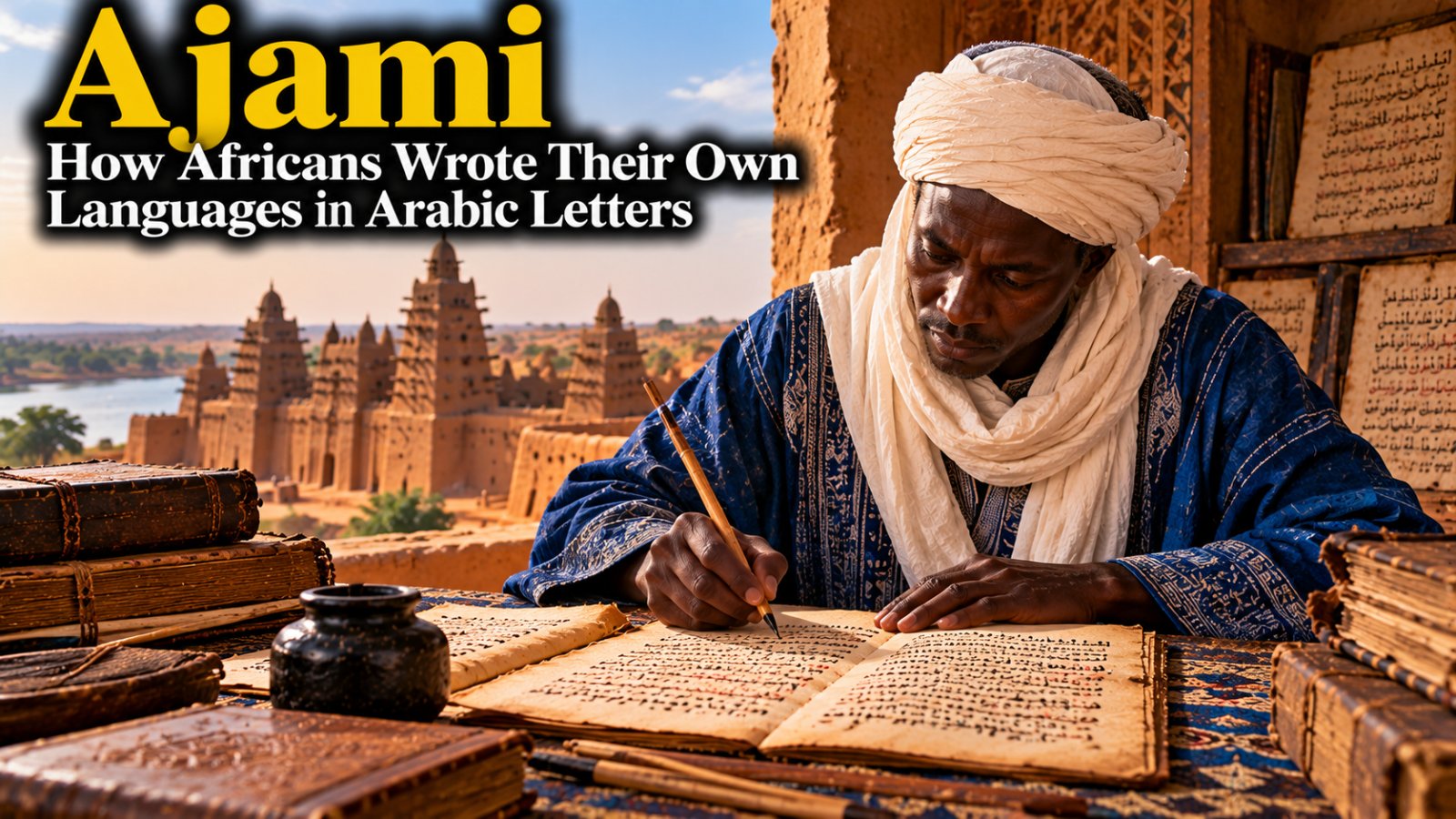
Long before the Latin alphabet was used for Wolof, people wrote it in Arabic script, a tradition known as Ajami or Wolofal. Scholars and poets of Senegal's Sufi brotherhoods, especially the Muridiyya founded by Sheikh Amadou Bamba, composed religious poetry in Wolofal. Poets such as Serigne Moussa Kâ wrote celebrated works in it. The linguist Fallou Ngom has shown that this written tradition is far richer than outsiders long assumed. Today, Wolof is also written in the Latin alphabet, with an official spelling.
Literature, film and music
Wolof has a strong presence in Senegalese culture:
- Film. The great filmmaker Ousmane Sembène made films in Wolof, such as Mandabi (1968), to reach ordinary audiences.
- Literature. The novelist Boubacar Boris Diop wrote Doomi Golo (2003), a celebrated novel written in Wolof, and there is a growing movement to publish books in the language.
- Music. Wolof is the language of mbalax, Senegal's popular music, made famous by Youssou N'Dour, as described in our story on mbalax, and of Senegalese hip hop, one of Africa's most vibrant rap scenes.
Urban Wolof
In Dakar, people often speak an urban Wolof that mixes in many French words, sometimes called "Dakar Wolof" or "urban Wolof". A sentence may start in Wolof, borrow a French verb, and end with a Wolof proverb. Some purists complain; linguists see it as a sign of a living, adapting language.
Words that travelled
Some scholars have suggested that a few English words, carried by enslaved West Africans to the Americas, may have Wolof roots. Proposed examples include "banana" and "yam" (from ñam, "to eat"). Others are more speculative. These suggestions are debated, and it is wise to treat them as possibilities rather than settled facts.
Teranga and everyday words
One of the best-known Wolof words is teranga, meaning hospitality, a value at the heart of Senegalese identity. Here are a few more useful words:
- Salaam aleekum / Maalekum salaam — hello (and reply)
- Na nga def? — how are you?
- Maa ngi fi — I'm fine (literally "I am here")
- Jërëjëf — thank you
- Waaw / Déedéet — yes / no
- Ba beneen yoon — until next time
Why it matters
Wolof shows how an African language can become the shared voice of a modern nation, used in markets, music, film and politics. Its rich written tradition in Ajami challenges the myth that African languages had no writing. And every greeting exchanged in Wolof, with its patient questions about family and health, carries the warmth that Senegal calls teranga.
Further reading
- Fiona McLaughlin, "Senegal: The Emergence of a National Lingua Franca," in Andrew Simpson (ed.), Language and National Identity in Africa (Oxford University Press, 2008)
- Fallou Ngom, Muslims beyond the Arab World: The Odyssey of Ajami and the Muridiyya (Oxford University Press, 2016)
- Boubacar Boris Diop, Doomi Golo (Éditions Papyrus Afrique, 2003)