The Kingdom of Kush: Sudan's Pyramids and the Pharaohs Who Ruled Egypt
Sudan has more pyramids than Egypt. They belong to Kush, an African kingdom that lasted over a thousand years, ruled Egypt, and was led by powerful queens.
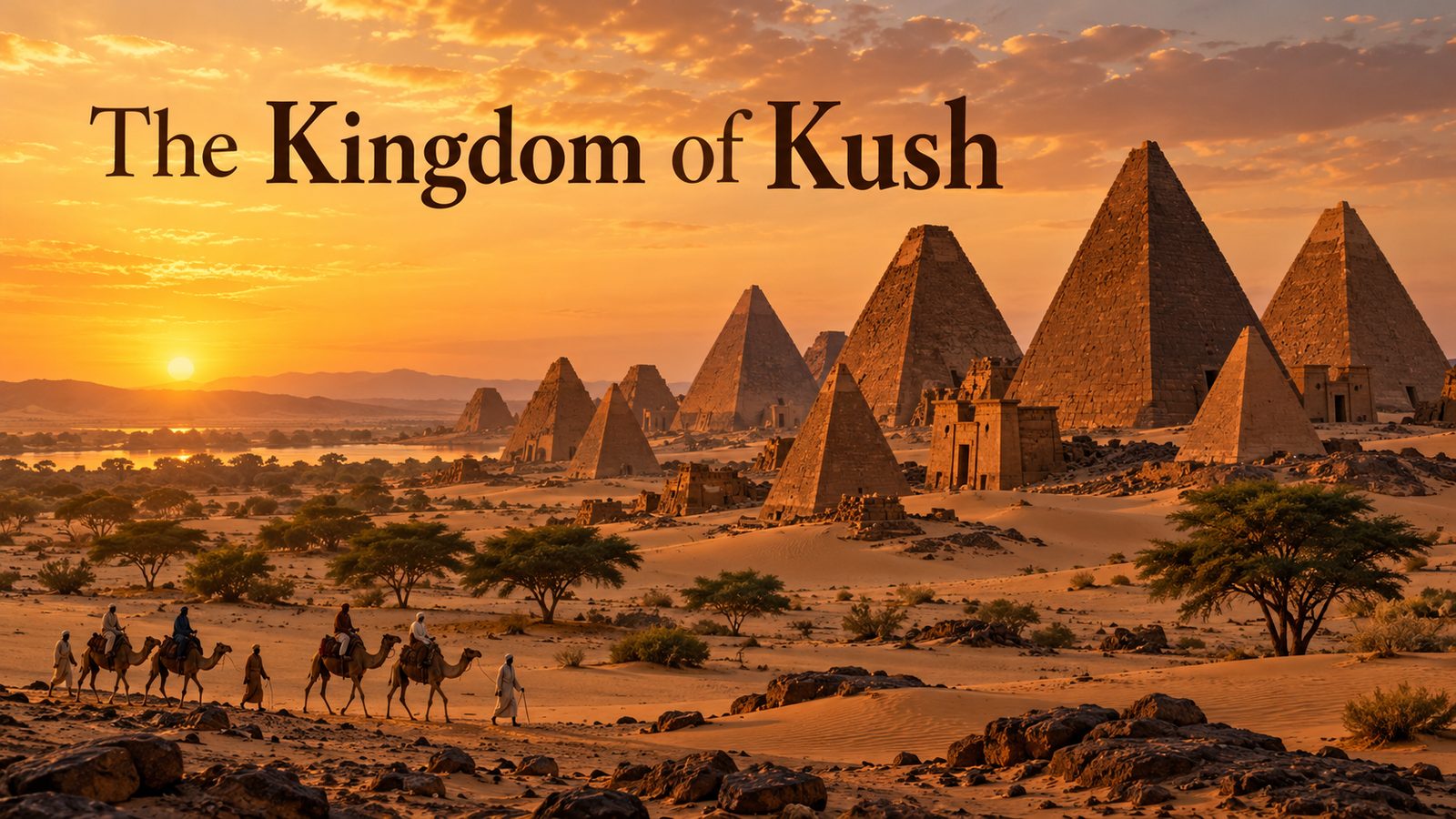
Ask most people where to find pyramids and they will say Egypt. But travel south along the Nile into Sudan, to a stretch of desert about 200 kilometres northeast of Khartoum, and you will find more of them — steep, narrow pyramids clustered in the sand, dozens upon dozens. They are the royal tombs of Meroë, capital of the Kingdom of Kush, one of the great civilisations of ancient Africa.
Nubia and the rise of Kush
The land along the Nile south of Egypt has long been known as Nubia. Its people traded, fought and intermarried with Egypt for thousands of years. Egyptians called the region to their south Kush, and from around the 8th century BCE a powerful Kushite kingdom emerged, with its first capital at Napata, near the sacred mountain of Jebel Barkal.
Kush had its own earlier roots in the kingdom of Kerma, which flourished from around 2500 BCE, with one of Africa's oldest cities. By the time of Napata, Kushite kings had adopted many Egyptian religious ideas — worshipping the god Amun, building temples and pyramids — while remaining a distinctly African state.
The Kushite pharaohs
In the 8th century BCE, with Egypt divided and weak, the Kushite king Piye marched north and conquered it. He and his successors ruled Egypt as its 25th Dynasty for close to a century. The most famous of them, Taharqa, built monuments from Nubia to the Nile Delta and is even mentioned in the Bible.
For a time, the king who sat on the throne of the pharaohs was a Nubian from the south. The dynasty ended when the Assyrians invaded Egypt in the 7th century BCE and the Kushites withdrew to their homeland — but Kush itself was far from finished.
Meroë: iron, trade and pyramids
Around the 3rd century BCE, the centre of the kingdom shifted south to Meroë, between the fifth and sixth cataracts of the Nile. Here Kush grew rich from:
- Iron. Meroë was a major centre of iron smelting; huge heaps of slag still lie around the city, earning it the nickname "the Birmingham of Africa" from early archaeologists.
- Trade. Gold, ivory, ebony, animal skins and other goods flowed north to Egypt and the Mediterranean, and Meroë traded with the Red Sea world.
- Agriculture. Rains in the region allowed herding and farming beyond the narrow Nile valley.
Kushite kings and queens were buried under pyramids — smaller and steeper than Egypt's, with a small chapel at the base. More than 200 pyramids were built in the royal cemeteries of Meroë and at the older sites of Napata, far outnumbering those in Egypt. Many were damaged in the 1830s by an Italian treasure hunter, Giuseppe Ferlini, who broke their tops open looking for gold.
In 2011, UNESCO listed the Archaeological Sites of the Island of Meroe — including the city, its cemeteries and the religious centres of Musawwarat es-Sufra and Naqa — as a World Heritage Site.
The queens of Kush
One of the most striking features of Kush was the power of its royal women. Several queens, known by the title kandake (the origin of the name "Candace"), ruled in their own right. Carvings at Meroë show queens as large, powerful figures striking down enemies.
The most famous is Amanirenas, who led Kushite forces against the Romans after they conquered Egypt in the late 1st century BCE. Kushite troops raided Roman territory, and a bronze head of the emperor Augustus — apparently seized in one such raid — was found buried beneath the steps of a temple at Meroë, where Kushites could walk over it. The conflict ended in a treaty that was favourable to Kush.
A script still unread
Meroë developed its own writing system, the Meroitic script, with both hieroglyphic and cursive forms. Scholars can read the sounds of the letters, but the language itself remains only partly understood — one of the great unsolved puzzles of African history. Along with Ethiopia's Ge'ez, it is a reminder that Africa developed several writing systems of its own.
The end of Kush
Meroë declined in the 4th century CE, under pressure from shifting trade, environmental change and the rise of the kingdom of Aksum in Ethiopia, whose king Ezana recorded a campaign into the region. Kush was succeeded by Christian Nubian kingdoms that lasted for centuries more.
Why it matters
Kush is one of the longest-lasting civilisations in African history, with its own kings, queens, cities, industry and writing. For too long it was treated as a footnote to Egypt. Its pyramids, standing quietly in the Sudanese desert, tell a different story — of an African kingdom that once ruled the Nile from the Mediterranean to the heart of the continent.
Further reading
- UNESCO World Heritage Centre — Archaeological Sites of the Island of Meroe
- African World Heritage Sites — Meroe
- David N. Edwards, The Nubian Past: An Archaeology of the Sudan (Routledge, 2004)