Malagasy: The African Language With Roots in Borneo
Madagascar's national language sits off the coast of Africa, yet its closest relative is spoken in Borneo. Here is the remarkable story of Malagasy and its speakers.
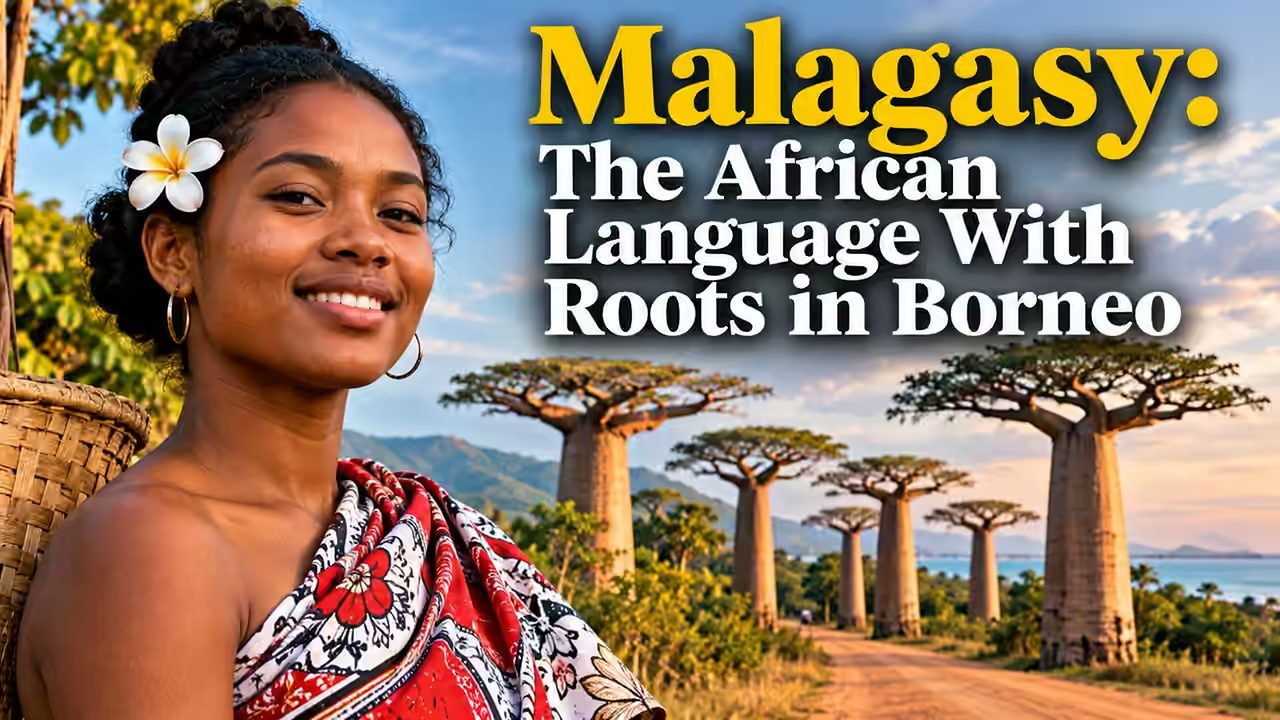
Say "hello" in Madagascar and you might hear Manao ahoana! in return. Thank someone and they will reply to your Misaotra. These words belong to Malagasy, the language spoken by almost everyone on the world's fourth-largest island.
Madagascar lies just off the coast of Mozambique, and its people have deep African roots. Yet linguists discovered long ago that Malagasy is not related to the Bantu languages of the nearby mainland. Its closest relatives are spoken thousands of kilometres away, across the Indian Ocean, in Indonesia and especially on the island of Borneo.
An Austronesian language in Africa
Malagasy belongs to the Austronesian family, one of the largest language families in the world. Its members stretch from Taiwan and the Philippines through Indonesia and Malaysia to the Pacific islands of Hawaii and New Zealand. Madagascar is its far western edge.
As early as the seventeenth century, European travellers noticed that Malagasy words resembled Malay. In 1951, the Norwegian missionary and linguist Otto Christian Dahl went further. He showed that Malagasy is especially close to Ma'anyan, a language spoken along the Barito River in southeast Borneo. Later studies have confirmed this link, while also finding words borrowed from Malay, Javanese and languages of the island of Sulawesi.
How did it get there?
The answer lies with some of history's greatest sailors. Seafarers from what is now Indonesia crossed the Indian Ocean in outrigger canoes and sailing ships, and settled in Madagascar, probably during the first millennium CE. Many researchers place the main arrival somewhere around the middle of that millennium, though the exact date is still debated.
Genetic studies tell a similar story. The people of Madagascar today have roughly equal ancestry from Southeast Asia and from East Africa, reflecting centuries of mixing between Austronesian settlers and Bantu-speaking migrants from the mainland. Yet the language that won out was Austronesian, with a smaller layer of African words. A recent study using dialect comparisons, available as an open research paper on the settlement of Madagascar, suggests the first landing was on the island's southeast coast.
African and Arabic layers
Although its grammar and core vocabulary are Austronesian, Malagasy absorbed words from many neighbours:
- Bantu languages gave words for some animals and farming terms. The common word for "dog", amboa, is thought to come from Africa.
- Arabic contributed the names of the days of the week and terms linked to astrology and divination, brought by traders and Muslim scholars along the Indian Ocean coast. Monday, Alatsinainy, comes from Arabic.
- French and English added modern words during the nineteenth and twentieth centuries.
This mixing reflects Madagascar's place in the Indian Ocean world, the same trading network that shaped Kiswahili on the East African coast.
From Arabic script to the Latin alphabet
Before the nineteenth century, some Malagasy was written in Sorabe, a version of the Arabic script. Its guardians were scribes of the Antemoro people of the southeast, who copied texts on history, medicine and astrology. Sorabe is a cousin of the Ajami writing used for Hausa, Wolof and Fulfulde in West Africa.
In 1823, King Radama I of the Merina kingdom adopted the Latin alphabet, working with Welsh missionaries of the London Missionary Society, including David Jones. The Malagasy alphabet has 21 letters and leaves out c, q, u, w and x. A few tips for reading it:
- The letter o sounds like "oo", so Antananarivo has an "oo" at the end.
- A final y is pronounced like "i".
- Many final vowels are said very lightly, so long words often sound shorter than they look.
One language, many dialects
Malagasy has many regional dialects, linked to the island's different peoples, such as the Merina of the central highlands, the Betsileo, the Sakalava of the west and the Antandroy of the far south. Speakers from different regions can usually understand one another, though the southern dialects sound most distinct.
The standard language used in schools, government and the media is based on the dialect of the Merina, around the capital, Antananarivo. Since independence in 1960, Malagasy has been the national language, sharing official status with French.
Words and wisdom
Malagasy has a rich spoken culture. Kabary, the art of formal speech, is performed at weddings, funerals and family events, where skilled orators weave proverbs and poetry into long, elegant speeches. Hainteny, a form of traditional poetry built on images and wordplay, explores love, nature and human relationships.
Proverbs, called ohabolana, are everywhere in daily life, much as in the African proverbs treasured across the mainland. Spoken words also play a central role in ceremonies such as famadihana, the "turning of the bones", when families gather to honour their ancestors. Like Somali poetry, Malagasy oratory shows how much power words can carry in a society built on oral tradition.
A few words to try
- Manao ahoana — hello / how are you?
- Misaotra — thank you
- Veloma — goodbye
- Eny — yes
- Tsia — no
Why it matters
Malagasy is living proof that Africa's history was shaped by journeys across the Indian Ocean as well as across the continent. Its story connects Borneo to Madagascar, Arab traders to Bantu farmers, and ancient sailors to millions of modern speakers.
It also reminds us that the continent's linguistic map is wider and more surprising than many people realise. To hear Malagasy spoken is to hear an Austronesian voice that has made itself completely at home in Africa.
Further reading
- Serva et al., "The settlement of Madagascar: what dialects and languages can tell us" (arXiv)
- Global Literature in Libraries Initiative — From Sorabe script to Latin script
- Otto Chr. Dahl, Malgache et Maanjan: une comparaison linguistique (Egede-Instituttet, 1951)
- Alexander Adelaar, "Malagasy" in The Austronesian Languages of Asia and Madagascar (Routledge, 2005)