isiZulu: South Africa's Most Spoken Home Language and the Zulu Phrases to Know
Sawubona, yebo, ngiyabonga: isiZulu is spoken at home by about one in four South Africans. Discover its story, its click sounds and the phrases to start with.
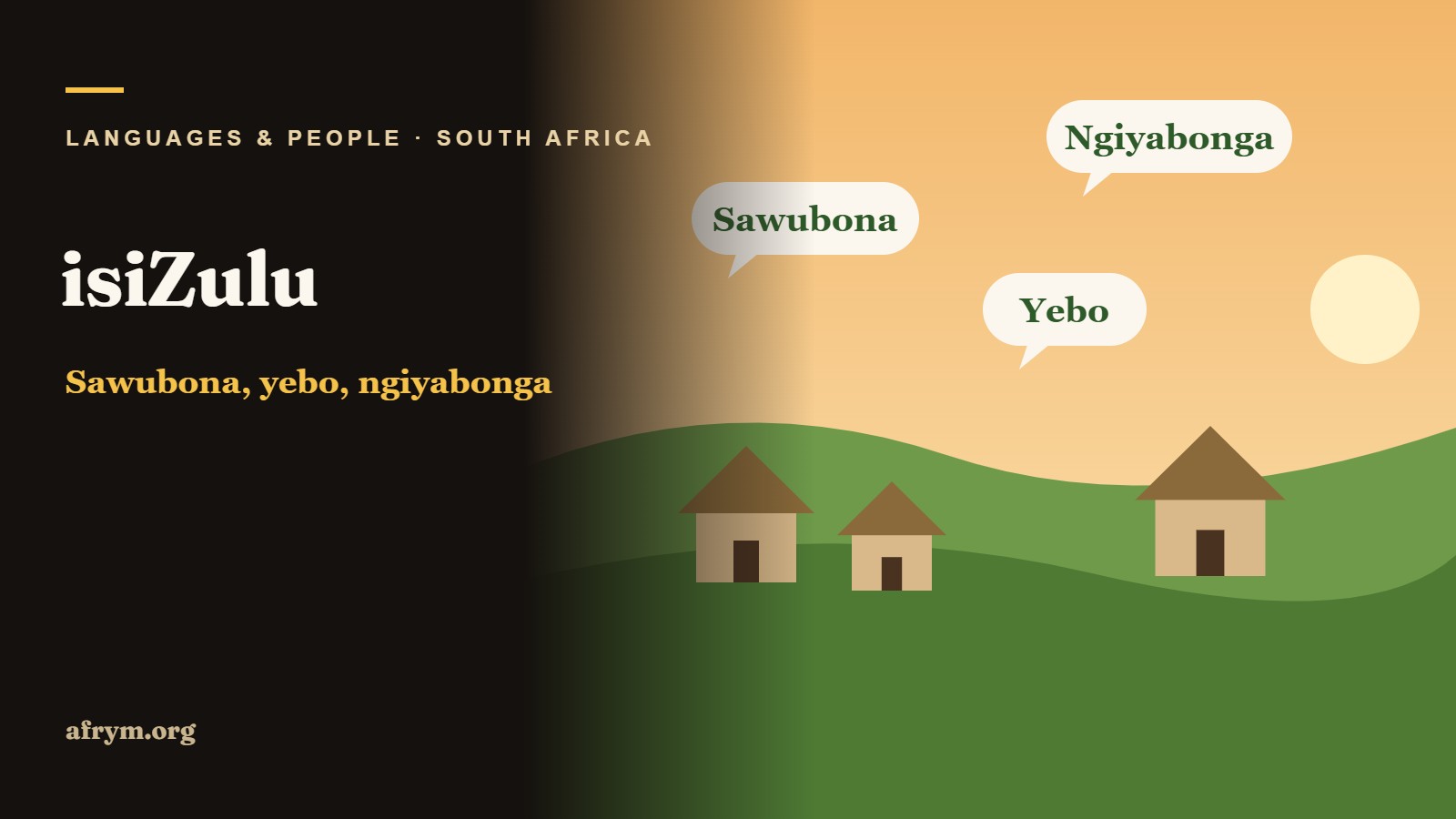
Quick answer: isiZulu (Zulu) is a Bantu language of the Nguni group and the most widely spoken home language in South Africa. In Census 2022, about 24.4% of South Africans, roughly 14.6 million people, said it was the language they speak most at home. Most speakers live in KwaZulu-Natal, Gauteng and Mpumalanga. Start with Sawubona (hello), Yebo (yes) and Ngiyabonga (thank you).
Walk into a taxi rank in Durban, a market in Soweto or a church service in Pietermaritzburg and you will hear it: a warm, rolling language full of long vowels, rising and falling tones, and the occasional sharp click. isiZulu is the language of grandmothers' stories, radio dramas, gospel choirs and stadium chants. It is also, by a clear margin, the language most South Africans grow up speaking.
How many people speak isiZulu?
Statistics South Africa measures the language people use most often in their households. In 1996, 22.8% of the population named isiZulu. By 2022, that share had risen to 24.4%, keeping it in first place ahead of isiXhosa and Afrikaans. You can read the figures in Stats SA's Census 2022 report on cultural change.
Those speakers are concentrated in a few places. About two-thirds live in KwaZulu-Natal, the historic Zulu heartland on the Indian Ocean coast, where around eight in ten residents speak it at home. Large communities also live in Gauteng, around Johannesburg, and in Mpumalanga. Millions more understand it as a second or third language, because South Africans often switch between several languages in a single day.
isiZulu is one of South Africa's 12 official languages, alongside English, Afrikaans, Sesotho, isiXhosa, South African Sign Language and others.
Part of the Nguni family
isiZulu belongs to the Nguni branch of the Bantu languages, together with isiXhosa, siSwati and isiNdebele. Speakers of these languages can often follow one another's conversations, much as Spanish and Portuguese speakers can. The Ndebele spoken in Zimbabwe is especially close, because its speakers' ancestors broke away from the Zulu kingdom in the 19th century.
Like other Bantu languages, isiZulu groups nouns into classes marked by prefixes. That is why the language is called isiZulu, the people are amaZulu, and one Zulu person is umZulu. Once you notice the prefixes, the language starts to make sense.
The clicks
isiZulu has three main click sounds, written with the letters c, q and x:
- c is a soft "tsk" made with the tongue behind the front teeth, as in cela (please, ask for).
- q is a hollow pop from the roof of the mouth, as in iqanda (egg).
- x is the side click people use to urge on a horse, as in ixoxo (frog).
Linguists believe the Nguni languages took these sounds from neighbouring Khoisan languages over centuries of contact. isiXhosa uses even more of them, as our story on isiXhosa's clicks explains.
Everyday Zulu phrases
Greetings matter in isiZulu, and they come in singular and plural forms.
- Sawubona — Hello (to one person; literally "I see you")
- Sanibonani — Hello (to more than one person)
- Yebo — Yes (also the reply to Sawubona)
- Cha — No
- Unjani? — How are you?
- Ngiyaphila — I am well
- Ngiyabonga — Thank you
- Ngiyabonga kakhulu — Thank you very much
- Ngiyaxolisa — I am sorry
- Ngiyakuthanda — I love you
- Hamba kahle — Go well (said to someone leaving)
- Sala kahle — Stay well (said by the person leaving)
The pair Hamba kahle and Sala kahle shows how carefully the language thinks about who is going and who is staying. If you are collecting greetings, compare these with our guides to Swahili phrases and Yoruba phrases.
A language with a royal past
In the early 19th century, the Zulu kingdom grew into a major power in south-eastern Africa, and its language spread with it. Zulu regiments later defeated a British force at Isandlwana in 1879, a battle still remembered with pride.
Missionaries and Zulu scholars began writing the language in the Latin alphabet in the 19th century, and a strong written tradition followed: novels, poetry, newspapers, hymn books and school textbooks. Praise poetry, izibongo, which honours kings, clans and heroes, remains a living art.
Where you hear it today
isiZulu sits at the heart of South African culture. The tiptoeing harmonies of isicathamiya, the guitar music of maskandi, and the dance floors of kwaito and amapiano all carry Zulu lyrics. TV soap operas, football commentary and political speeches use it, and it is a common language of the townships around Johannesburg, where people from many backgrounds meet.
Visual culture speaks too. The colours and patterns of Zulu beadwork have long carried messages about love, age and status that people "read" like a quiet language of their own.
Frequently asked questions
How do you say hello in Zulu?
Say Sawubona to one person and Sanibonani to a group. The usual reply is Yebo, meaning "yes" or "I see you too".
How do you say thank you in Zulu?
Ngiyabonga. To say "thank you very much", add kakhulu: Ngiyabonga kakhulu.
Is Zulu the same as Xhosa?
No, but they are closely related Nguni languages with similar grammar and many shared words. Speakers can often understand each other, especially with practice.
Where is isiZulu spoken?
Mainly in South Africa, above all in KwaZulu-Natal, Gauteng and Mpumalanga. Smaller communities live in neighbouring countries such as Lesotho, Eswatini and Zimbabwe.
Why it matters
isiZulu shows that an African language can be thoroughly modern: it is spoken in boardrooms and on social media as easily as at weddings and funerals. Learning even a few words opens doors, because a simple Sawubona carries a whole idea about seeing and respecting the person in front of you, an idea close to the spirit of ubuntu. Say it with a smile, and you will very likely hear a warm Yebo! in reply.
Further reading
- Statistics South Africa — South Africa's evolving cultural landscape (Census 2022)
- Brand South Africa — The languages of South Africa
- Derek Nurse and Gérard Philippson (eds), The Bantu Languages (Routledge, 2003)
- C. M. Doke, Textbook of Zulu Grammar (Longmans, 1927; later editions)