Yoruba Phrases: Good Morning, Thank You, I Love You and Everyday Words
How do you say good morning, thank you or I love you in Yoruba? Learn the everyday Yoruba greetings and words, plus why respect matters in every hello.
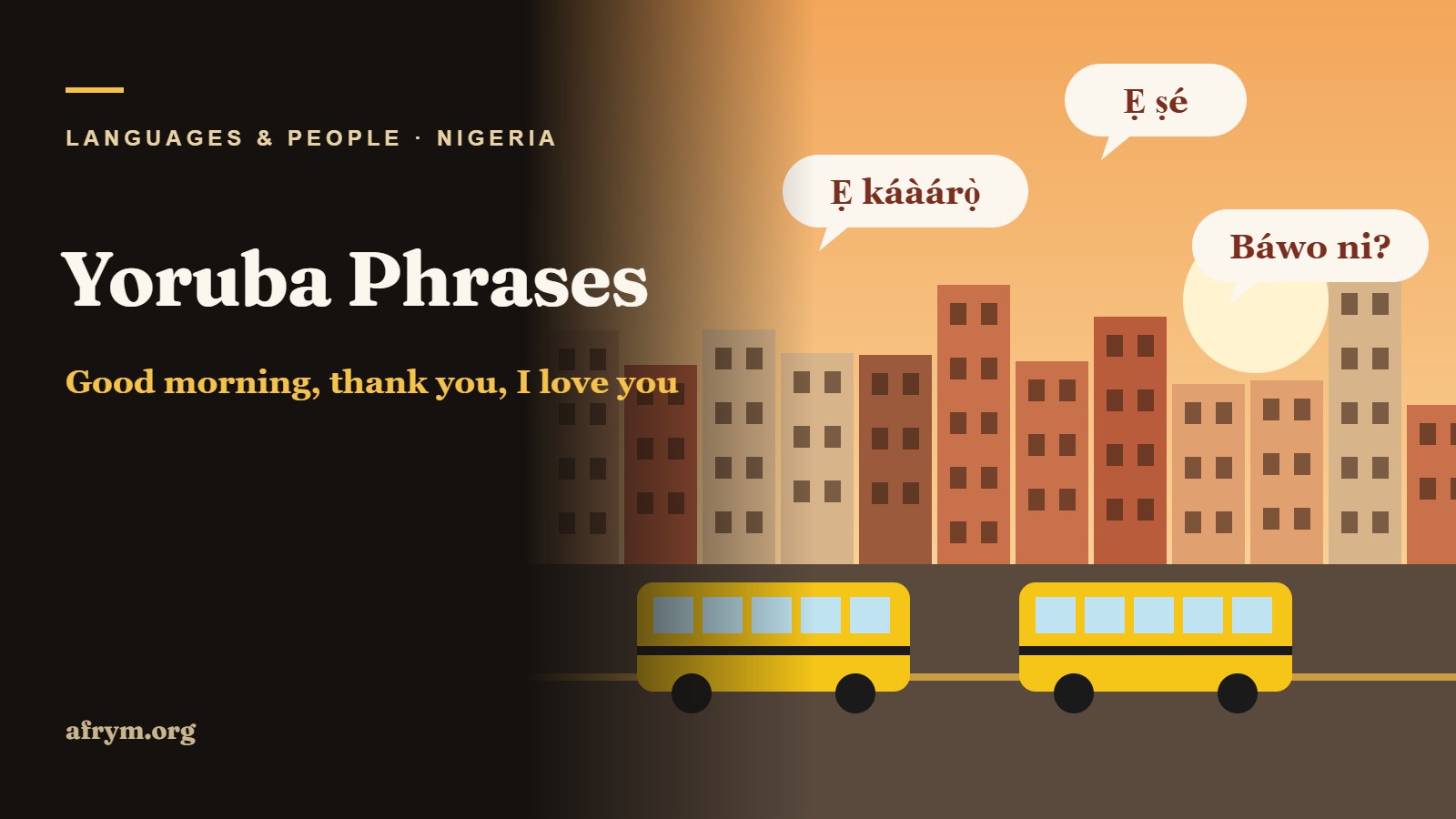
Quick answer: In Yoruba, good morning is Ẹ káàárọ̀, how are you? is Báwo ni?, thank you is Ẹ ṣé, please is Ẹ jọ̀ọ́ and I love you is Mo nífẹ̀ẹ́ rẹ. Phrases that begin with Ẹ are the polite forms, the ones to use with older people and strangers.
Spend one morning in Ibadan or Lagos and you will notice something quickly: nobody just walks past anybody. A trader calls out Ẹ káàárọ̀ as you pass her stall. A boy bends low to greet his uncle. A neighbour leaning on a gate asks how the family is before saying anything else.
Yoruba, spoken by tens of millions of people in south-western Nigeria, Benin and Togo and across a worldwide diaspora, is a language that takes greeting seriously. Our main story on the Yoruba language covers its history and tones. Here we keep it practical: the words that will carry you through a day.
First, the respect rule
Before learning any phrase, learn this. Yoruba greetings change depending on who you are talking to.
- Start with Ẹ when speaking to an elder, someone you don't know, someone senior, or more than one person.
- Start with O, or drop the first sound, when speaking to a friend, an age-mate or someone younger.
So Ẹ ṣé is a respectful "thank you", while O ṣé is the relaxed version you might say to a classmate. When in doubt, use Ẹ. Being too polite has never offended anyone in Yorubaland.
Body language counts too. In traditional families, younger men and boys prostrate before elders and young women kneel. Even a quick bend of the knee or a small bow shows you know the custom.
Saying hello through the day
There is no single word that means "hello". Instead, Yoruba speakers greet according to the time of day.
- Ẹ káàárọ̀ / Káàárọ̀ — Good morning
- Ẹ káàsán / Káàsán — Good afternoon
- Ẹ kú ìrọ̀lẹ́ / Ẹ káalẹ́ — Good evening
- Ó dàárọ̀ — Good night (literally "until morning")
- Ẹ káàbọ̀ / Káàbọ̀ — Welcome
"How are you?" and how to answer
- Báwo ni? — How are you? / How is it going?
- Ṣé dáadáa ni? — Is everything well?
- Dáadáa ni — It's fine
- Mo wà dáadáa — I'm well
You will often hear people answer Dáadáa ni even when life is complicated. The exchange is about showing care, not giving a full report.
Polite words to keep handy
- Ẹ ṣé / O ṣé — Thank you
- Ẹ ṣé púpọ̀ — Thank you very much
- Ẹ jọ̀ọ́ — Please
- Ẹ má bínú — Sorry (literally "don't be angry")
- Bẹ́ẹ̀ni — Yes
- Rárá — No
Words of love and friendship
- Mo nífẹ̀ẹ́ rẹ — I love you
- Ọ̀rẹ́ mi — My friend
- Oríire! — Congratulations! / Good fortune!
- Ẹ kú ọdún — Season's greetings, heard around Christmas, New Year and festivals
Introducing yourself
- Kí ni orúkọ rẹ? — What is your name?
- Orúkọ mi ni… — My name is…
- Ṣé o gbọ́ Yorùbá? — Do you understand Yoruba?
- Díẹ̀díẹ̀ — A little
The "Ẹ kú" greetings
Some of the warmest Yoruba greetings recognise what a person is doing at that moment. They usually begin with Ẹ kú.
- Ẹ kú iṣẹ́ — Well done at work
- Ẹ kú ilé — Greetings to everyone at home
- Ẹ kú ìrìn àjò — Greetings for your journey
- Ó dàbọ̀ — Goodbye
Ẹ kú iṣẹ́ travelled a long way along the coast. In Sierra Leone it became Kushɛ, the everyday Krio hello, as you can see in our guide to Krio phrases.
At the market
- Èló ni? — How much is it?
- Ó wọ́n jù — It's too expensive
- Owó — Money
- Omi — Water
- Oúnjẹ — Food
In big city markets you will hear Yoruba mixed freely with English and Nigerian Pidgin, so don't be surprised if a reply switches languages halfway through.
Counting from one to ten
| Number | Yoruba |
|---|---|
| 1 | ọ̀kan |
| 2 | èjì |
| 3 | ẹ̀ta |
| 4 | ẹ̀rin |
| 5 | àrún |
| 6 | ẹ̀fà |
| 7 | èje |
| 8 | ẹ̀jọ |
| 9 | ẹ̀sán |
| 10 | ẹ̀wá |
Twenty is ogún and one hundred is ọgọ́rùn-ún. Above twenty, Yoruba numbers are built partly by subtraction, a clever system that language lovers enjoy puzzling over.
Tones: the secret to sounding right
Yoruba uses three main tones: high (´), low (`) and mid, which is usually left unmarked. The same letters with different tones can mean completely different things, so the marks matter. The easiest way to train your ear is to listen. Try the praise singing of fuji, the guitars of jùjú, or the talking drum, which copies the rise and fall of spoken Yoruba.
The University of Georgia's lesson on greetings in Yoruba is a helpful next step if you want to go deeper into the etiquette.
Frequently asked questions
How do you say hello in Yoruba?
Greet by time of day: Ẹ káàárọ̀ in the morning, Ẹ káàsán in the afternoon and Ẹ kú ìrọ̀lẹ́ in the evening. Báwo ni? (how are you?) is a friendly all-day option.
What is "I love you" in Yoruba?
Mo nífẹ̀ẹ́ rẹ. It is sometimes written Mo ní ìfẹ́ rẹ.
How do you say "thank you" in Yoruba?
Say Ẹ ṣé to an older person or a group, and O ṣé to a friend. Add púpọ̀ to mean "very much".
What does "Ẹ kú" mean?
It opens many greetings and acknowledges what someone is doing or going through, as in Ẹ kú iṣẹ́ (well done at work) or Ẹ kú ọdún (season's greetings).
Why it matters
Learning a handful of Yoruba words changes how people respond to you, whether you are in Lagos, Cotonou or a Yoruba church in London. It also opens a window onto a culture whose ideas crossed oceans, from the wisdom of Ifá to the river festival of Osun-Osogbo. Begin with a respectful Ẹ káàárọ̀ and a heartfelt Ẹ ṣé. Chances are someone will smile, answer you, and teach you your next word.
Further reading
- University of Georgia African Studies — Greetings in Yoruba
- Omniglot — Useful phrases in Yoruba
- Omniglot — Yoruba numbers
- Antonia Yétúndé Fọlárin Schleicher, Jẹ K'Á Sọ Yorùbá (Yale University Press, 1993)