Ajami: How Africans Wrote Their Own Languages in Arabic Letters
For centuries, people across West and East Africa wrote Hausa, Wolof, Fula and Swahili in an adapted Arabic script called Ajami. Colonial officials barely noticed. Here is the hidden story of Africa's other literacy.
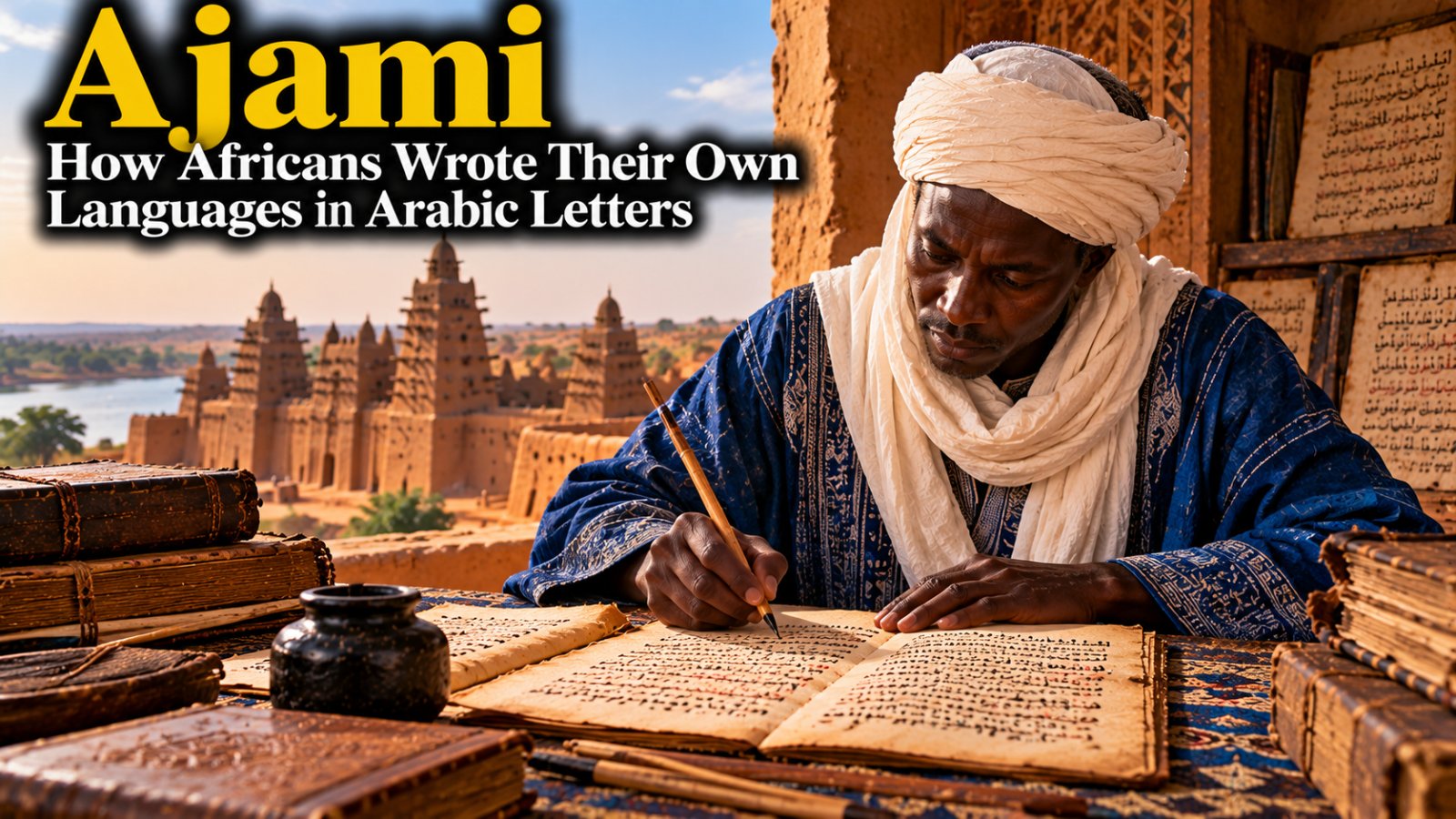
Walk through a market in Senegal or northern Nigeria and look closely at the hand-painted signs, the notes pinned to a stall, or the cover of a small booklet of poems. Some of the writing looks like Arabic. But read it aloud and it is not Arabic at all. It is Wolof, or Hausa, or Fula, written in Arabic letters that have been changed to fit an African tongue.
This writing system is called Ajami, and it has been quietly recording African lives, faith, business and poetry for hundreds of years.
What the word means
Ajami comes from the Arabic word ʿajam, an old term for people who were not Arabs or who did not speak Arabic. Over time, Ajami came to mean writing a non-Arabic language in Arabic script. Persian, Turkish and Urdu were all written this way. In Africa, the same idea spread wherever Islam and Qur'anic schools arrived.
Changing the alphabet to fit African sounds
Arabic letters were designed for Arabic, and African languages have sounds that Arabic does not. Wolof has the sounds p, g, ñ and ŋ. Hausa has special "popped" consonants made by closing the throat. Fula has its own implosive sounds.
Writers solved the problem with creativity. They took existing Arabic letters and added extra dots or marks to create new ones. In Wolof Ajami (often called Wolofal), for example, a letter for b with extra dots can stand for p. Vowel marks, which are usually left out in everyday Arabic writing, are often written in full, because the vowels of African languages carry a lot of meaning.
Each language developed its own conventions, and spelling often varied from region to region and teacher to teacher, much as English spelling did before dictionaries.
Where Ajami was used
Ajami grew out of Qur'anic schools. A child learned the Arabic alphabet in order to recite the Qur'an, and then used the same letters to write their own language. From there it spread into every part of life:
- Religious teaching, so that people who did not understand Arabic could learn the basics of their faith in their mother tongue.
- Poetry, from hymns of praise to the Prophet to songs of love, loss and politics.
- History and genealogy, recording family lines, local rulers and important events.
- Medicine, including written remedies for snakebite, stomach pain and other illnesses.
- Trade and daily life, such as letters, loans, receipts and shop accounts.
Ajami was used for Hausa, Fula (also called Fulfulde or Pular), Wolof, Mandinka, Kanuri, Songhay and many other languages. On the East African coast, Swahili poets wrote long religious and heroic epics in Arabic script for centuries before the Latin alphabet took over. In Madagascar, a similar tradition called sorabe was used to write Malagasy.
Poets, saints and resistance
Some of Africa's most loved writers used Ajami.
In the early nineteenth century, Nana Asma'u, the scholar daughter of Usman dan Fodio, founder of the Sokoto Caliphate, wrote poems in Fula, Hausa and Arabic. She used verse to teach women across the region, and her work is still read in northern Nigeria today.
In Senegal, Ajami is closely linked to the Muridiyya, the Sufi brotherhood founded by Sheikh Amadou Bamba in the late nineteenth century. When the French colonial authorities exiled Bamba to Gabon in 1895, his followers did not stop writing. The poet Serigne Moussa Ka composed Wolof Ajami verses describing Bamba's trials and his patience under persecution. These poems were copied, recited and sung across the country, carrying a message the French could not easily read. Ajami became a quiet form of resistance.
The literacy that colonial records missed
When European colonial officials counted how many Africans could read and write, they usually only counted people who were literate in European languages and the Latin alphabet. Millions of people who could read and write their own language in Ajami were recorded as "illiterate".
Scholars such as Fallou Ngom of Boston University argue that this has distorted our picture of African history. If you only look at texts in French, English or Arabic, you miss what ordinary African Muslims were writing to each other in their own languages. Huge collections of Ajami manuscripts, held in family libraries in places such as Senegal, Mali, Guinea and Nigeria, remain uncatalogued and untranslated.

Ajami today
Ajami never disappeared. In the Senegalese holy city of Touba, the heart of the Muridiyya, you can still see Wolofal on signs, murals and religious texts. Older traders in northern Nigeria still keep accounts in Hausa Ajami. Universities and digital projects are now teaching the script and scanning old manuscripts before they decay.
For many people, though, the Latin alphabet has become the standard, through schools, governments and mobile phones. The challenge is to make sure that the knowledge stored in Ajami does not get lost in the switch.
Why it matters
The old idea that Africa had no writing before Europeans arrived was always wrong. Africa has its own scripts, like Ge'ez, Tifinagh and Nsibidi, the great manuscript libraries of Timbuktu, and Ajami, a system that let ordinary people write prayers, poems, letters and medicines in the languages they spoke at home.
Ajami reminds us that literacy is not one alphabet. It is the ability to put your own words on paper, and Africans have been doing that, in their own way, for a very long time.
Further reading
- Boston University, Bostonia — Fallou Ngom and the Ajami script (Summer 2009)
- Boston University, Resources in Ajami — Wolof Ajami Reader
- Fallou Ngom, Muslims beyond the Arab World: The Odyssey of Ajami and the Muridiyya (Oxford University Press, 2016)