Famadihana: Madagascar's Turning of the Bones
Every few years in Madagascar's highlands, families open their ancestral tombs, rewrap the remains of loved ones in fresh shrouds, and dance with them. Here is what famadihana means.
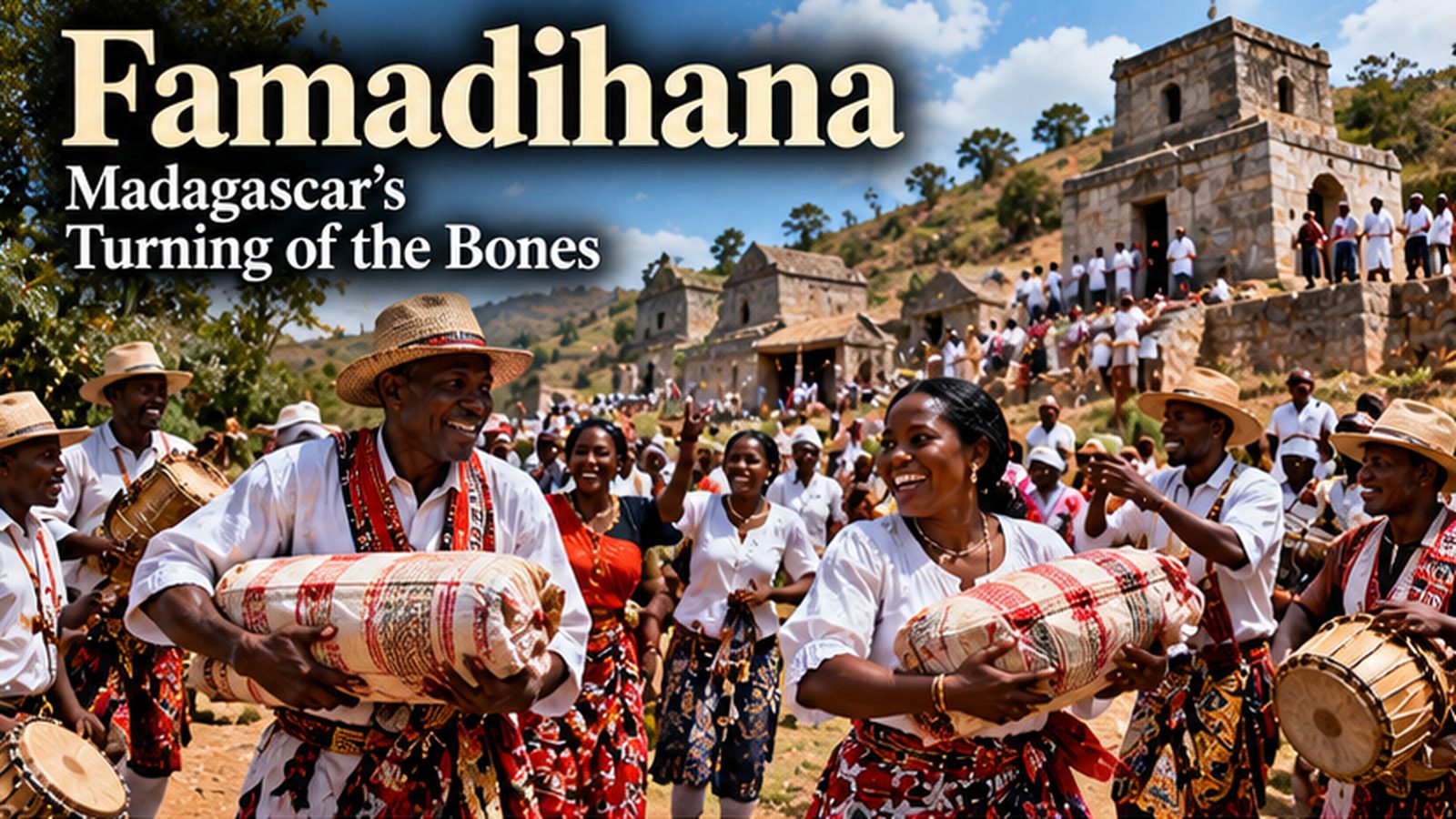
On a hillside in the highlands of Madagascar, a brass band plays and a crowd of relatives gathers around a large stone tomb. The doors are opened. One by one, bodies wrapped in cloth are carried out into the sunlight. Family members hold them, talk to them, and wrap them in fresh, new shrouds. Then, to the sound of music, they lift the ancestors onto their shoulders and dance. To an outsider, it can be astonishing. To the families, it is one of the most joyful and loving occasions of their lives. This is famadihana, the "turning of the bones."
The Malagasy and their ancestors
Madagascar is home to around 30 million people, the Malagasy, whose language belongs to the Austronesian family — related to languages of Borneo — a legacy of seafarers from Southeast Asia who settled the island long ago and mixed with people from the African mainland. The island has many regional groups and customs, but across much of it, ancestors (razana) hold a central place.
The Malagasy believe that the dead remain part of the family. The ancestors watch over their descendants, can bless or punish them, and must be respected. The family tomb, often a large stone structure built on ancestral land, is more important than many houses, and people say that a person "belongs" to the tomb where they will be buried.
The ceremony
Famadihana is practised especially by the Merina and Betsileo peoples of the central highlands. It typically takes place:
- Every several years — often around seven years — after a person's death, depending on family custom and the advice of an astrologer or diviner.
- In the dry season, roughly between June and September, when the ceremony is permitted.
The steps usually include:
- Preparing — families send invitations, buy new shrouds and food, and hire musicians. A famadihana can be very expensive, sometimes costing more than a wedding.
- Opening the tomb — the remains of one or more ancestors are carried out.
- Rewrapping — the old shrouds are removed and the remains are wrapped in new ones, traditionally made of silk. The names of the dead may be written on the cloth so they are not confused.
- Celebrating — relatives hold the bodies, speak to them, share family news, and dance with them to music, often carrying them around the tomb.
- Returning — the ancestors are placed back in the tomb, sometimes turned upside down, and the doors are sealed until the next ceremony.
The atmosphere is festive: there is food, drink, music and dancing, and hundreds of guests may attend.
Love, memory and belonging
Families explain famadihana in different ways: as a chance to see and touch loved ones again; to keep them warm and comfortable with new cloth; to reunite the scattered branches of the family; and to make sure the ancestors continue to bless the living. Children learn the names and stories of their forebears. For many, it is less about death than about continuity — the family, living and dead, gathered together.
Faith and change
Most Malagasy are Christians, and many combine church membership with ancestral rites. Some churches accept famadihana as a cultural custom; others discourage it. Health authorities have also raised concerns during outbreaks of disease, and some families have chosen to hold the ceremony less often. In towns, rising costs and changing lifestyles mean fewer families practise it than before. Still, in the highlands, the brass bands play every dry season.
Madagascar's unique linguistic and cultural history is part of the story of Africa's languages, which includes Malagasy's surprising connection across the Indian Ocean.
Why it matters
Famadihana challenges the way many cultures think about death — as an ending, something to be hidden away. For the Malagasy families who practise it, the dead are still family, worth new silk, music and dancing. It is a ceremony of grief turned into celebration, and of love that does not end at the tomb.
Further reading
- Bradt Guides — Madagascar's famadihana: the turning of the bones
- CNN — Famadihana, Madagascar: sacred ritual unearths the dead
- Maurice Bloch, Placing the Dead: Tombs, Ancestral Villages and Kinship Organization in Madagascar (Seminar Press, 1971)