Stone Town, Zanzibar: The Coral-Stone City Where Africa Met the Indian Ocean
Carved doors, coral-stone houses and a painful past: Zanzibar's Stone Town is a UNESCO World Heritage city built by centuries of Indian Ocean trade. Here is its story.
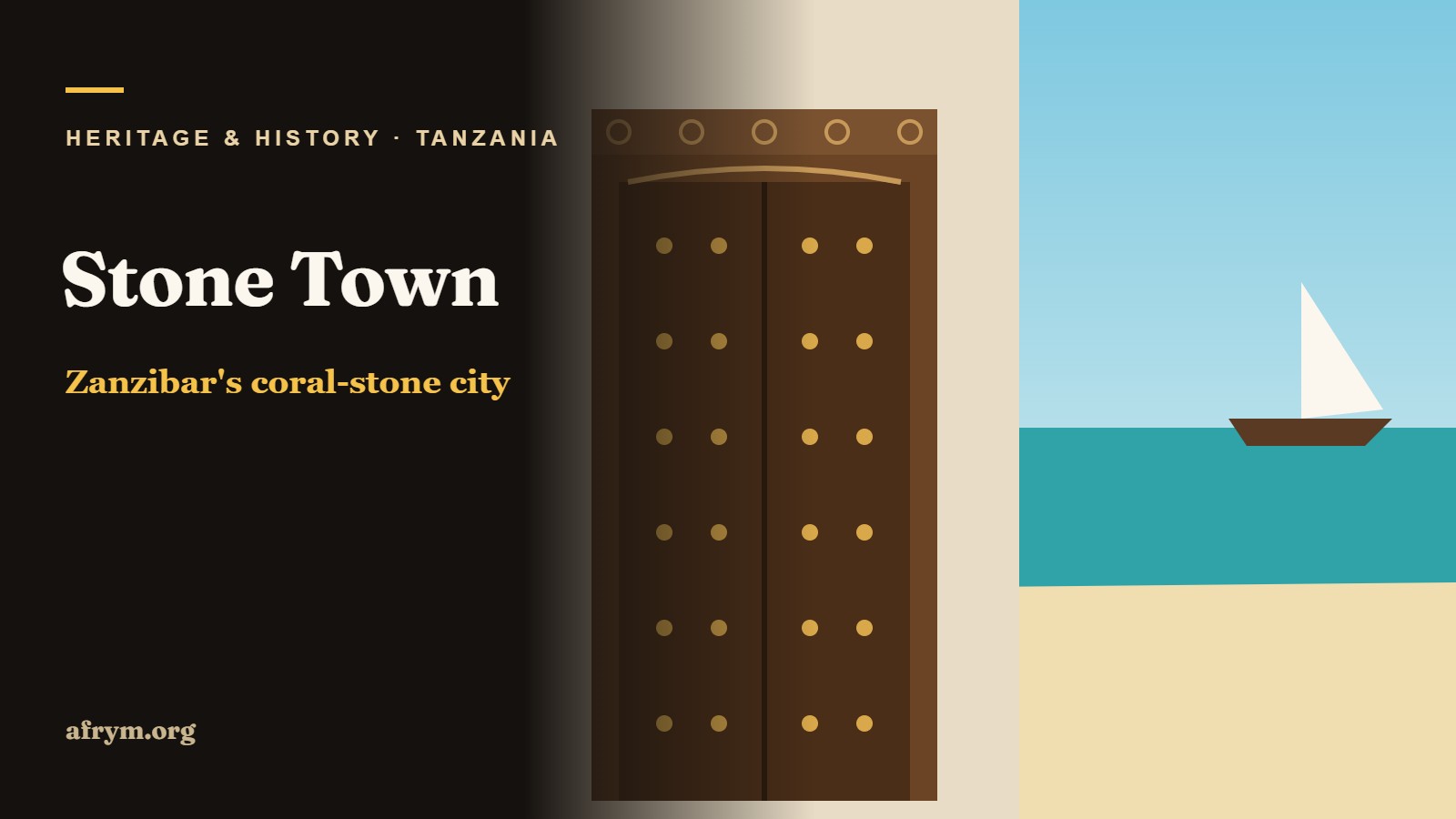
Quick answer: Stone Town is the historic heart of Zanzibar City, on Unguja island off the coast of Tanzania. Built mostly in the 18th and 19th centuries from coral stone and mangrove timber, it blends Swahili, Arab, Indian and European styles and is famous for its carved wooden doors. It was also one of East Africa's main slave-trading ports. UNESCO listed it as a World Heritage Site in 2000.
Step off the ferry in Zanzibar and the city closes around you within minutes. Lanes too narrow for cars twist between tall, lime-washed houses. Balconies almost touch overhead. A cart rattles past loaded with coconuts, a call to prayer drifts over the rooftops, and at every turn there is a door: dark wood, carved with chains, lotus flowers and fish, studded with brass spikes.
This is Stone Town, and almost every building in it tells a story about the ocean.
A city made by the monsoon winds
For centuries, the seasonal monsoon winds carried sailing ships between East Africa, Arabia, Persia and India. Merchants arrived on one wind and left months later on the next. Along this coast grew the Swahili towns, places like Kilwa Kisiwani and Lamu, where African, Arab and Asian traders, sailors and families mixed.
Zanzibar's position, close to the mainland and sheltered from the open sea, made it ideal. In the early 19th century, Omani Arabs arrived as traders and later as owners of clove plantations, and the island's capital grew rapidly. Merchants from India opened shops and banks, and later British officials added their own buildings. The result is a town UNESCO describes as an outstanding example of cultural fusion.
Built from the sea itself
Stone Town's name comes from its building material. Most houses are made of coral rag, rough lumps of fossil coral, set in thick lime mortar. Their floors and ceilings rest on poles of mangrove timber, and their walls are plastered and lime-washed. The thick walls keep rooms cool in the heat.
You can still read the town's history in its architecture:
- Omani-style houses are massive, flat-roofed blocks with plain walls, inner courtyards and heavy square doors.
- Indian shop-houses have a shop on the ground floor, family rooms above, and simpler folding doors.
- Swahili houses are lower, often with a stone bench, the baraza, outside the front door where neighbours sit and talk.
The famous doors
Zanzibar's doors are its signature. Many have square frames in the older Omani style, while others have rounded tops influenced by Indian craftsmen. Carvers decorated them with symbols such as chains, fish, lotus flowers and date palms, and some were fitted with sharp brass studs. People often say the studs recall Indian doors built to resist elephants, a story that is easier to repeat than to prove. You can compare them with the woodwork in our story on the carved doors of the Swahili coast.
Landmarks of the old town
- The House of Wonders (Beit el-Ajaib), built in 1883 for Sultan Barghash as a ceremonial palace. It was among the first buildings in East Africa to have electricity and running water.
- The Old Fort, raised on the site of a Portuguese church and turned into a garrison by the Omanis.
- The Old Dispensary, a lacy, balconied building completed in 1887 by an Indian architect.
- The Hamamni Persian Baths, a 19th-century public bathhouse.
- Christ Church Anglican Cathedral, built on the site of the town's last open slave market.
A painful history
Stone Town's beauty sits beside a hard truth. In the 19th century, Zanzibar was one of the main slave-trading ports of East Africa. Captives taken from the mainland were sold here, many of them forced to work on the island's clove and coconut plantations. The open slave market was closed in 1873, and Christ Church was built on the spot as a memorial. Today a museum there tells the story of those who suffered.
UNESCO lists this history as one reason the town matters: it was a place where the slave trade flourished and where the campaign against it was finally won. Our story on Gorée Island covers the Atlantic side of the same tragedy.
Living heritage
Stone Town is not a museum. Families still live in its houses, and the town is full of schools, mosques, cafés and workshops. Women wear brightly printed kanga cloth, evening crowds gather at the Forodhani waterfront gardens for grilled seafood, and the sound of taarab music still drifts from wedding halls. Each February, the Sauti za Busara festival fills the Old Fort with music from across Africa.
Protecting it is not easy. Coral stone crumbles when it gets wet, tourism brings traffic and new buildings, and old houses are expensive to repair. Zanzibar's Stone Town Conservation and Development Authority, set up in 1985, works with residents and UNESCO to guide repairs. You can read UNESCO's assessment on its Stone Town page.
Frequently asked questions
Where is Stone Town?
It is the old quarter of Zanzibar City on Unguja, the main island of the Zanzibar archipelago, which is part of Tanzania.
Why is it called Stone Town?
Because its houses were built of coral stone and lime, unlike the mud-and-thatch homes that surrounded it in the past.
When did Stone Town become a World Heritage Site?
UNESCO inscribed it on the World Heritage List in 2000.
What is Stone Town famous for?
Its carved wooden doors, narrow lanes, mixed Swahili, Arab, Indian and European architecture, and its history as a centre of the Indian Ocean trade, including the slave trade.
Why it matters
Stone Town shows that Africa's coast was never a dead end but a crossroads. Ideas, goods, faiths, foods and people moved through its harbour for centuries, and the town absorbed them all into something distinctly Swahili. Remembering both its splendour and its suffering gives a fuller picture of East African history, and of the Indian Ocean world that Africa helped to build.
Further reading
- UNESCO World Heritage Centre — Stone Town of Zanzibar
- UNESCO Urban Heritage Atlas — Stone Town of Zanzibar
- World Heritage Site — Stone Town of Zanzibar
- Abdul Sheriff, Slaves, Spices and Ivory in Zanzibar (James Currey, 1987)