Kilwa Kisiwani: The Swahili City That Ibn Battuta Called Beautiful
On a small island off Tanzania stand the ruins of a medieval city that minted its own coins and controlled the gold trade of East Africa. Here is the story of Kilwa.
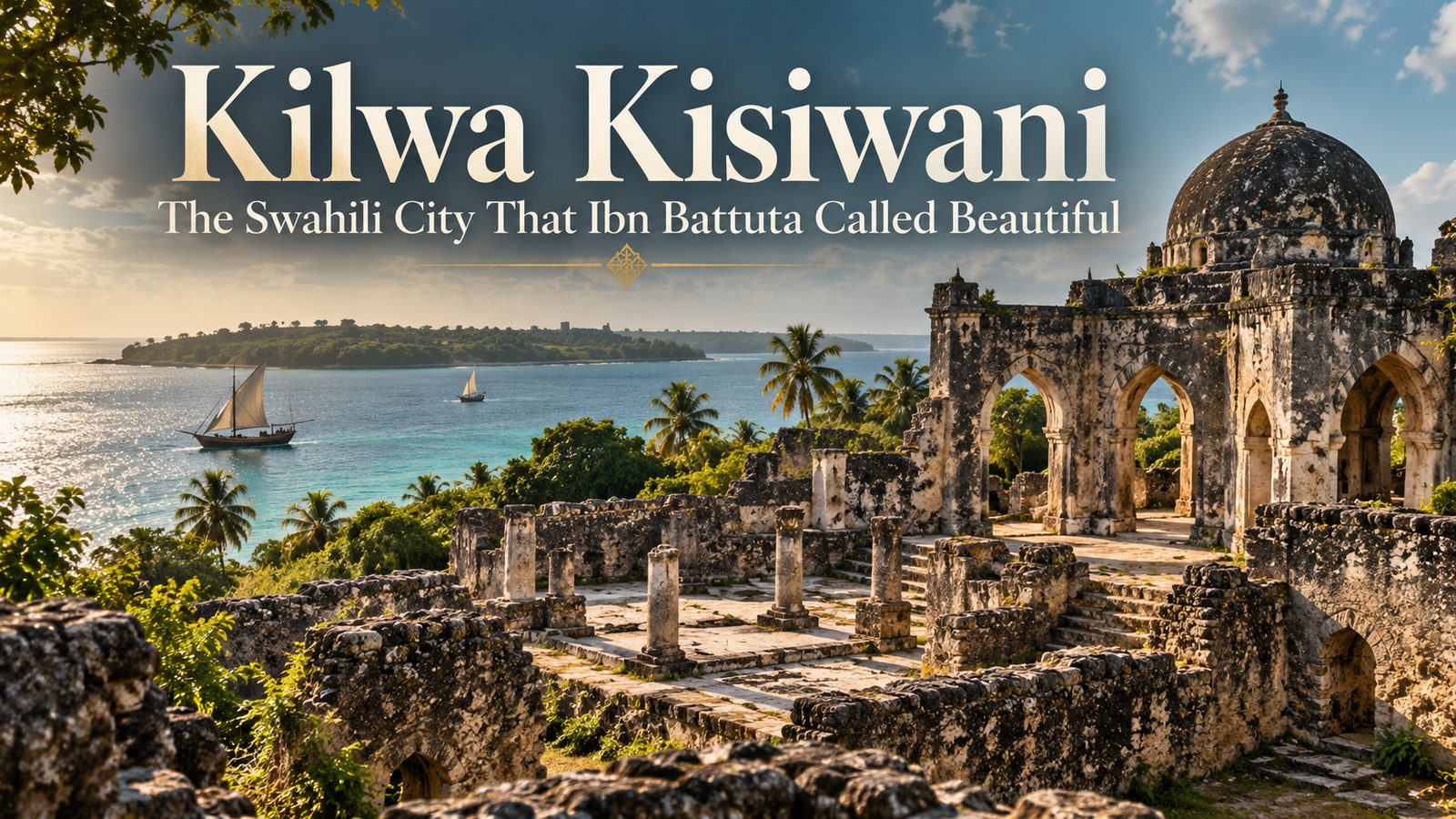
Today, the island of Kilwa Kisiwani is quiet. Fishermen mend nets, goats wander, and a few hundred families live in simple houses. But scattered across the island are the ruins of something extraordinary: a great domed mosque, a vast palace with a bathing pool overlooking the sea, the walls of houses and tombs, and a crumbling fort. Seven hundred years ago, this was one of the richest cities on the Indian Ocean.
A city of gold
Kilwa Kisiwani ("Kilwa on the island") lies just off the southern coast of Tanzania. It was one of the most important Swahili city-states — trading towns along the East African coast that were African in language and roots, Islamic in religion, and connected by sea to Arabia, Persia, India and China.
Kilwa's power came from trade, and above all from gold. Gold mined in the interior of southern Africa — in the region linked to Great Zimbabwe — was carried to the port of Sofala in what is now Mozambique, and Kilwa came to control that trade. Ivory, too, passed through its harbour. In exchange, merchants brought in cloth, beads, glass, carnelian, perfumes, Persian glazed pottery and Chinese porcelain.
The city's golden age was in the 13th and 14th centuries. Its rulers minted their own copper coins — a sign of wealth and independence shared by very few places in sub-Saharan Africa at the time.
The buildings
Kilwa's ruins show the skill of Swahili builders, who worked mainly in coral stone and lime mortar.
- The Great Mosque — first built in the 11th century and greatly enlarged in the 13th and 14th centuries, it is often described as the oldest standing mosque on the East African coast. Its prayer hall is roofed with rows of domes and barrel vaults supported by columns, and pieces of Chinese porcelain were set into the ceiling as decoration.
- Husuni Kubwa — a huge palace and trading complex built on a cliff above the sea in the early 14th century. It had courtyards, audience halls, storerooms and an octagonal bathing pool. It was one of the largest buildings in sub-Saharan Africa of its time.
- Gereza — a fort first built by the Portuguese in the early 16th century and later rebuilt by the Omanis.
Nearby, on the island of Songo Mnara, are the remains of another Swahili town of the 14th and 15th centuries, with mosques, a palace and dozens of coral-stone houses.
Ibn Battuta's visit
In 1331, the great Moroccan traveller Ibn Battuta visited Kilwa on his journey down the East African coast. He was impressed. In his travel memoir he ranked it among the finest and best-built towns he had seen anywhere, and praised its sultan for his generosity and his devotion to religious learning. His description is one of the most vivid outside accounts of medieval Swahili civilisation.
Decline
Kilwa's fortunes changed in the 15th century, as trade patterns shifted and rival cities rose. Then, in 1505, a Portuguese fleet attacked and sacked the city, seeking control of the gold trade. The Portuguese built a fort, but they never managed to restore Kilwa's prosperity. Over the following centuries, control passed to Omani Arabs, and the town shrank into the quiet place it is today.
Protecting the ruins
UNESCO listed the Ruins of Kilwa Kisiwani and Songo Mnara as a World Heritage Site in 1981. Erosion from the sea and the decay of the coral stone threatened the buildings, and in 2004 the site was added to the List of World Heritage in Danger. After years of conservation work with local communities, including stabilising walls and improving site management, it was removed from the danger list in 2014.
Kilwa belongs to the same coastal world that produced the carved doors of Zanzibar and Lamu and the Kiswahili language itself.
Why it matters
Kilwa Kisiwani tells a story that was long overlooked: that East Africa had rich, cosmopolitan cities with their own coins, architecture and international trade, centuries before European ships arrived. The ruins are quieter now. But stand in the Great Mosque, look up at the domes, and you can still glimpse the city that impressed one of history's greatest travellers.
Further reading
- UNESCO World Heritage Centre — Ruins of Kilwa Kisiwani and Ruins of Songo Mnara
- Zamani Project — Kilwa Kisiwani
- Stephanie Wynne-Jones, A Material Culture: Consumption and Materiality on the Coast of Precolonial East Africa (Oxford University Press, 2016)