Kasubi Tombs: Where the Kings of Buganda Rest
A vast thatched dome on a Kampala hill holds four kings of Buganda. Destroyed by fire in 2010 and rebuilt by hand, the Kasubi Tombs are a living royal shrine.
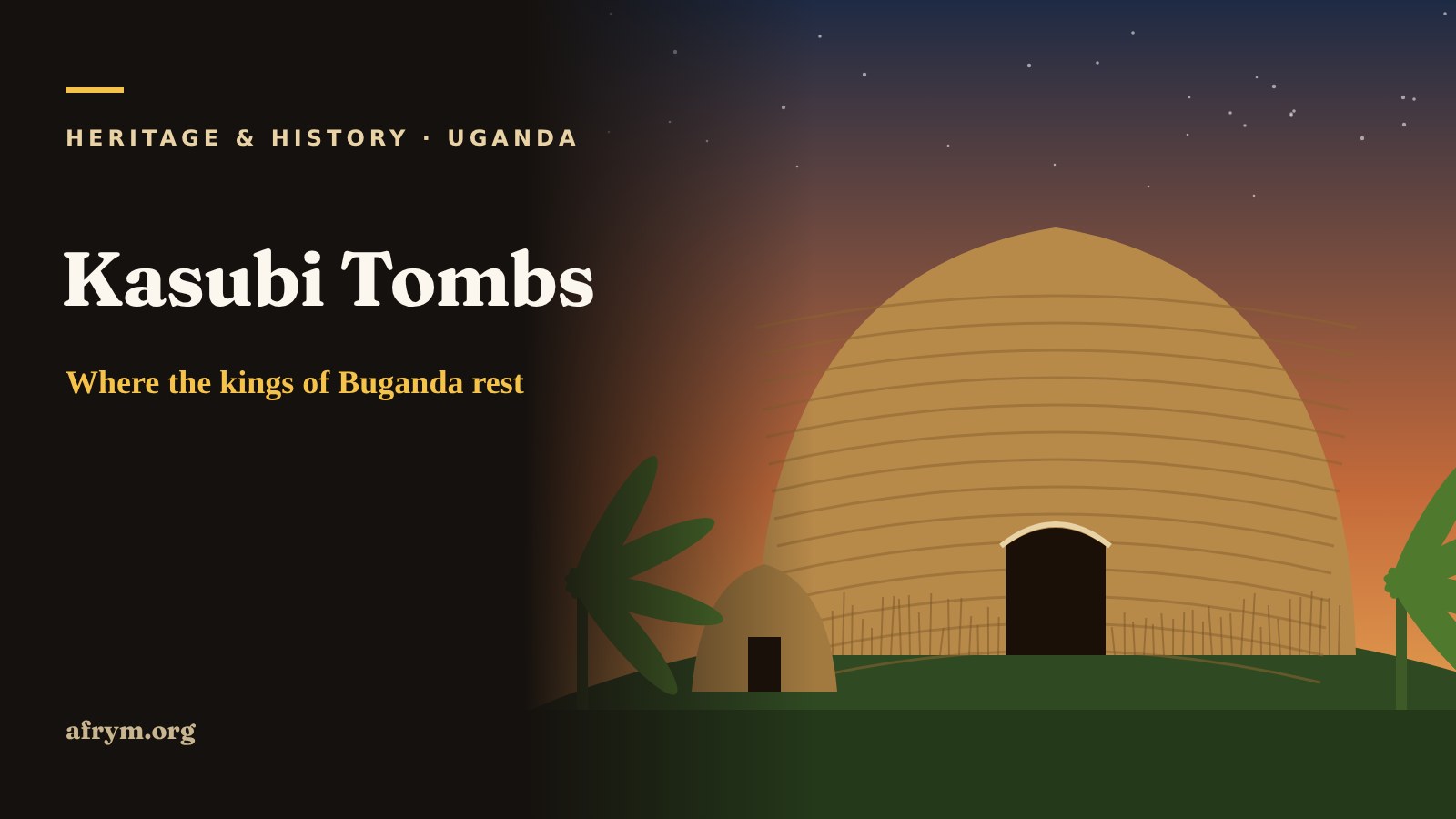
On Kasubi Hill in Kampala, just a few kilometres from the traffic of Uganda's capital, stands a building unlike anything else in the city. It is a giant dome of grass thatch that sweeps almost to the ground, with a low, dark doorway at its front. Inside, behind a great curtain of barkcloth, lie four kings of Buganda.
This is Muzibu Azaala Mpanga, the heart of the Kasubi Tombs. For the Baganda, the largest ethnic group in Uganda, it is not a museum but a sacred place where the kingdom's past and present meet.
A palace that became a tomb
The main house was built in 1882 as a palace for Kabaka (King) Muteesa I, one of Buganda's most famous rulers. When he died in 1884, he was buried inside his own palace, and the hill became a royal burial ground.
Three of his successors were later laid to rest beside him:
- Muteesa I, who welcomed the first European travellers and Muslim and Christian teachers to his court;
- Mwanga II, his son, who resisted British control and died in exile;
- Daudi Chwa II, who became king as an infant and reigned for decades under the British protectorate;
- Sir Edward Muteesa II, the last king of the old line, who also became Uganda's first president and died in London in 1969.
Together their graves trace the story of Buganda from an independent kingdom on the shores of Lake Victoria to a part of modern Uganda.
Built from grass, reeds and wood
What makes Kasubi so remarkable is its material. The great dome is made almost entirely from organic things that grow nearby: wooden poles, bundles of reeds, layers of thatching grass and sheets of barkcloth. Inside, rings of reeds run around the high ceiling, the work of specialist builders.
Barkcloth, made by beating the bark of the mutuba fig, plays a special role. Long sheets of it hang inside the house and close off the sacred area where the kings lie, an area ordinary visitors do not enter. Drums matter here too. In Buganda they marked every great passage of life, from coronations to royal deaths, much as talking drums carried messages across West Africa.
Like the earth mosques of Mali, such as the Great Mosque of Djenné, a building like this survives only through constant care. Thatch must be renewed, reeds replaced and the knowledge of how to do it passed from elders to apprentices.
A living royal community
Kasubi is still very much alive. Royal widows and custodians from Buganda's clans live on the site, look after the tombs and keep the rituals going. Different clans hold different duties, a reminder of how closely the kingdom's social order is tied to this place.
Visitors are asked to dress modestly and to follow the custodians' guidance on where to walk and how to behave. Many find that the quiet atmosphere under the dark, high thatch feels closer to a church or a sacred grove than to a historic monument.
For the Baganda, the tombs connect people to their kings and ancestors, a role played elsewhere by places such as Great Zimbabwe in the south or the rock-cut churches of Lalibela in Ethiopia. Much of what is known about Kasubi has also been carried by memory and speech, the same oral tradition that keeps history alive across the continent.
World Heritage and the fire of 2010
In 2001, UNESCO added the Tombs of Buganda Kings at Kasubi to the World Heritage List, praising the site as an outstanding example of traditional architecture built with organic materials, and as a place of deep spiritual meaning.
Then, on the night of 16 March 2010, disaster struck. A fire, whose cause has never been fully explained, swept through Muzibu Azaala Mpanga and destroyed the great dome. Crowds gathered on the hill in grief. The tombs themselves survived beneath the ashes, but the building that sheltered them was gone, and UNESCO placed the site on its List of World Heritage in Danger.
Rebuilt by hand
Rebuilding Kasubi was never just a construction project. It had to be done the traditional way, with the right materials, the right builders and the right ceremonies. Clan elders guided the work, thatchers were trained, and grass, reeds and trees had to be found in large quantities.
The work took more than a decade. Along with the main house, the gatehouse called Bujjabukula was renovated, and a fire-fighting system was added to protect the new thatch. In September 2023, UNESCO's World Heritage Committee decided that the restoration was complete enough to take Kasubi off the danger list, as it explained in its announcement of the decision.
Visiting Kasubi
Kasubi lies on the west side of Kampala and is easy to combine with a day in the city: a plate of matoke for lunch, or a rolex from a roadside stall. Guides from the site explain the history and the customs, and visitors are normally asked to take off their shoes before entering the main house. Check opening arrangements before you go, as some ceremonies close parts of the site.
Why it matters
The Kasubi Tombs show that monuments do not have to be built from stone to last. Their strength lies in the people who maintain them: the thatchers, the clan elders, the widows and custodians who keep the place alive.
When fire destroyed the dome, the Baganda rebuilt it with the same grass, reeds and barkcloth as before. In doing so, they proved that a culture's heritage survives as long as the knowledge of how to make it is still being handed down.