Leptis Magna: Libya's Roman City by the Sea and the Emperor It Produced
Founded by Phoenicians and rebuilt by an African-born emperor, Leptis Magna in Libya is one of the best-preserved Roman cities anywhere. Here is its story.
Quick answer: Leptis Magna is an ancient city on the coast of Libya, about 100 km east of Tripoli. Founded by Phoenician traders, it became one of the richest cities of Roman Africa, and it was the birthplace of the emperor Septimius Severus, who rebuilt it in grand style. It has been a UNESCO World Heritage Site since 1982.
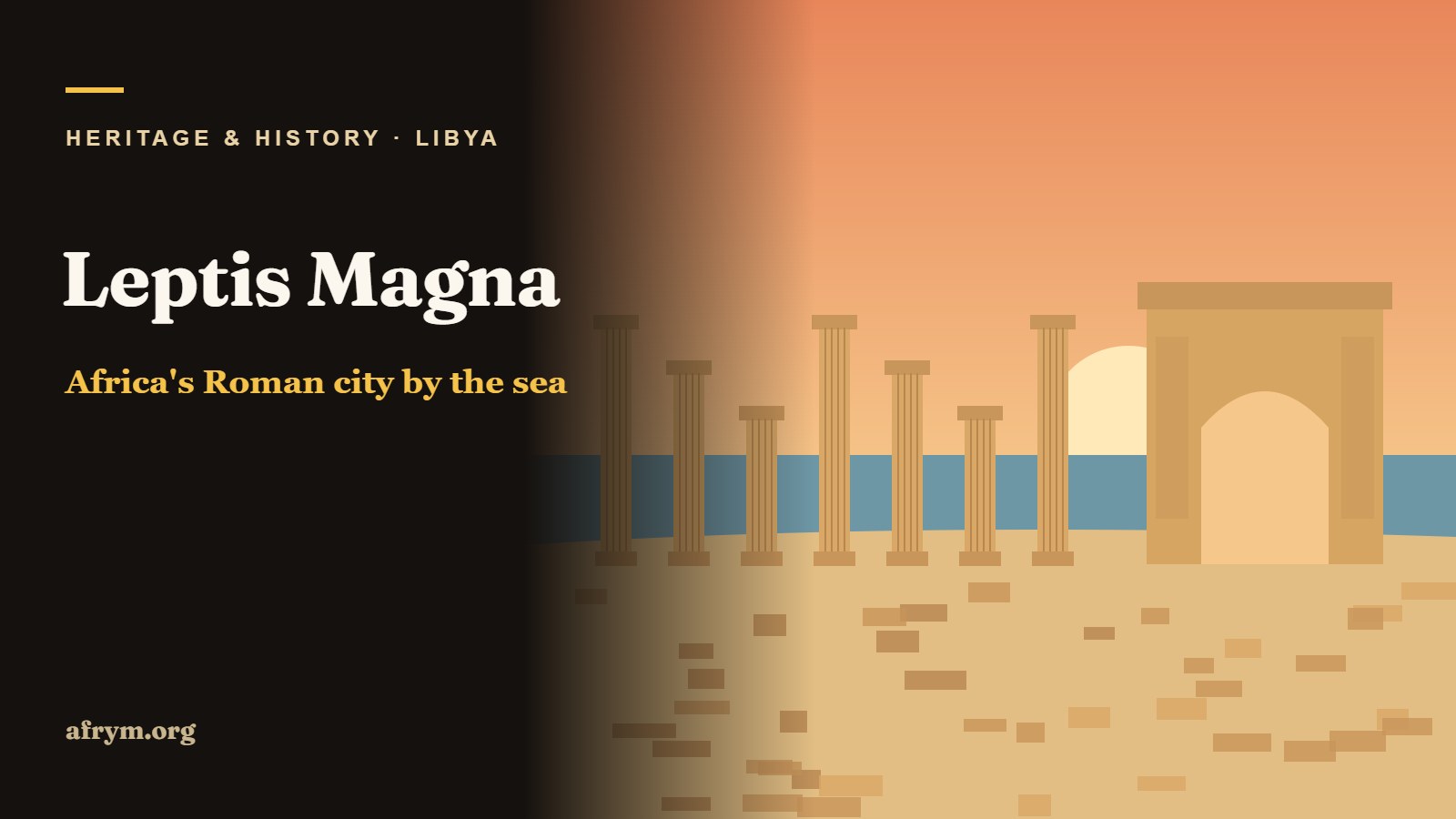
Picture a marble street running straight towards the sea. On either side stand columns the colour of honey, some still carrying their carved tops. Ahead is a harbour where ships once tied up beside warehouses and a lighthouse. Behind you, a semicircle of stone seats looks out over the water from a theatre that has stood for nearly two thousand years.
That is Leptis Magna today. For centuries, much of it lay under drifting sand, and that sand is a large part of why so much of it survived.
Before Rome: a Phoenician trading town
The city's story starts with sailors. Phoenician traders from the eastern Mediterranean set up a harbour here, probably by the 7th century BCE. Later the town fell within the world of Carthage, the powerful Phoenician city in today's Tunisia.
Its people spoke and wrote Punic, the Carthaginian language, and they kept using it officially long after Roman rule began. Leptis was not a Roman colony planted in Africa, but an African and Mediterranean city that, over time, became Roman too.
Its wealth came from geography. The coastal plain grew olives and grain, and routes from the Sahara and the interior reached the sea here. Leptis sat on the meeting point of land and water trade.
Becoming a Roman city
After Carthage was destroyed, Leptis spent a period under the Numidian kingdom of Masinissa before breaking away to become an ally of Rome. In the following centuries it flourished.
Local families with Punic names paid for temples, markets and monuments in the Roman style, and proudly recorded their gifts in inscriptions. An amphitheatre went up in 56 CE. The emperor Trajan raised Leptis to the rank of a Roman colony early in the 2nd century, and under Hadrian the city gained a large public bath complex.
The boy from Leptis who ruled Rome
In 145 CE, a boy named Lucius Septimius Severus was born into a wealthy Leptis family. He climbed through the ranks of Roman government and the army, and in 193 CE, after a civil war, he became emperor. He ruled until 211 and founded a dynasty that held power in Rome for decades.
Severus remembered where he came from. He granted his hometown valuable tax privileges and began a building programme that turned it into one of the showpieces of the empire:
- a new forum, with a temple honouring his family;
- an enormous basilica, around 160 metres long, completed in 216, five years after his death;
- a colonnaded avenue leading to a monumental fountain;
- an improved harbour with quays, storehouses and a lighthouse;
- a four-sided arch at a crossroads, carved with scenes of the emperor and his family.
How Severus saw his own identity, and how others saw him, is still discussed by historians, and the evidence is not simple. But the core fact is striking: a man from a North African coastal town reached the top of the Roman world. Anthony Birley's biography, listed in our sources, is a careful guide to what can and cannot be known.
Slow decline and the protecting sand
No city stays at its peak forever. Raids from the interior, the financial troubles of the later Roman Empire and a devastating attack in 363 CE weakened Leptis. It came under Vandal rule and then Byzantine rule, and after the Arab conquest of the 7th century it stopped functioning as a city.
Wind carried sand over its streets and buildings. Over the centuries visitors removed columns and marble, but the dunes kept much of the rest hidden and safe. In the early 20th century, Italian archaeologists and Libya's antiquities services began uncovering it, revealing a city in astonishing condition.
What you can see there
- The theatre, with its seats facing the sea.
- The market, where stone counters and measuring tables still stand.
- The Hadrianic Baths, with pools and changing rooms.
- The Hunting Baths, which still show painted scenes of hunters and wild animals.
- The Severan Forum and Basilica, with carved pillars and massive columns.
- The restored Arch of Septimius Severus.
Many of the best statues and mosaics are kept in the site museum and in the national museum in Tripoli.
Protected, but at risk
UNESCO inscribed Leptis Magna on its World Heritage List in 1982. In 2016, it was moved onto the List of World Heritage in Danger along with Libya's other World Heritage sites, because of the dangers posed by conflict in the country. You can read UNESCO's description on its Leptis Magna page.
Through difficult years, Libyan archaeologists, guards and local people have worked to look after the site, and it remains deeply important to Libyans.
One of Africa's great ancient cities
Leptis belongs alongside Africa's other ancient wonders: the temples of Abu Simbel, the royal cities of Kush and the stone enclosures of Great Zimbabwe. Long before any of these, people of the Sahara left their mark in the rock art of Tassili n'Ajjer, and the Amazigh languages featured in our story on Tamazight and Tifinagh are still spoken in the region today.
Frequently asked questions
Where is Leptis Magna?
It lies on Libya's Mediterranean coast, near the modern town of Al-Khums, about 100 km east of Tripoli.
Who built Leptis Magna?
It was founded by Phoenician traders and grew under Carthaginian influence. Its grandest buildings were added in Roman times, especially under the emperor Septimius Severus, who was born there.
Why is Leptis Magna so well preserved?
After the city was abandoned, sand covered much of it for centuries, protecting many buildings until excavations began in the early 20th century.
Is Leptis Magna a World Heritage Site?
Yes. It was listed in 1982, and since 2016 it has also been on UNESCO's List of World Heritage in Danger.
Why it matters
Leptis Magna is a reminder that the ancient Mediterranean was shared by many peoples, and that Africa sat at its heart. Phoenician sailors, Carthaginian culture, local Libyan communities and Roman power all shaped this place, and one of its own sons became emperor. Walking down its marble streets, you are walking through a chapter of African history as much as a Roman one.
Further reading
- Britannica — Leptis Magna
- UNESCO World Heritage Centre — Archaeological Site of Leptis Magna
- World Heritage Site — Archaeological Site of Leptis Magna
- Anthony Birley, Septimius Severus: The African Emperor (Routledge, 1999)