Nyatiti: The Eight-String Lyre of Kenya's Luo People
Played seated, with a bell-ringing toe ring keeping time, the nyatiti is the Luo people's beloved lyre. Learn how it is made, played and kept alive in Kenya.
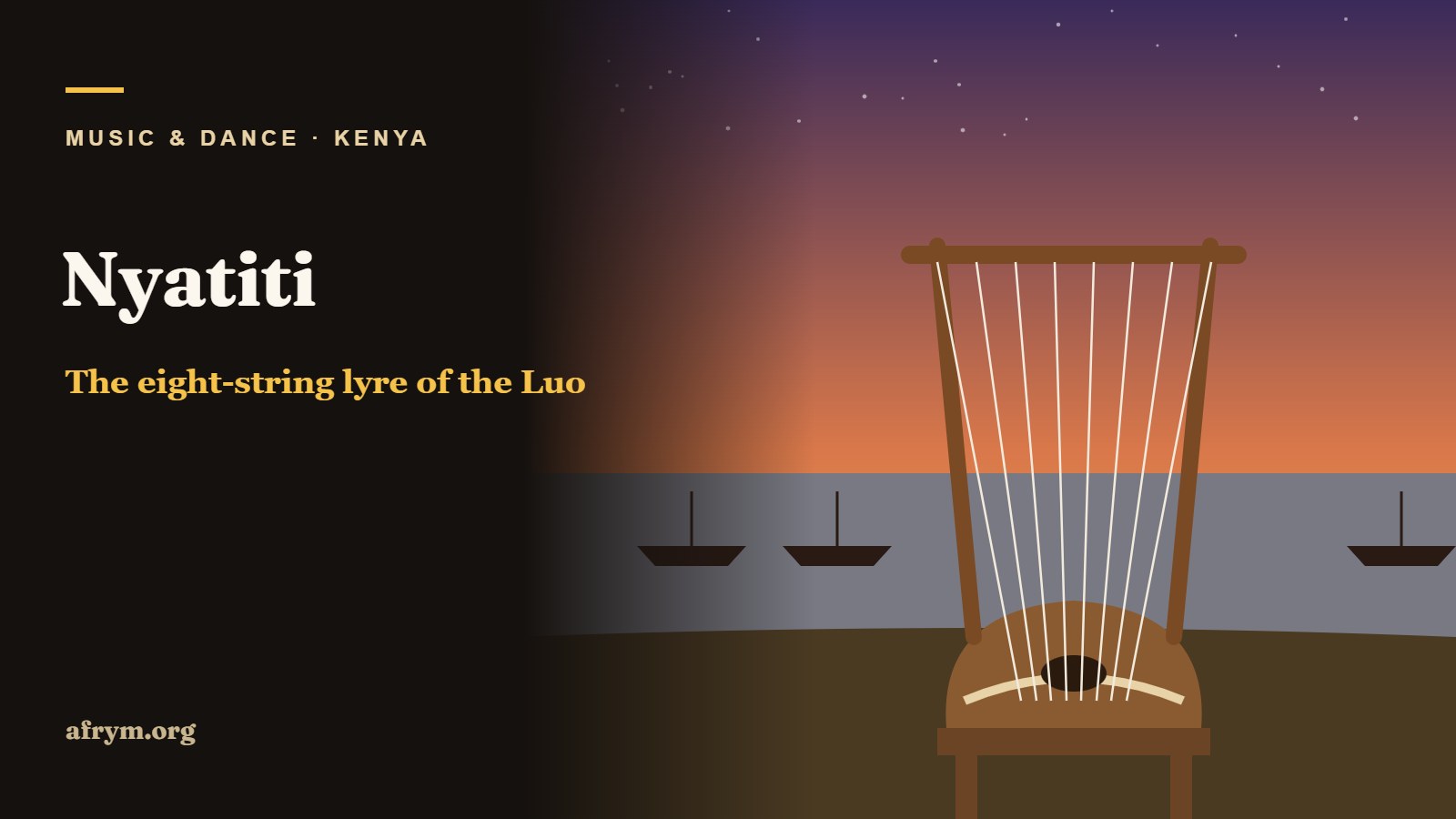
Quick answer: The nyatiti is an eight-stringed lyre played by the Luo people of western Kenya, around Lake Victoria. The player sits on a low stool, plucks the strings with both hands, sings, and keeps time with an iron ring on the big toe that strikes the instrument. It is traditionally played at gatherings that honour the dead and celebrate community life.
The first thing you notice is the rhythm. A sharp, metallic click lands on every beat, joined by the rattle of little bells. Then come the strings, bright and rolling, two hands weaving a pattern that sounds like more than one player. Finally a voice rises above it, telling a story.
All of this comes from one musician and one instrument: the nyatiti.
The Luo and the lake
The Luo are a Nilotic people whose heartland lies along the shores of Lake Victoria in western Kenya, in areas such as Kisumu, Siaya and Homa Bay. They are one of Kenya's largest communities, with relatives across the borders in Uganda and Tanzania. Fishing, farming and cattle have shaped their lives for generations.
The nyatiti is the instrument most closely tied to Luo identity, though similar lyres are played elsewhere in the region, including among the Kalenjin. It belongs to a wider family of East African lyres that includes the obokano of the Gusii and the litungu of the Luhya.
Built from wood, hide and string
A nyatiti is made from a handful of materials:
- a carved wooden bowl that acts as the sound box, often likened to the shape of a traditional Luo house;
- cowhide stretched tight across the bowl, with a hole to release the sound;
- two arms rising up from the bowl, joined at the top by a crossbar;
- eight strings running between the crossbar and the base. Around the lake, many players have long used fishing line.
There is no single "correct" tuning. Each musician tunes the strings to fit his or her own voice.
Eight strings, one life
Ask a Luo musician why there are eight strings and you may hear a beautiful answer. The first four strings stand for the four days a newborn boy spends secluded after birth. The other four stand for the four days of mourning after a man dies. Between them, the strings hold an entire life.
That symbolism fits the instrument's role. The nyatiti is at home both in celebration and in grief.
How the music is made
The player sits low, traditionally on a small wooden stool. Both hands pluck the strings in an interlocking pattern. On the big toe of the right foot sits a metal ring called oduong'o, which taps the arm of the lyre to mark the beat. Small bells known as gara are often tied around the ankle, adding a shimmer to every movement.
Then there is the voice. A nyatiti song might praise a family, retell local history, mourn a loved one or poke fun at the powerful. Good players are poets as much as musicians, which places them in the same storytelling world as West Africa's griots and their kora and the mbira players of Zimbabwe.
Where you would hear it
Traditionally the nyatiti was played at send-off ceremonies for the dead, at remembrance gatherings, and at social evenings when neighbours came together to listen, dance and drink. Musicians were admired, but some were also seen as wanderers, carrying their lyres from homestead to homestead.
For a long time the nyatiti was played almost only by men, with skills handed down from father to son. That is no longer true. Women now play it on stages in Kenya and abroad, and young musicians of all backgrounds are picking it up.
From the lakeside to the world
In the 20th century, the nyatiti helped shape Kenyan popular music. The guitar style called benga, which grew up around Lake Victoria, borrowed its quick, picked patterns and carried them over to electric guitar and bass.
Its most famous international voice was Ayub Ogada, born Job Seda. After a performance at the WOMAD festival in 1988, he recorded the album En Mana Kuoyo for Peter Gabriel's Real World label and introduced the lyre to listeners across the globe. He held the instrument more upright on his lap, changing the way many later players approached it, and inspired a generation before his death in 2019.
Others carried the torch, including Anyango, a Japanese musician who studied in Kenya and became one of the first women to perform professionally on the nyatiti, and Kenyan artists such as Makadem, who mixes it with modern sounds. Pan African Music's history of the nyatiti tells more of this story.
Keeping it alive
Phones, radio and modern genres compete for young listeners, but teachers, festivals and recording projects in Kenya are helping the nyatiti survive. Some players blend it with jazz, electronic music or coastal taarab. Others guard the old styles closely. Both approaches keep alive the Luo language, proverbs and history carried in the songs, part of East Africa's rich oral tradition.
Frequently asked questions
What is the nyatiti?
It is an eight-stringed lyre from western Kenya, closely associated with the Luo people.
How many strings does a nyatiti have?
Eight. Many players link them to the four days after a birth and the four days of mourning after a death.
How is the nyatiti played?
Seated, with both hands plucking the strings while the player sings. A ring on the right big toe taps the instrument to keep time, often with bells on the ankle.
Who was Ayub Ogada?
A Kenyan musician, born Job Seda, who brought the nyatiti to international audiences through his recordings with Real World Records. He died in 2019.
Why it matters
The nyatiti proves how much one person can hold together: melody, rhythm, poetry and memory. Its strings tell the story of a human life, and its songs keep the names of the departed alive. Like the talking drum and the balafon, it reminds us that African instruments do far more than make sound. They speak, they remember, and they bring people together.
Further reading
- Pan African Music — A history of nyatiti
- The Elephant — Ayub Ogada: the passing of a nyatiti evangelist
- NPR — Meet the musicians and storytellers of Kenya
- Gerhard Kubik, Theory of African Music (University of Chicago Press, 2010)