The Mbira: Zimbabwe's Instrument for Speaking With the Ancestors
Metal keys on a wooden board, played with the thumbs inside a gourd: the mbira has called the spirits of the Shona for centuries, and now plays on world stages.
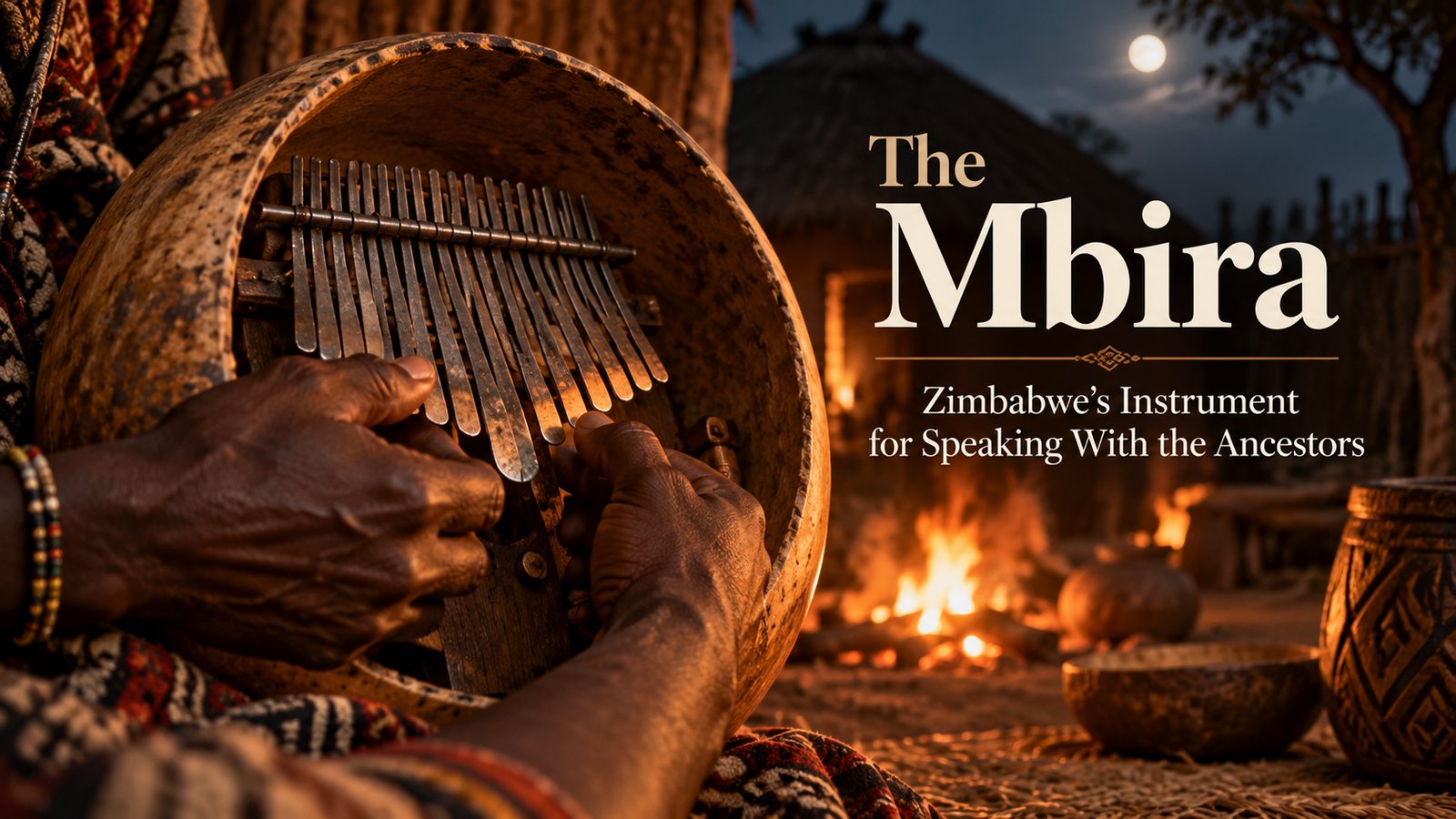
It looks almost too simple to be a serious instrument: a flat wooden board about the size of a paperback book, with a row of narrow metal keys fixed across it. But place it inside a large gourd, pluck the keys with your thumbs, and a shimmering, circling music fills the air — a sound that, for the Shona people of Zimbabwe, can open a door to the ancestors.
What the mbira is
The mbira belongs to a family of instruments found across Africa and often called "thumb pianos" or lamellophones (from the Latin for "little plates"). Similar instruments exist under many names: sansi in Malawi, kalimba and likembe in other regions. The Zimbabwean version with the deepest ceremonial role is the mbira dzavadzimu — "mbira of the ancestors."
A typical mbira dzavadzimu has:
- 22 or more metal keys, traditionally forged by hand, arranged in two or three rows and tuned to a scale.
- A hardwood soundboard (gwariva) that the keys are clamped to with a metal bar.
- A gourd resonator (deze), a large calabash cut in half, which amplifies the sound.
- Buzzers — shells, bottle caps or beads attached to the board or the gourd, which add a buzzing hum that players consider an essential part of the sound.
Players use both thumbs and the right index finger, picking out interlocking patterns. Two mbira played together, one leading (kushaura) and one following (kutsinhira), weave a dense, hypnotic texture, often accompanied by hosho gourd rattles and singing.
Music for the spirits
For the Shona, the mbira is above all a ceremonial instrument. It is central to the bira, an all-night ceremony in which a family gathers to call on the spirits of its ancestors. The music plays for hours; people sing, clap and dance; and a spirit medium may enter a trance through which an ancestor speaks, offering advice or help with a problem such as illness or a bad harvest.
Mbira also plays at funerals, memorials, rain-making ceremonies and at the installation of chiefs. Specific pieces have names and histories, and some are believed to be centuries old. UNESCO, which added the mbira of Zimbabwe and the sansi of Malawi to its list of the world's intangible cultural heritage in December 2020, notes that the instrument carries songs about good conduct and past events — history in music.
A long history
Metal-keyed mbira have been made in the region for a very long time; archaeologists have found evidence of them from well over a thousand years ago. The instrument's heartland is the same region that produced Great Zimbabwe, the stone capital of a medieval Shona state, and the two are often linked in the Zimbabwean imagination as symbols of a deep, continuous culture.
During the colonial era, missionaries and officials often discouraged mbira music because of its links to traditional religion. The music survived in villages and at ceremonies — and in the 1960s and 1970s it came roaring back.
Mbira and the struggle for independence
During Zimbabwe's war of liberation in the 1970s, musicians such as Thomas Mapfumo transferred mbira patterns to the electric guitar, creating chimurenga ("struggle") music, whose lyrics encouraged resistance to white-minority rule. The mbira became a symbol of national identity. After independence in 1980, musicians including Stella Chiweshe — one of the first women to play an instrument traditionally reserved for men — and Dumisani Maraire, who taught mbira in the United States, brought it to audiences around the world.
Learning and making
Mbira knowledge is traditionally passed on by apprenticeship, often within families, and makers who forge the keys and tune them by ear are highly respected. Today, formal lessons, workshops and recordings supplement the old ways, and mbira are built and played in Europe, America and Japan as well as across southern Africa.
Why it matters
The mbira shows how an instrument can be far more than a way of making sound. It is a memory, a prayer and a conversation with the past. Sit through a bira as dawn breaks and the music is still circling, and you understand why the Shona say that the mbira is not played for people — it is played for the spirits, and the people are welcome to listen.
Further reading
- UNESCO — Mbira/Sansi inscribed on the Representative List of the Intangible Cultural Heritage of Humanity (2020)
- Australian Museum — Mbira, thumb piano of Africa
- Paul F. Berliner, The Soul of Mbira: Music and Traditions of the Shona People of Zimbabwe (University of California Press, 1978)