The Kora and the Griots: West Africa's Living Libraries
With 21 strings and a body made from a giant calabash, the kora carries centuries of West African history, sung by hereditary musicians called jeli or griots.
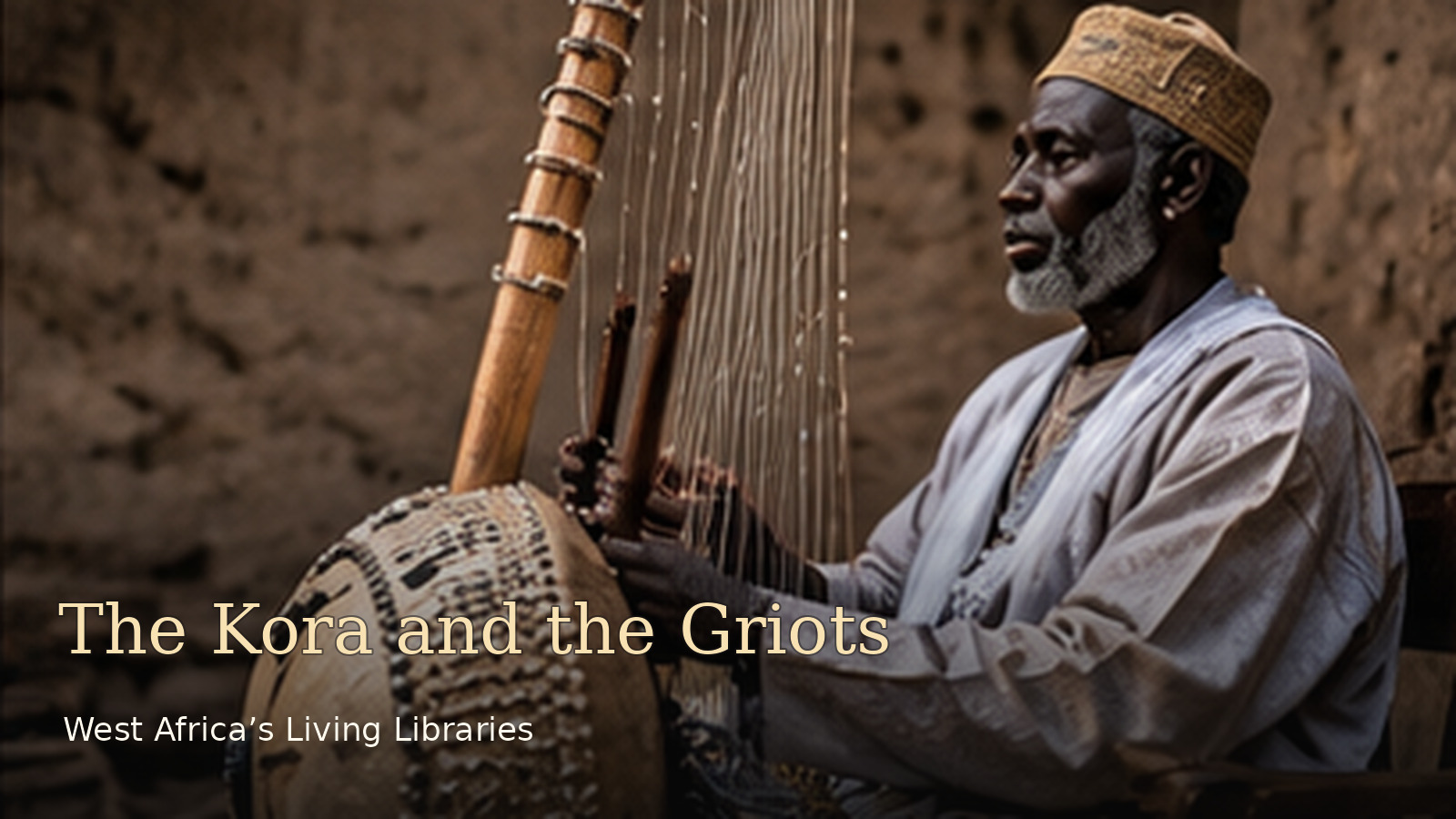
The sound of the kora is hard to forget: a cascade of bright, rippling notes, like a harp and a guitar playing at once, with bass lines and melodies weaving together under the singer's voice. For centuries, this instrument has been the voice of the jeli — the hereditary musicians, historians and praise-singers of West Africa, often known in English and French as griots.
Who are the jeli?
Among the Mande peoples — including the Mandinka, Maninka and Bamana of Mali, Guinea, Senegal, the Gambia and Guinea-Bissau — society traditionally included families of specialists. The jeli (plural jelilu; also jali) were born into their role. Their job was to remember.
Jeli families kept the genealogies of noble families, the history of kingdoms and the stories of great ancestors. They advised kings, negotiated between families, sang at weddings and naming ceremonies, and praised patrons — sometimes in return for gifts. In a world where history was carried mainly in memory, the jeli were living libraries.
The epic of Sunjata
The most famous story the jeli tell is the epic of Sunjata (or Sundiata) Keita, the founder of the Mali Empire in the 13th century — the empire under which Timbuktu later grew into a great centre of learning. It tells how a boy who could not walk grew into a hero, defeated the sorcerer-king Sumanguru (Soumaoro Kanté), and united the Mande peoples.
The epic has been performed for centuries, and it differs from teller to teller. One version, told by the Guinean jeli Mamadou Kouyaté, was written down by the historian Djibril Tamsir Niane and published in 1960 as Sundiata: An Epic of Old Mali, now read in schools around the world. In the story, Sunjata's own jeli, Balla Fasséké, is an ancestor of the Kouyaté family — one of the great jeli lineages still active today.
How the kora is made
The kora is a harp-lute with 21 strings. Its parts are simple and beautiful:
- The body is a large calabash (a dried gourd), cut in half and covered with cowhide, which acts as a soundboard.
- A long wooden neck passes through the calabash.
- The strings — traditionally strips of leather, now usually nylon fishing line — run from the neck over a tall bridge in two rows.
- Leather rings around the neck were traditionally used to tune the strings; many modern koras use wooden pegs or guitar-style machine heads.
The player holds the instrument facing them by two handles and plucks the strings with the thumbs and index fingers, playing bass, melody and accompaniment at the same time.
Where the kora came from
The kora's origins are debated. Researchers, including the ethnomusicologist Eric Charry, link its rise to the Kaabu kingdom of the Senegambian Mandinka, in what is now Guinea-Bissau, Senegal and the Gambia. Oral traditions tell their own stories: in some, the instrument was given to people by a jinn (a spirit), and one tradition places its origin at a sacred well and baobab tree in the Gambia.
Whatever its exact beginnings, the kora became the instrument of the jeli, and in many families only jeli traditionally had the right to play it, along with the balafon (a wooden xylophone) and the ngoni (a lute).
Masters of the kora
Kora music reached the wider world in the second half of the 20th century. Some names to know:
- Alhaji Bai Konte and Jali Nyama Suso of the Gambia, who recorded influential albums in the 1970s.
- Sidiki Diabaté of Mali, one of the great masters of his generation.
- Toumani Diabaté, Sidiki's son, whose solo albums and collaborations — from the Malian guitarist Ali Farka Touré to musicians in flamenco, blues and classical music — made him perhaps the most famous kora player in the world until his death in 2024.
- Ballaké Sissoko, another Malian virtuoso known for his collaborations.
- A new generation, including Sidiki Diabaté (Toumani's son, named after his grandfather), who mixes the kora with modern Malian pop.
Why it matters today
The jeli tradition is adapting. Many griots now sing on radio and television, at political rallies and on streaming platforms. Some young people from non-jeli families learn the kora, and players in Europe, America and Asia study with West African masters.
But the core idea remains: music as memory. When a jeli takes up the kora and begins to sing the names of ancestors, they are doing what their families have done for hundreds of years — making sure that no one, and no story, is forgotten.
Further reading
- Eric Charry, "Kora: in search of the origins of West Africa's famed stringed musical instrument," The Conversation (2023)
- Eric Charry, Mande Music: Traditional and Modern Music of the Maninka and Mandinka of Western Africa (University of Chicago Press, 2000)
- D.T. Niane, Sundiata: An Epic of Old Mali (1960)