The Djembe: West Africa's Goblet Drum and Its Mande Roots
Carved from one piece of wood and topped with goatskin, the djembe was born among the Mande peoples of West Africa. Today it may be the most played hand drum on Earth.
Play one stroke on a djembe and the whole room hears it. Strike the centre and a deep bass booms out. Hit near the edge with flat fingers and you get a warm, round tone. Snap the fingertips against the rim and a sharp slap cracks through the air. Three simple sounds, but in the hands of a master drummer, they can carry an entire village into dance.
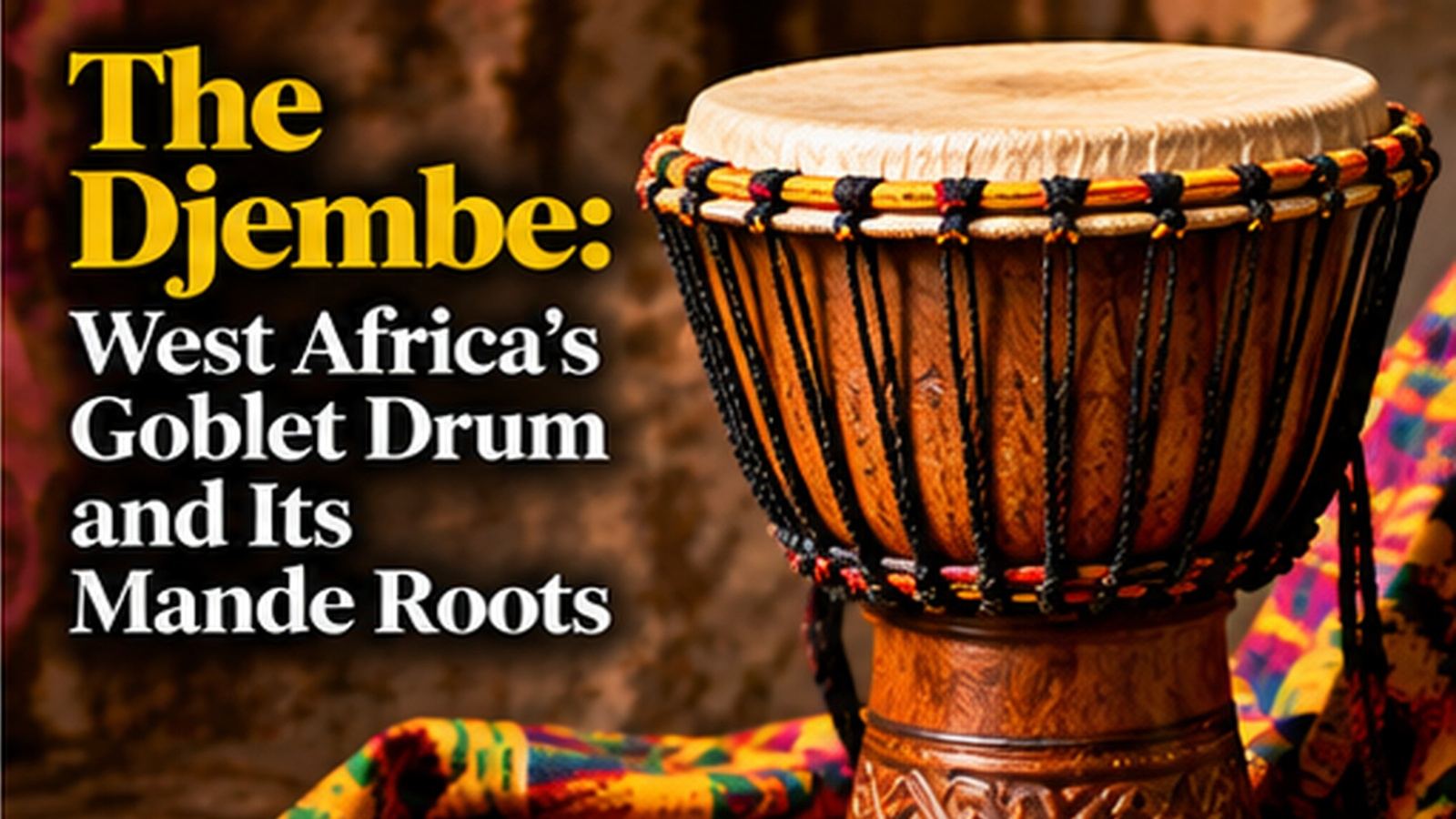
The djembe (also spelled jembe) is a goblet-shaped hand drum from West Africa. Over the past seventy years it has travelled from Mande villages to concert halls, drum circles and music schools across the world.
Where the djembe comes from
The djembe belongs to the Mande peoples, the family of cultures that includes the Malinke (Maninka), Bamana and others in present-day Guinea, Mali, Senegal, The Gambia, Côte d'Ivoire and Burkina Faso. These are the heirs of the great Mali Empire, the realm of rulers such as Mansa Musa.
According to the Metropolitan Museum of Art, the drum is closely tied to the numu, the blacksmith families of Mande society. Blacksmiths made the iron tools needed to carve the wood, and many famous drummers still carry blacksmith family names such as Camara, Doumbia and Kanté. Some scholars link the drum's spread along the Upper Niger to the movements of blacksmith groups many centuries ago, though its exact age is unknown.
A popular story explains the name with a Bamana saying, Anke djé, anke bé, meaning "everyone gather together". Whether or not that is the true origin, it describes the drum's job well.
How a djembe is made
A traditional djembe is carved from a single log of hardwood. In Guinea the favourite wood is lenke; other woods such as dugura and African mahogany are also used. Carvers hollow out the trunk into a goblet shape: a wide bowl on top, a narrow waist and an open base.
A goatskin is soaked, stretched over the bowl and held by iron rings. Rope is then laced up and down the body in a zigzag pattern and pulled tight to tune the skin. Players often add sesse or segesege, thin metal plates with rings that buzz when the drum is played.
In many communities, carving a drum is not just a technical job. Before cutting a tree, carvers may make offerings, such as kola nuts, to respect the spirit of the wood, much as the kola nut opens other important moments in West African life.
Three tones and the dunun
Djembe players, called djembefola, build their music from three main strokes:
- Bass: the flat palm near the centre, giving a deep, round sound;
- Tone: the fingers near the edge, producing a clear, open note;
- Slap: the fingertips snapping against the edge, sharp and bright.
The djembe rarely plays alone. It is accompanied by the dunun (or dundun), a set of cylinder-shaped bass drums played with sticks, often with a bell mounted on top. In a typical ensemble, supporting djembes play steady repeating patterns while the lead drummer improvises over them, talking to the dancers and pushing the energy higher.
The relationship is a little like that between the lead and supporting drums in Ghana's talking drum tradition, or the call and response of kora and voice.
Music for life's big moments
In Mande villages, djembe music accompanies weddings, naming ceremonies, harvests, the coming of age of young people and celebrations of all kinds. Each rhythm has its own name and purpose: some are for women's dances, some for blacksmiths, some for masquerades or the full moon. Dancers and drummers respond to each other, so a good drummer watches the dance floor as closely as their own hands.
From the village to the world
The djembe's global journey began in the 1950s. The Guinean poet and director Fodéba Keïta founded Les Ballets Africains, a dance and music company that toured the world with spectacular shows. After Guinea's independence in 1958, it became the country's national ensemble, and its drummers amazed audiences in Europe, America and Asia.
Later, master drummers such as Mamady Keïta and Famoudou Konaté taught thousands of students abroad and opened schools in Europe and the United States. Today djembes are played in drum circles, primary schools, music therapy sessions and pop recordings, and they are carved for export in Ghana, Senegal and far beyond.
The drum's popularity has also brought debate. Mande musicians point out that many djembes made for tourists are lower quality, and that the drum's rhythms carry meanings that deserve to be learned properly, not just copied. The Met's notes on the jembe show how much tradition sits behind the instrument.
How to start playing
- Sit with the drum tilted slightly away from you, so the base can breathe.
- Practise the three strokes slowly, keeping your hands relaxed.
- Learn a simple accompaniment pattern before trying to solo.
- If you can, learn from a teacher who knows the Mande rhythms and their stories.
Why it matters
The djembe shows how a village instrument can become a global voice. It carries the craft of Mande blacksmiths and carvers, the rhythms of countless celebrations and the energy of artists who took it onto world stages.
Every time someone sits down to play, they join a conversation that started centuries ago in West Africa, in the same family of traditions as balafon music and the songs of Wassoulou.
Further reading
- The Metropolitan Museum of Art — Jembe
- Drum Connection — History of the Djembe
- Eric Charry, Mande Music: Traditional and Modern Music of the Maninka and Mandinka of Western Africa (University of Chicago Press, 2000)
- Uschi Billmeier, Mamady Keïta: A Life for the Djembé (Arun-Verlag, 1999)