Carthage: The African City That Challenged Rome
Founded by Phoenician settlers on the coast of Tunisia, Carthage became a Mediterranean superpower, fought three wars with Rome and produced Hannibal. Here is its story.
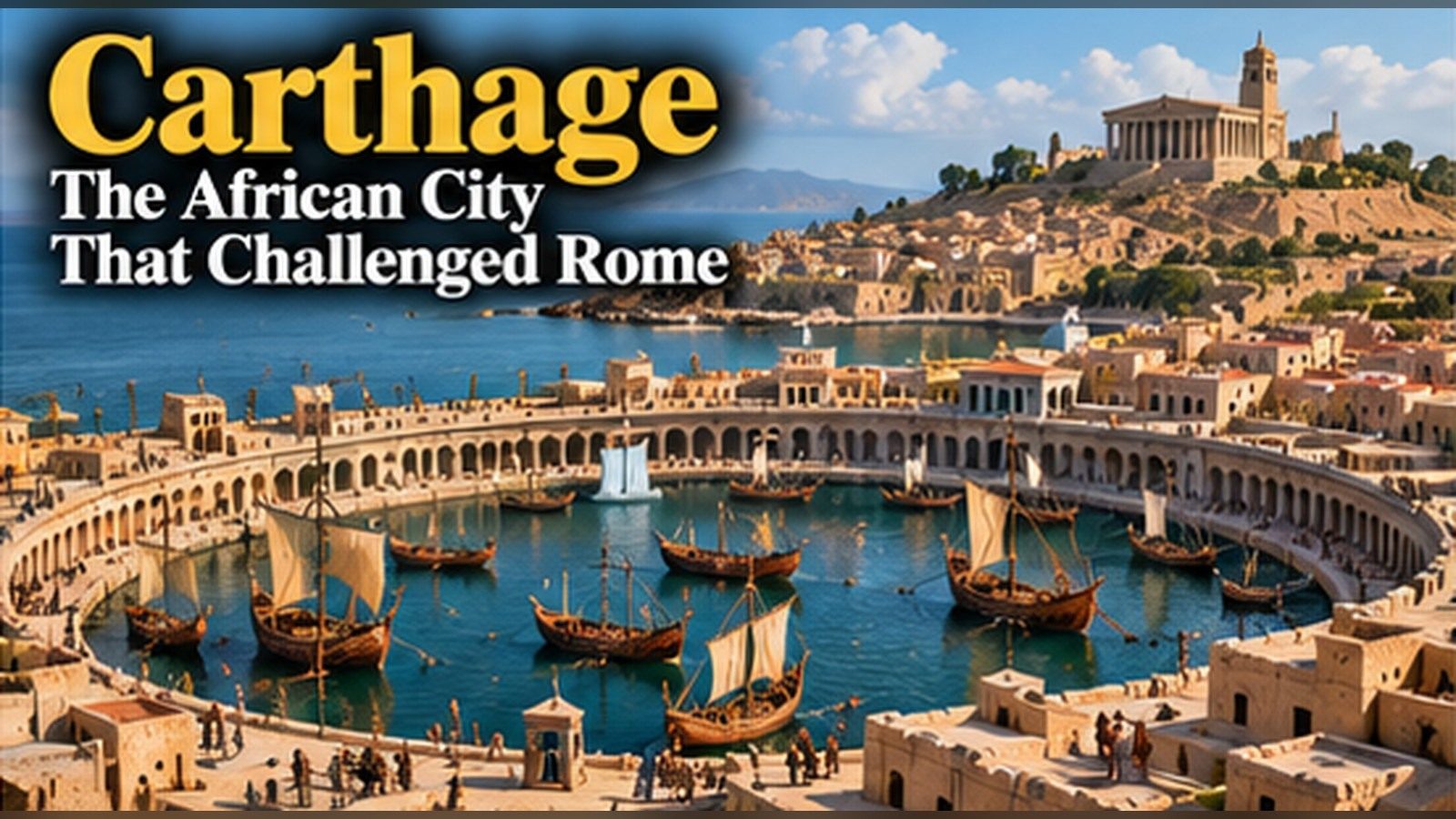
On a hill overlooking the Gulf of Tunis, among the villas of a modern suburb, stand the ruins of one of the ancient world's great cities. Broken columns, the foundations of houses, a vast Roman bath complex by the sea, and two strange, circular harbours that once sheltered a mighty navy. This is Carthage — an African city that, for centuries, rivalled Rome for control of the Mediterranean.
A Phoenician colony
According to tradition, Carthage was founded around 814 BCE by settlers from Tyre, a great city of the Phoenicians on the coast of present-day Lebanon. Its name, Qart-hadasht, means "New City."
A famous legend tells that a Tyrian princess named Elissa (known to the Romans as Dido) fled her homeland and arrived in North Africa. A local ruler offered her as much land as she could cover with an ox-hide. She cut the hide into thin strips and used them to encircle a whole hill — the Byrsa — where she founded her city. The story is legend, but archaeology confirms Phoenician settlement there by the 8th century BCE.
A Mediterranean superpower
Carthage grew into the centre of a vast trading empire, with colonies and trading posts across North Africa, Sicily, Sardinia, southern Spain and beyond. Its merchants traded metals, textiles, purple dye, pottery, grain and luxury goods. Its sailors explored far beyond the Mediterranean; one Carthaginian, Hanno, is said to have led a voyage down the Atlantic coast of West Africa.
Carthaginian society blended Phoenician roots with strong North African influences, including the Amazigh (Libyan and Numidian) peoples of the region. Its people spoke Punic, a form of Phoenician, and worshipped gods such as Baal Hammon and Tanit.
The city's twin harbours — a rectangular commercial port and a circular military harbour with sheds for warships around its edge — were among the engineering marvels of the ancient world.
The Punic Wars
As Rome expanded, conflict with Carthage became inevitable. They fought three Punic Wars between 264 and 146 BCE.
- The First Punic War (264–241 BCE) was fought mainly over Sicily, and Rome won by building a navy to match Carthage's.
- The Second Punic War (218–201 BCE) brought Carthage's greatest general, Hannibal Barca. In 218 BCE, he led an army — including famous war elephants — from Spain over the Alps into Italy, and won a series of stunning victories, above all at Cannae in 216 BCE. But he could not take Rome itself, and was eventually recalled to Africa and defeated at Zama in 202 BCE.
- The Third Punic War (149–146 BCE) ended in disaster for Carthage. Roman politicians, led by Cato the Elder — who reportedly ended his speeches with "Carthage must be destroyed" — pushed for war. In 146 BCE, after a long siege, Roman forces captured and destroyed the city.
Roman Carthage
Carthage did not stay dead. About a century later, the Romans rebuilt it as Roman Carthage, and it became the capital of the province of Africa and one of the largest cities in the Roman Empire. The great Antonine Baths, built in the 2nd century CE, are among its most impressive ruins. Carthage became an important centre of early Christianity; St Augustine, born in what is now Algeria, studied and taught there. Later, the city was captured by the Vandals in 439 CE, and in 698 CE by Arab forces, after which the new city of Tunis grew nearby.
Carthage today
UNESCO listed the Archaeological Site of Carthage as a World Heritage Site in 1979. Visitors can see the Byrsa hill, the Punic harbours, Roman villas, theatres and baths, and the Carthage National Museum. The site is surrounded by modern suburbs, which has created challenges for its protection.
North Africa's ancient story is not only Phoenician and Roman; it is also deeply Amazigh, as celebrated each year at the new year of Yennayer.
Why it matters
Carthage reminds us that the ancient Mediterranean was not only a European story. One of its great powers was an African city, whose ships, traders and generals shaped the history of three continents. For more than a century, Rome feared Carthage — and the name of Hannibal is still remembered as one of history's greatest military minds.
Further reading
- UNESCO World Heritage Centre — Archaeological Site of Carthage
- Richard Miles, Carthage Must Be Destroyed: The Rise and Fall of an Ancient Civilization (Allen Lane, 2010)
- Serge Lancel, Carthage: A History (Blackwell, 1995)