Thieboudienne: The Fish and Rice Dish at the Heart of Senegal
Stuffed fish, vegetables, tomato-red rice and a crispy crust everyone fights over. Thieboudienne is Senegal's national dish, recognized by UNESCO, and every family thinks theirs is the best.
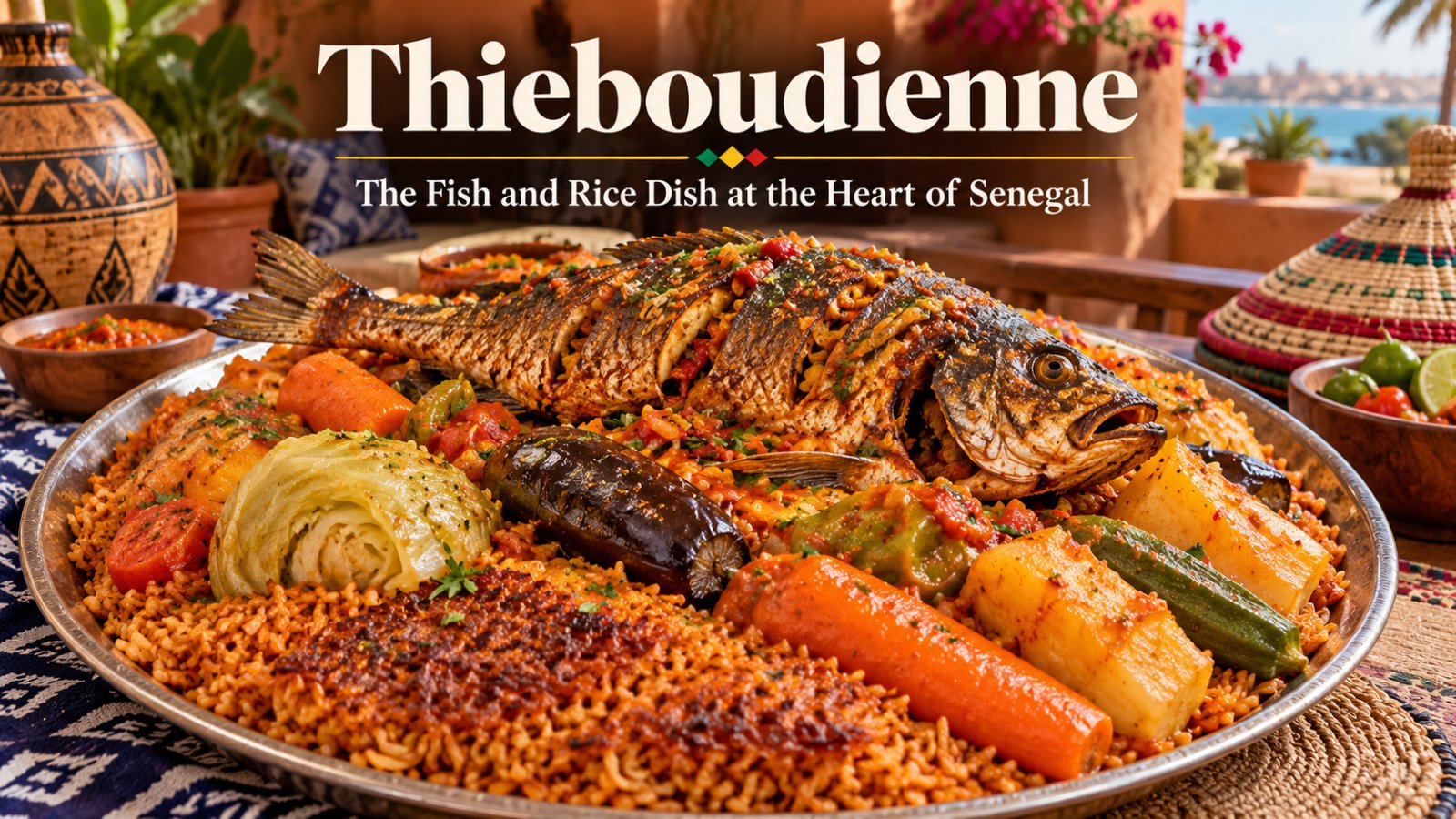
Around one o'clock in Dakar, the city slows down. In offices, shops and family courtyards, people gather around a single wide bowl set on a mat or a low table. In the middle of the bowl is a pile of reddish rice, glistening with oil. On top sit a whole stuffed fish, chunks of cassava, carrot, cabbage, aubergine and pumpkin, and a few small balls of dark, pungent seasoning. Before anyone eats, somebody breaks the fish and pushes the best pieces towards the guests.
This is thieboudienne, Senegal's national dish. In Wolof it is written ceebu jën, which simply means "rice of fish".
What goes into the bowl
No two families make it exactly the same, but the basic idea is always the same: fish and vegetables are cooked in a rich tomato sauce, then taken out, and the rice is cooked in the flavoured broth that is left behind.
The main ingredients usually include:
- Fresh fish. The classic choice is thiof, a large white grouper, but cooks also use sea bream, captain fish or whatever the morning catch brings.
- Broken rice. Not long-grain or basmati, but rice broken into small pieces, which soaks up the sauce beautifully.
- Vegetables. Cassava, carrots, cabbage, aubergine, pumpkin, okra, sweet potato and turnip, depending on the season.
- The rof. A green paste of parsley, garlic, spring onion, chilli and pepper, pushed into slits cut in the fish so the flavour goes right through.
- Fermented flavours. A little guedj (dried, fermented fish), yeet (fermented sea snail) and netetu (fermented locust beans) give the dish its deep, savoury taste. Visitors sometimes find the smell strong at first. Most end up loving it.
Some cooks add tamarind or a squeeze of lime at the end, and a fiery chilli sauce is usually served on the side.
The prize at the bottom of the pot
Ask any Senegalese person about thieboudienne and they will soon mention the xoon (often spelled khogne): the golden crust of rice that forms at the bottom of the pot. It is crispy, slightly smoky and full of concentrated flavour. In many homes, it is scraped out and shared as a treat, and children compete for it. Cooks judge their own skill partly by how good the crust turns out.
Red and white
The best-known version is red thieboudienne, coloured with tomato paste. There is also white thieboudienne (ceebu jën bu weex), made without tomato, where the flavour comes from the fish, vegetables and fermented seasonings alone. Many older Senegalese say the white version is the original. In Saint-Louis and along the coast, you will also find versions made with dried fish, or with meat instead of fish on days when fish is expensive.
Where it came from
Thieboudienne is linked above all with Saint-Louis, the old colonial capital on an island at the mouth of the Senegal River. UNESCO notes that the dish grew up in the fishing communities there. Local tradition gives the credit to a cook named Penda Mbaye, who is said to have created the recipe in the late nineteenth or early twentieth century. Her story is told with pride in Saint-Louis, although, like many food legends, it is hard to prove.
The broken rice has a less romantic history. Under French rule, Senegal's farmers were pushed to grow groundnuts for export, and cheap broken rice was shipped in from French Indochina to feed the people. Broken rice was a by-product the French did not want; Senegalese cooks turned it into a national treasure. Today Senegal still imports a large share of its rice, and the government has long tried to grow more at home, especially in the Senegal River valley.
Rules of the bowl
Thieboudienne is not just food. It is a way of eating together, and it comes with manners every child learns:
- Everyone eats from the same bowl, each person from the section directly in front of them.
- Many families eat with the right hand, rolling the rice into a small ball.
- You do not reach across into someone else's part of the bowl.
- The host or eldest person shares out the fish and best vegetables, often giving the finest pieces to guests.
- You stop eating when you are full, and you thank the cook.
These habits are part of teranga, the Senegalese idea of generous hospitality. A visitor who arrives at lunchtime is almost always invited to join the bowl.
UNESCO and a fishing crisis
UNESCO recognised ceebu jën in 2021, making it part of humanity's shared intangible heritage. The decision honours the whole culinary art: the recipe, the techniques that mothers pass to daughters, and the customs of sharing.
The recognition came at a difficult time. The thiof that gives the classic dish its flavour has become scarcer and more expensive, as Senegal's waters face heavy pressure from large industrial fishing fleets. Many families now make thieboudienne with cheaper fish, and the question of who gets to fish West Africa's coast has become an important political issue.
Why it matters
Thieboudienne holds a great deal of Senegal's story in one bowl: the fishing towns of the coast, the hard history of colonial trade, the skill of generations of women cooks, and the deep habit of sharing. If you want to understand Senegal, a good place to start is sitting on a mat at lunchtime, right hand ready, waiting for someone to pass you a piece of fish.
You might also enjoy our story on jollof rice, West Africa's other great rice dish, which some historians believe has roots in the old Wolof kingdom of Jolof.
Further reading
- UNESCO Intangible Cultural Heritage — Ceebu jën, a culinary art of Senegal (inscribed 2021)
- Quartz Africa — Senegal's thieboudienne listed as UNESCO cultural heritage (2021)
- Pierre Thiam, Yolele! Recipes from the Heart of Senegal (Lake Isle Press, 2008)