Teranga: Why Senegal Calls Itself the Land of Hospitality
In Senegal, a stranger is fed before being questioned. The Wolof word teranga describes a whole way of treating people — and even names the national football team.
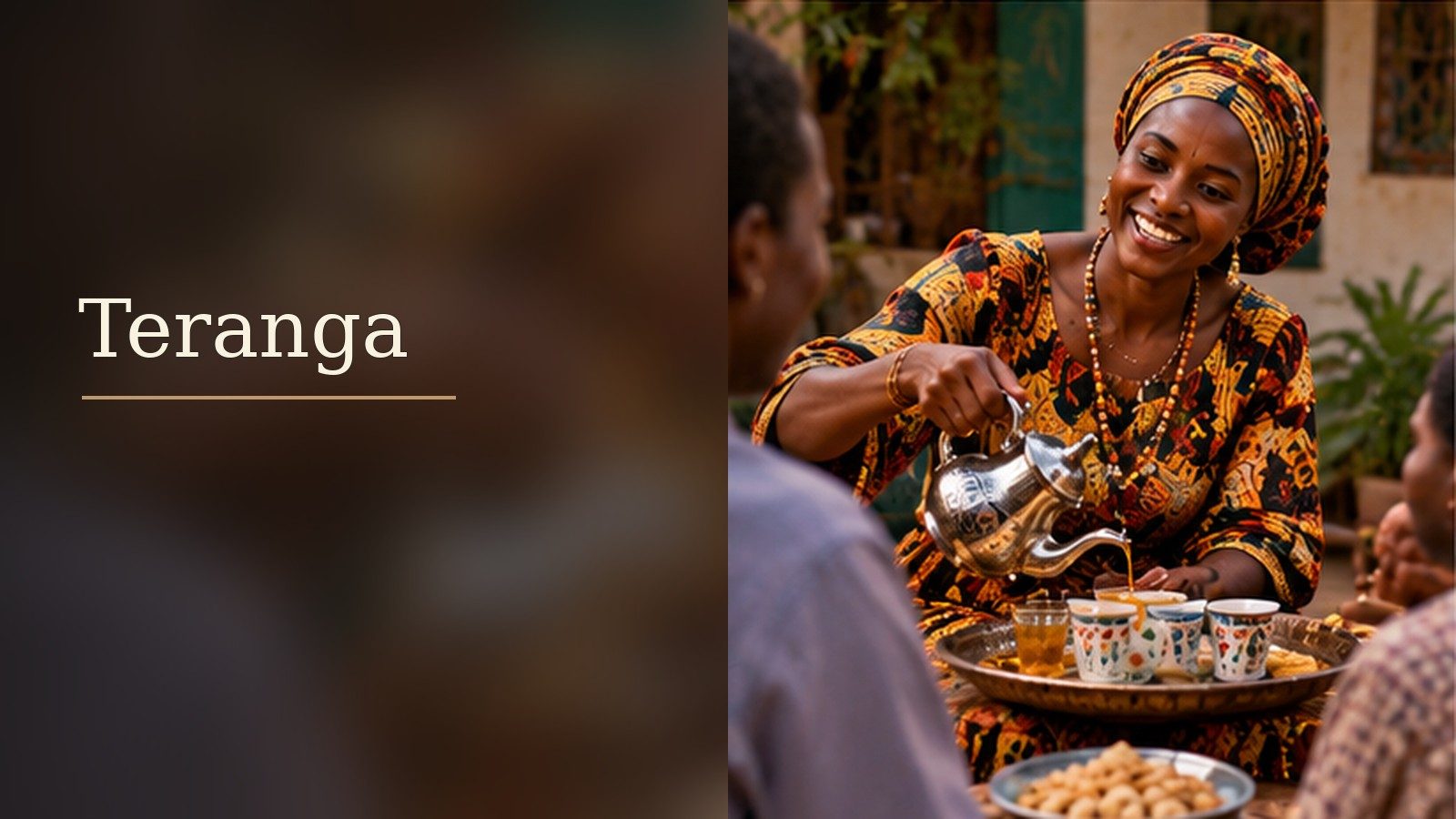
Arrive at a Senegalese home at lunchtime — any home, announced or not — and the same thing will happen. A place will be made for you around the large shared bowl. Someone will push the best pieces of fish or meat towards your side. Only later, once you have eaten, will anyone ask what brought you there. This is teranga, and Senegal is proud enough of it to call itself le pays de la teranga — the land of hospitality.
A word that is hard to translate
Teranga is a Wolof word, from the language spoken by the largest ethnic group in Senegal and understood by most of the country. "Hospitality" is the usual translation, but Senegalese people will tell you it means more than that. It includes generosity, warmth, respect for the guest, and a readiness to share whatever one has, however little. It is both a value and a duty: a host who fails to show teranga has failed as a person.
The idea runs through daily life:
- The shared bowl. Meals are typically eaten from one large platter, with family and guests sitting around it on the floor or at a low table. The host arranges the food so that everyone, especially visitors, gets the choicest pieces. Senegal's national dish, ceebu jën — the ancestor of jollof rice — is made for exactly this kind of sharing.
- Tea. The ritual of ataya, strong green tea with mint and sugar brewed in three rounds, each sweeter than the last, is an invitation to sit, talk and stay. Refusing it is hard.
- Greetings. A conversation in Senegal cannot begin without a proper exchange of greetings — asking after each other's family, health and peace. To skip them is to deny someone their dignity.
- Room for the stranger. Travellers, students and migrants have long found beds and meals in Senegalese homes, often with people they barely knew.
Where it comes from
Teranga has deep roots in the cultures of the Senegambia region — among the Wolof, Serer, Fula, Mandinka, Diola and others — where hospitality to travellers was both a moral rule and a practical necessity in a land of long distances. Islam, the religion of most Senegalese, reinforced it: the Qur'an and the sayings of the Prophet place strong emphasis on generosity to guests and the poor. Senegal's influential Sufi brotherhoods, such as the Mourides and the Tijaniyya, built communities around sharing and service.
The country's political history matters too. Senegal is often described as one of West Africa's most stable democracies, with a tradition of religious tolerance between its Muslim majority and Christian minority. Many Senegalese link that stability to teranga: a culture of making room for others.
The Lions of Teranga
Teranga is so central to Senegal's self-image that it names the national football team, the Lions de la Teranga. When the Lions won the Africa Cup of Nations for the first time in 2022, celebrations across Dakar were, naturally, accompanied by shared meals and glasses of ataya. The team's nickname is a small example of a big idea: that a nation's strength lies in its welcome.
Teranga abroad
Senegalese communities in Paris, New York, Milan and elsewhere have carried teranga with them. Visitors who have stayed with Senegalese families often describe it as the thing they remember most — not a monument or a beach, but the feeling of being treated as a relative by people who had no obligation to do so. Peace Corps volunteers and travellers have written about recognising teranga in Senegalese neighbourhoods far from Dakar.
A value under pressure?
Like hospitality everywhere, teranga faces modern strains: urban life, economic hardship and the pace of cities like Dakar can make the open door harder to keep. Some Senegalese worry it is weakening. Others point out that the shared bowl is still at the centre of the table, and that a visitor still cannot leave hungry.
Why it matters
Teranga is a philosophy expressed not in books but in meals, greetings and open doors. It says that the measure of a person — and a country — is how they treat those who arrive with nothing. Senegal chose it as a name for itself, and anyone who has sat around a Senegalese bowl understands why.
Further reading
- Olympics.com — Why is Senegal called "the land of Teranga"?
- Peace Corps — Finding teranga from Senegal to the streets of Paris
- Leonardo Villalón, Islamic Society and State Power in Senegal (Cambridge University Press, 1995)