Mwaka Kogwa: Zanzibar's New Year of Mock Fights and Burning Huts
Each July in the village of Makunduchi, Zanzibaris welcome a "Shirazi" new year by settling the past year's grudges with banana stems and burning a thatched hut.
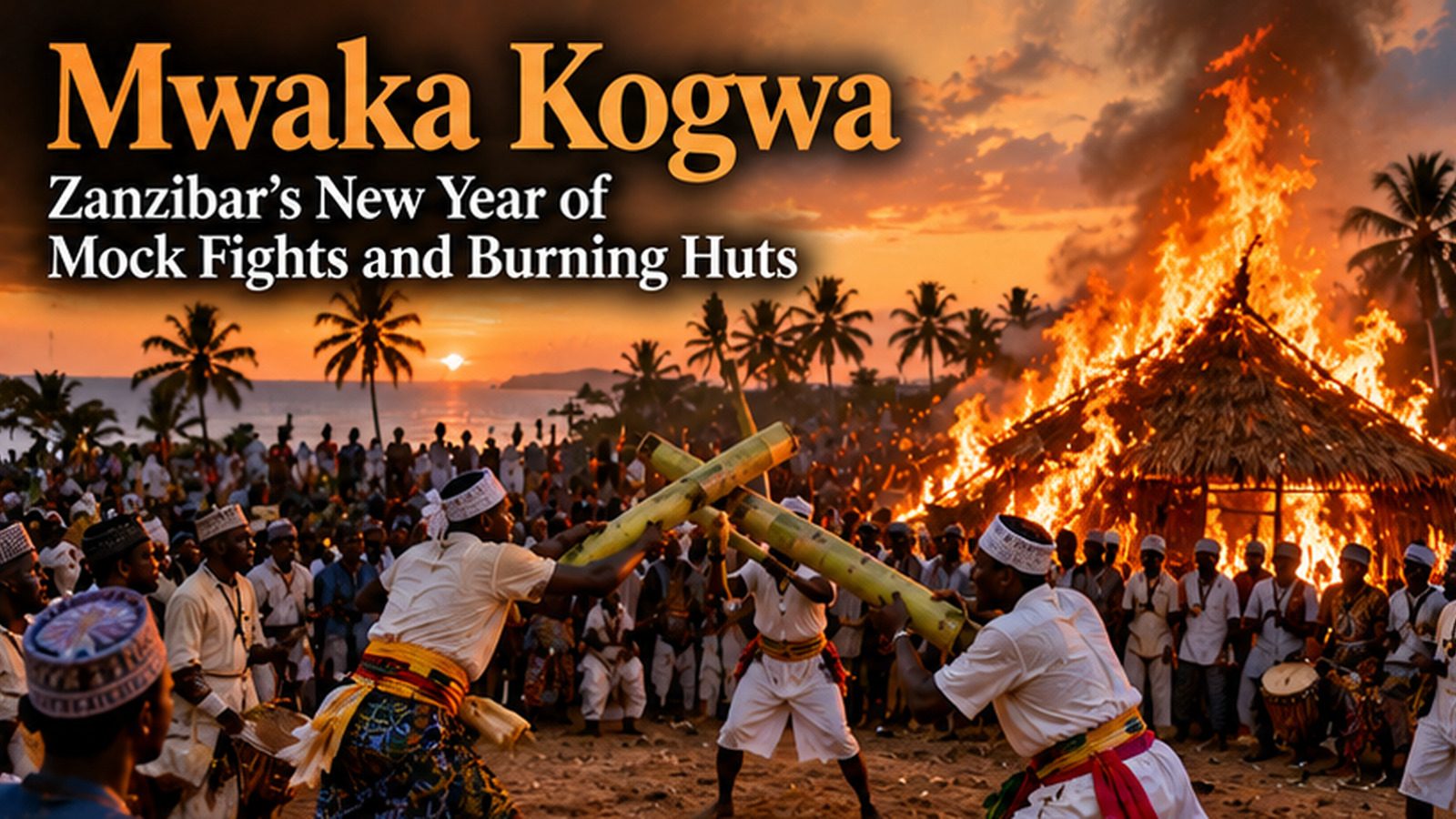
Each July, in a village at the southern end of Zanzibar, crowds gather for one of the most unusual new year celebrations in Africa. Men line up and whack each other with banana stalks. Women in their finest clothes sing songs that tease, praise and advise. A small thatched hut is set on fire, and everyone watches where the smoke blows. Then the whole village feasts. This is Mwaka Kogwa, the traditional new year of the island's south.
A "Shirazi" new year
Mwaka Kogwa is Kiswahili, roughly "the year is bathed" or "washing the year." The festival marks the start of a new year according to an old solar calendar used on the Swahili coast, sometimes called the Nairuzi or Shirazi calendar. It is linked in local tradition to Persian settlers — the Shirazi — whom many coastal Swahili families count among their ancestors, and to the Persian new year, Nowruz. Because it follows a different calendar from the Islamic and Gregorian years, Mwaka Kogwa usually falls in late July.
The festival is most famous in Makunduchi, a village in southern Unguja, Zanzibar's main island, though it is celebrated elsewhere too.
Settling the score
The best-known part of Mwaka Kogwa is the mock fight. Men from different parts of the village face each other, armed with banana stems, and beat each other — loudly, but mostly harmlessly. The idea is that the year's arguments and resentments are released, so the community can start the new year in peace. Once the fighting is over, the grudges are supposed to be forgotten.
In earlier times, the fights could be more serious. Today, they are energetic but playful, and the crowd cheers and laughs as much as it winces.
Songs of the women
While the men fight, women sing and dance, dressed in colourful kangas and their best clothes. Their songs are part of the ritual: they comment on village life, on love and marriage, on events of the past year, and on hopes for the new one. The songs can be teasing and witty, and everyone listens closely.
Burning the hut
A traditional healer or elder builds a small hut of palm thatch. It is set on fire, and people watch closely: which way the smoke drifts is taken as a sign of what the coming year holds — signalling a good harvest, prosperity or trouble ahead. In some accounts, a person goes inside before the hut is lit and escapes as it burns, symbolising survival and renewal; the details vary from telling to telling.
Feasting and visiting
The festival ends with a feast. Families cook large meals, and in Makunduchi it is said that no one should go hungry — anyone, including strangers and visitors, is welcome to eat at any house. People dance, play music late into the night, and visit friends and relatives.
A window into Swahili history
Mwaka Kogwa is a reminder of how many layers make up Swahili culture: African traditions, Islamic faith, Persian and Arab connections, and a seafaring life tied to the Indian Ocean. The coast's old trading towns — including medieval Kilwa Kisiwani, whose early rulers also claimed "Shirazi" origins — share that layered history.
Why it matters
Many cultures mark the new year with resolutions. The people of Makunduchi do something bolder: they air their grievances openly, beat them out with banana stems, burn the old year in a bonfire, and then sit down together to eat. It is a joyful, slightly wild reminder that a community needs ways to let go of the past before it can start again.
Further reading
- Pongwe — Mwaka Kogwa Festival, Zanzibar
- TalkAfricana — Mwaka Kogwa, the Tanzanian festival where men fight to settle grudges
- Abdul Sheriff, Slaves, Spices and Ivory in Zanzibar (James Currey, 1987)