Kwanzaa: Seven Days, Seven Principles
From today until 1 January, millions of people of African descent light the candles of the kinara and reflect on the Nguzo Saba, seven principles drawn from African values. Here is the story of Kwanzaa.
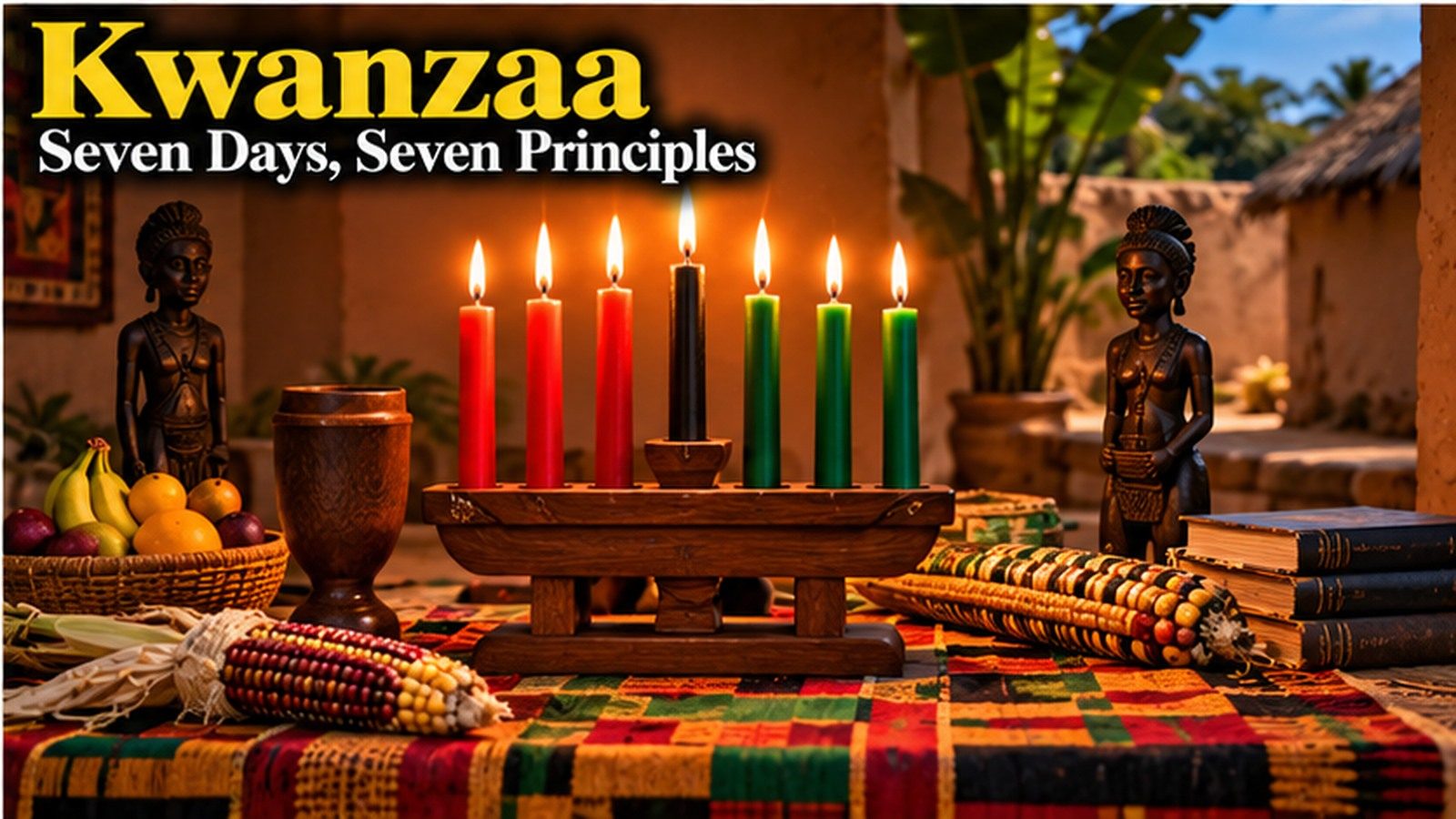
Today, in homes across the United States, the Caribbean and other parts of the African diaspora, families will gather around a table decorated with a woven mat, fruits and vegetables, ears of corn and a candle holder with seven candles: one black, three red and three green. A child will light the black candle in the centre and say a single word: "Umoja" — unity. This is the first day of Kwanzaa, a week-long celebration of African heritage, family and community, held from 26 December to 1 January.
A holiday born in 1966
Kwanzaa was created in 1966 by Maulana Karenga, an African American professor and activist, in the aftermath of the Watts uprising in Los Angeles and during the rise of the Black Power movement. Karenga wanted to give African Americans a holiday that would celebrate their African roots, strengthen family and community bonds, and promote values of unity and self-determination.
Kwanzaa is a cultural, not a religious, holiday. People of any faith can celebrate it, and many celebrate it alongside Christmas or other holidays.
Why Kiswahili?
The name Kwanzaa comes from the Kiswahili phrase matunda ya kwanza, meaning "first fruits". Karenga added an extra "a" to the word kwanza ("first"). He chose Kiswahili because it is a pan-African language, spoken across East Africa and not tied to a single ethnic group, and because it symbolised the unity of African peoples. We described the language in our story on Kiswahili.
Kwanzaa was inspired by first-fruits and harvest festivals found in many African cultures, such as the yam festivals of West Africa, the umkhosi festivals of the Zulu, and others, though it is a new creation rather than a copy of any particular African festival.
The seven principles: Nguzo Saba
At the heart of Kwanzaa are the Nguzo Saba, the seven principles, one for each day:
- Umoja (Unity) — to strive for unity in the family, community, nation and race.
- Kujichagulia (Self-determination) — to define, name, create and speak for ourselves.
- Ujima (Collective work and responsibility) — to build and maintain the community together.
- Ujamaa (Cooperative economics) — to build and support businesses and share in their benefits. The word recalls the African socialism of Tanzania's Julius Nyerere, which we explored in our story on Ujamaa.
- Nia (Purpose) — to work for the development of the community.
- Kuumba (Creativity) — to do as much as possible to leave the community more beautiful and beneficial than we inherited it.
- Imani (Faith) — to believe in our people, our parents, our teachers, our leaders and the righteousness of our struggle.
The symbols
Kwanzaa has seven main symbols, with Kiswahili names:
- Mkeka: a woven mat, symbolising tradition and history, on which the other symbols are placed.
- Kinara: the candle holder, representing ancestors.
- Mishumaa saba: the seven candles: one black (for the people), three red (for the struggle) and three green (for the land and the future), the colours of the Pan-African flag.
- Mazao: crops, fruits and vegetables, symbolising harvest and the rewards of collective work.
- Muhindi: ears of corn, one for each child in the family, representing children and the future.
- Kikombe cha umoja: the unity cup, used to pour libations in honour of the ancestors.
- Zawadi: gifts, often handmade or educational, given mainly to children, to encourage growth and achievement.
How Kwanzaa is celebrated
Each evening, families gather to light one candle on the kinara, starting with the black candle in the centre, then alternating red and green. They discuss the principle of the day and how to apply it in their lives. Celebrations may include:
- Storytelling, poetry and reading about African and African American history.
- Music, drumming and dance.
- Libations poured for ancestors.
- Community events in schools, museums and cultural centres.
On 31 December, families and communities hold a karamu, a feast, with food from Africa, the Caribbean and the American South. On 1 January, the last day, there is a day of reflection.
Kwanzaa today
Kwanzaa grew rapidly in the 1970s and 1980s and became widely recognised in the United States. Millions of people celebrate it, though estimates vary. The US Postal Service has issued Kwanzaa stamps, and the holiday is marked in schools, museums and public events. It is also celebrated in Canada, the Caribbean, the UK and other countries with African diaspora communities.
Kwanzaa is less well known in Africa itself, where it is mainly an observance of the diaspora. But its use of Kiswahili and African symbols reflects a deep desire among people of African descent to reconnect with the continent.
Why it matters
Kwanzaa shows how a community can create a tradition to express its values and identity. Born in a time of struggle in 1960s America, it draws on African languages, symbols and harvest traditions to celebrate family, community and heritage. For one week each year, the seven principles invite millions of people to reflect on unity, purpose, creativity and faith, and on the connections between Africa and its diaspora.
Further reading
- Maulana Karenga, Kwanzaa: A Celebration of Family, Community and Culture (University of Sankore Press, 1998; commemorative ed. 2008)
- The Official Kwanzaa Website
- Keith A. Mayes, Kwanzaa: Black Power and the Making of the African-American Holiday Tradition (Routledge, 2009)
- Smithsonian National Museum of African American History and Culture — Kwanzaa