Mwana Pwo: The Chokwe Mask That Honours Women and Ancestors
Carved by men and danced by men, the Chokwe Mwana Pwo mask celebrates the beauty and wisdom of women. Discover its meaning, features and history.
Quick answer: Mwana Pwo ("young woman") is a carved wooden dance mask of the Chokwe people of Angola, the Democratic Republic of the Congo and Zambia. It honours female ancestors and the ideal of a beautiful, wise woman and mother. Although it represents a woman, it is carved and danced by men.
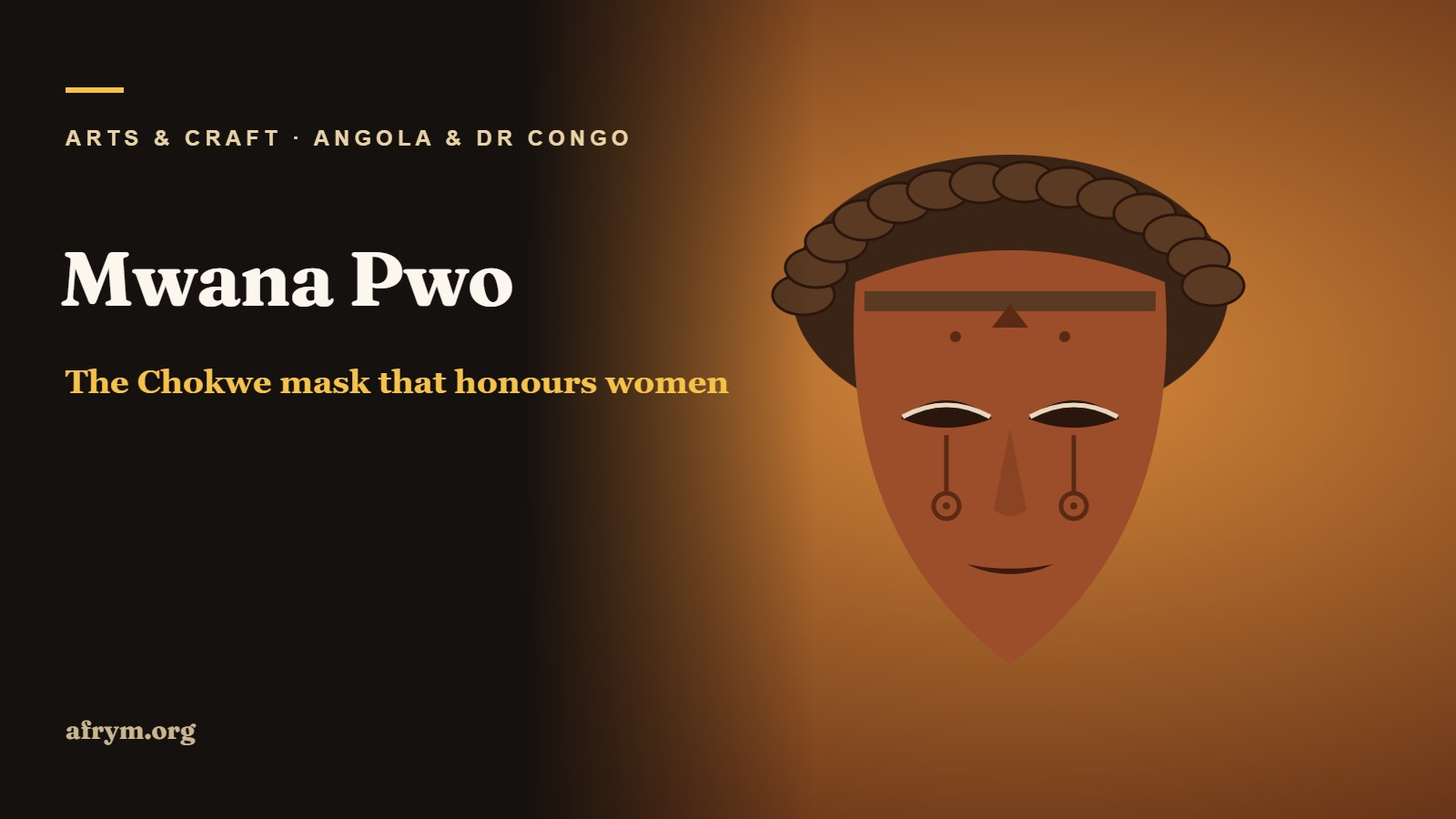
Look closely at a Mwana Pwo mask and it seems to be lost in thought. The eyes are almost closed. The lips are sealed. A fine line runs down from each eye like a tear, and small patterns mark the forehead and cheeks. Above it all sits a carefully braided hairstyle of plant fibre.
Museums around the world treasure these masks, and it is easy to see why. But a Mwana Pwo was never meant to sit silently behind glass. It was made to dance.
The Chokwe and their art
The Chokwe people live in north-eastern Angola, the southern Democratic Republic of the Congo and north-western Zambia. In the 19th century they spread across a wide area as hunters and traders, dealing in goods such as ivory, wax and rubber.
They are also among Central Africa's most admired sculptors. Chokwe carvers made decorated chairs for chiefs, staffs, figures of the hunter hero Chibinda Ilunga, and many kinds of masks. Their work stands beside the art of the Kingdom of Kongo and the woven raffia of the Kuba as one of the region's great traditions.
Chokwe society traces descent through the mother's line. Family identity and inheritance follow women, which helps explain why a mask devoted to female ancestors carries such weight.
The name and the idea
The mask was once called simply Pwo, meaning a woman who has given birth. Many people now prefer Mwana Pwo, "young woman". Either way, the mask stands for the women who came before: the honoured female ancestors, and above all the founding mother of a family line.
Neighbouring peoples, including the Lunda and communities in Zambia, have related masks with similar names, a sign of how art and ideas travelled across the region.
What the face tells you
Each feature has a purpose:
- Eyes half-closed and mouth shut: calm, modesty and inner wisdom.
- A tall, smooth forehead, often crossed by a headband.
- Tear lines below the eyes, sometimes ending in round marks on the cheeks.
- Scarification patterns, once admired as marks of beauty and belonging.
- Filed teeth, another historic beauty marker.
- A braided fibre coiffure, sometimes trimmed with beads or brass.
- A reddish finish from tukula, a powder ground from heartwood and mixed with palm oil.
Because carvers sometimes modelled a mask on a woman they admired, every Mwana Pwo is a little different. It is a portrait of an ideal, not a copy of one face.
When the mask dances
To perform, the dancer wears a full costume: a fitted body suit of knotted fibre, a skirt, carved wooden breasts, and often a rattle and a flywhisk. He moves slowly and gracefully, imitating the bearing of an elegant woman.
Mwana Pwo is one of the most popular Chokwe masks. It often appears at celebrations linked to boys' initiation, where it honours the mothers of the young initiates and entertains the village women. It is sometimes danced alongside a male mask character called Chihongo, and the pair are believed to bring fertility and good fortune.
The audience does not hold back. A clumsy dancer can be teased or chased off, while a gifted one may be invited from village to village.
Why a woman's mask is danced by a man
In Chokwe belief, as in many African masquerades, a mask is the visible form of an ancestral spirit. Men wear all masks, whatever the character. So the dancer is not simply acting out a woman. He gives a body to an honoured ancestor so she can visit the living.
Women are far from passive. They sing, respond and judge whether the dancer has done justice to the spirit he carries. A mask that praises women's beauty and motherhood is, in the end, performed for them.
The same belief in masks as visiting spirits links Mwana Pwo to traditions across Africa, from the Yoruba Egungun to the Bamana antelope headdress, Chiwara.
From village to museum
During the colonial period, many Chokwe masks were taken to Europe and North America by officials, traders and collectors. Today they are among the most recognisable pieces in museum collections. The Brooklyn Museum's Mwana Pwo mask is one well-known example.
Questions about who should own African art, like those around the Benin Bronzes, also apply to Chokwe objects. Meanwhile, carvers and dancers keep the tradition alive, and Mwana Pwo has become one of the best-known symbols of Angolan and Central African art, alongside East Africa's Makonde sculpture.
Frequently asked questions
What does Mwana Pwo mean?
It means "young woman" in Chokwe. The older name, Pwo, refers to a woman who has given birth.
What does the Mwana Pwo mask represent?
It represents female ancestors, especially the founding mother of a lineage, and an ideal of beauty, wisdom and fertility.
Who wears the Mwana Pwo mask?
Men. Among the Chokwe, all masks are worn by men, including those that represent women.
Where do the Chokwe live?
Mainly in north-eastern Angola, the southern Democratic Republic of the Congo and north-western Zambia.
Why it matters
Mwana Pwo shows how deeply a Central African society honoured women, as mothers, ancestors and keepers of the family line. It joins carving, dance, music and belief into one living art form. And its quiet, tear-marked face carries a lasting message: the women who came before are still present, still watched over, and still celebrated.
Further reading
- Smarthistory — Female (Pwo) Mask, Chokwe
- Dayton Art Institute — Object of the Month: Mwana Pwo
- Brooklyn Museum — Mask (Mwana Pwo)
- Manuel Jordán (ed.), Chokwe! Art and Initiation Among Chokwe and Related Peoples (Birmingham Museum of Art, 1998)