The Bamileke Elephant Mask: Beads, Power and the Kuosi Society
Covered in thousands of glass beads, with long flaps for ears and trunk, the elephant mask of Cameroon's Bamileke people is a dazzling sign of rank and royal power.
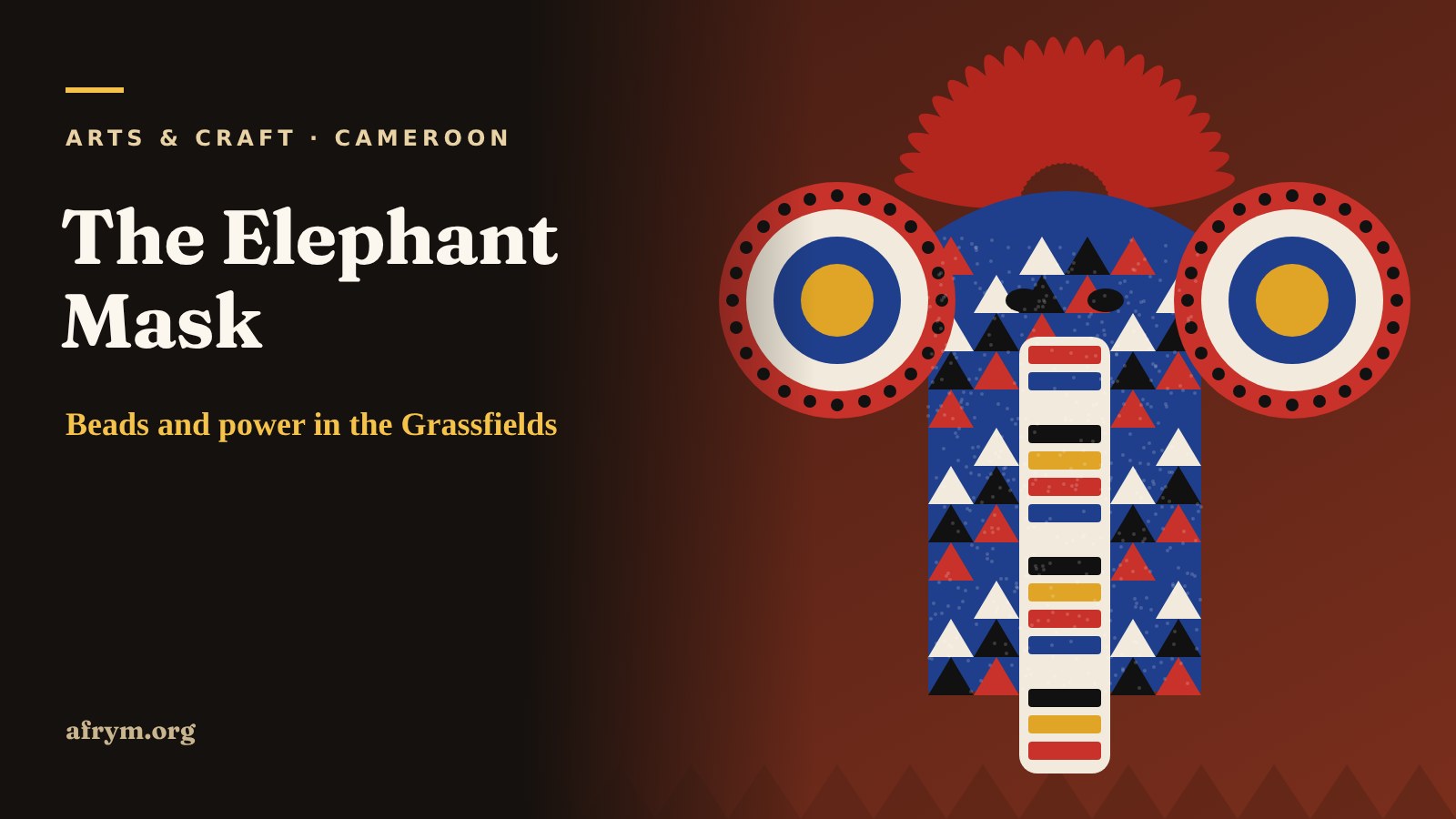
Picture a dancer moving slowly across a crowded courtyard in the highlands of western Cameroon. A tall cloth hood covers his head and chest. Two round discs stand out like ears, and a long panel hangs down his front like a trunk. Every surface glitters with tiny glass beads in red, blue, white and black. Behind him, feathers sway, and the crowd steps back to give him room.
This is the elephant mask of the Bamileke people, one of the most striking works of art made anywhere in Africa. Museums call it by the name mbap mteng, and it has long been linked to an exclusive men's association known as Kuosi.
Who are the Bamileke?
The Bamileke live in the Grassfields, a region of green hills and high plateaus in western Cameroon, around towns such as Bafoussam, Dschang and Bandjoun. They are organised into many separate kingdoms, or chiefdoms, each led by a ruler called the fon (or fo).
These kingdoms are famous for their art. Royal courts commissioned carved thrones, house posts, drinking horns, stools and masks, much as the courts of the Akan used carved stools and the kingdom of Benin made its celebrated bronze plaques. Art here was never just decoration. It showed who held power and how society was arranged.
What the mask looks like
Despite its name, the elephant mask is not carved from wood. It is made of cloth stretched over a frame of raffia and fibre, then covered with beads sewn on in tight rows. A wearer pulls it over his head like a hood, looking out through openings near the face.
Its main features are easy to spot:
- Two large round ears, set high on each side of the head;
- A long rectangular flap hanging down the front, standing for the trunk, often reaching below the waist;
- Bold geometric patterns, especially triangles, worked in contrasting colours.
Some scholars read the repeated triangles as the spots of a leopard, the other great royal animal of the Grassfields. If they are right, the mask combines the strength of the elephant with the cunning of the leopard in a single image.
Why beads meant power
The beads are the key to the mask's meaning. Glass beads were not made in the Grassfields. They arrived through long trade networks that linked western Cameroon with other parts of Africa and, beyond them, with Europe and the Middle East. Owning them in large quantities was a sign of great wealth.
In the past, access to beads was closely controlled by the fon and the elite, so covering an entire mask in them was a powerful statement. Much like the beadwork of the Maasai or the Zulu, colour and pattern could carry messages, but in the Grassfields the sheer quantity of beads also spoke of rank and royal favour. The raffia backing connects the mask to another great Central African art, the woven Kuba raffia cloth of Congo.
The elephant as a royal animal
In the kingdoms of the Grassfields, the elephant stands for political power. Its size, strength and long life made it a natural symbol for the fon and the leading men who supported him. Elephant images appear on royal stools, beaded objects and house carvings, and some traditions say that a powerful ruler could turn into an elephant or a leopard.
The Kuosi society
Kuosi is described by museums as an elite men's society in Bamileke kingdoms. Its members were typically wealthy, titled men, and joining or rising through its ranks required paying fees. The society supported the fon and helped uphold the order of the kingdom. Like many such associations in West and Central Africa, it kept much of its knowledge private, so outsiders know only part of its workings.
One thing is clear: the right to own and wear an elephant mask belonged to Kuosi. A member's full costume could include an indigo-dyed tunic, a beaded vest and belt, leopard skin or fur trim and a horsetail fly whisk, crowned by a tall headdress of red feathers from the African grey parrot. Complete outfits like this are very rare today, and even the masks themselves are hard to find.
The dance
Elephant masks appeared at important events: royal ceremonies, gatherings of the society and especially funerals of important people. Several masked dancers might perform together, moving with slow, heavy, controlled steps that suggested both dignity and danger.
The Brooklyn Museum describes the performance as assertive but restrained. Its online record of a Kuosi mask also notes the hybrid elephant-and-leopard reading of its patterns. Like the Egungun masquerade of the Yoruba or the antelope chiwara dancers of Mali, the elephant dance turned an idea into living movement, so that a whole community could see power pass before its eyes.
In museums today
Bamileke elephant masks are now held by museums across the world, including the Brooklyn Museum, the North Carolina Museum of Art and the Cleveland Museum of Art. Their bold shapes and colours have inspired fashion designers and contemporary artists. In Cameroon, beadwork remains a living craft, and Grassfields kingdoms still hold festivals where masks and royal regalia are displayed.
Cameroon's culture is far wider than its masks, of course. The same country gave the world the dance music of makossa.
Why it matters
The elephant mask is a reminder that African art was often made to be worn, danced and seen in motion, not hung on a wall. Each bead was a small piece of a vast trading world, and each mask a statement about who held power in a kingdom.
To look at one closely is to see how the Bamileke turned glass, cloth and raffia into a portrait of authority, strength and pride.
Further reading
- Brooklyn Museum — Kuosi Society Elephant Mask
- North Carolina Museum of Art — Kuosi Society Elephant Mask (mbap mteng)
- Smarthistory — Elephant Mask, Kuosi Society, Bamileke peoples
- Tamara Northern, The Art of Cameroon (Smithsonian Institution, 1984)