The Benin Bronzes: Royal Art, a Brutal Raid and the Long Road Home
The Benin Bronzes recorded the history of a West African kingdom in metal. In 1897, British troops looted thousands of them. Here is their story.
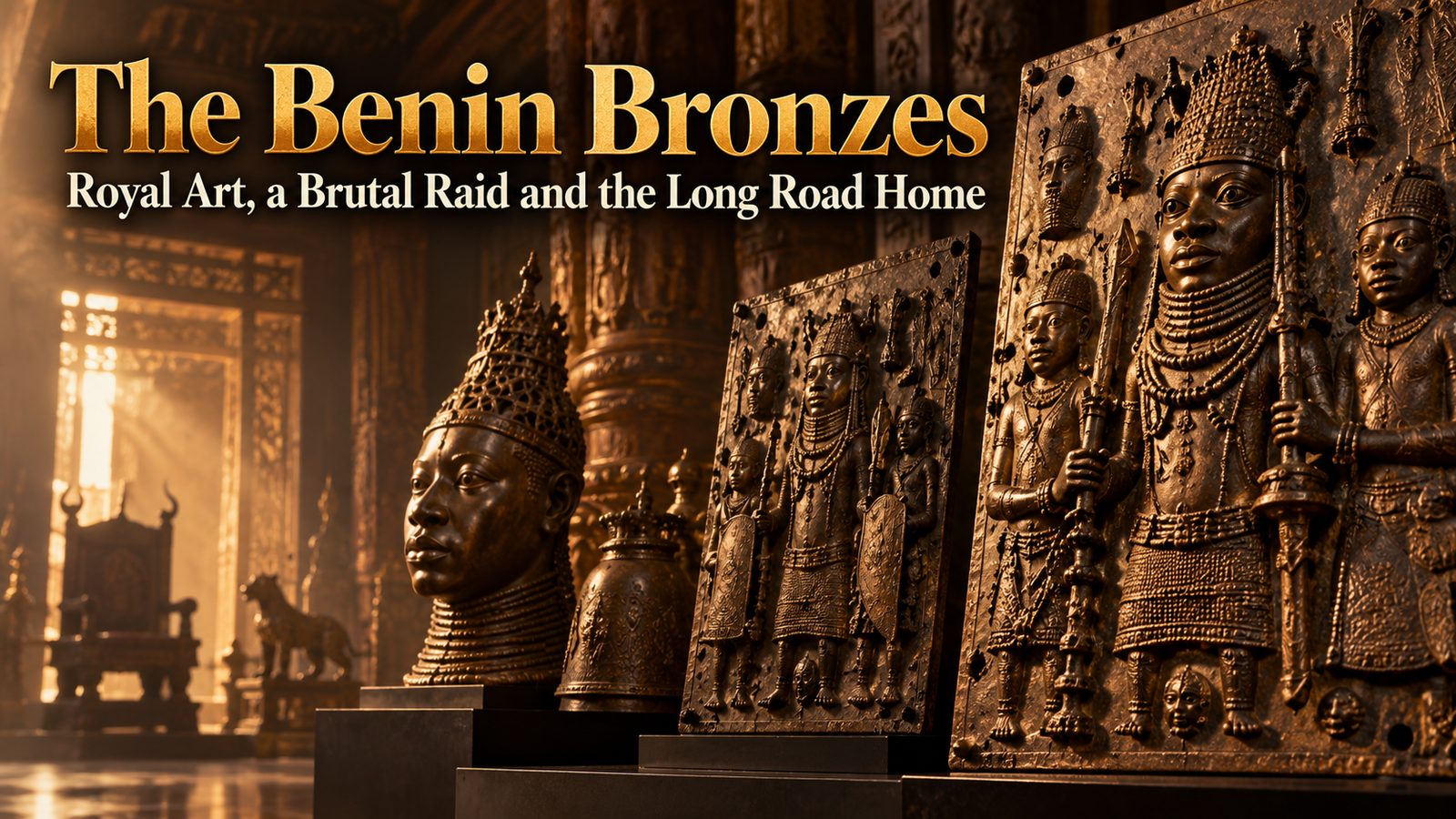
In museums from London to Berlin to New York, you can find them: metal plaques showing warriors, chiefs and Portuguese traders; commemorative heads of kings; carved ivory tusks. Together they are known as the Benin Bronzes. They are among the finest works of art ever made in Africa — and almost all of them left their home in a single, violent week in 1897.
The Kingdom of Benin
First, a clarification. The Kingdom of Benin was not in today's Republic of Benin. It was centred on Benin City in what is now Edo State, southern Nigeria, and was home to the Edo people. The kingdom was ruled by the Oba, a sacred king, and was one of the most powerful states in West Africa from around the 13th century until the late 19th century.
The Oba's court was a centre of art, ritual and power. Specialised guilds of craftsmen lived in their own quarters of the city and worked for the palace. The bronze casters — whose guild, known as the Igun Eronmwon, still works on Igun Street in Benin City today — were among the most prestigious.
How they were made
Most "bronzes" are actually brass or other copper alloys. Casters used the lost-wax method: they modelled a figure in wax over a clay core, covered it in more clay, then heated it so the wax melted out, leaving a mould. Molten metal was poured in. Each piece was unique.
Copper alloys were precious. From the late 15th century, the arrival of Portuguese traders brought large quantities of brass, often in the form of bracelets called manillas, which casters melted down. This is why Portuguese soldiers appear on some plaques — they were part of the kingdom's world.
The objects were not decoration. Plaques that once covered palace pillars recorded court life, battles and rituals — a kind of history in metal. Commemorative heads of past Obas were placed on ancestral altars. They were part of the kingdom's memory and religion.
The raid of 1897
In the 1890s, Britain was expanding its control over the region, and the Oba, Ovonramwen, resisted. In January 1897, a British party heading to Benin City was attacked and most of its members were killed. In February, Britain responded with a large military force — the so-called "punitive expedition."
British troops captured and burned much of Benin City, including the royal palace. Ovonramwen was sent into exile. Soldiers removed thousands of objects from the palace and shrines. Some were kept by officers; many were sold at auction in London to help pay for the expedition. Over time, an estimated 3,000 or more objects spread to museums and private collections around the world.
The long road home
For decades, Nigeria and the royal court of Benin asked for the objects to be returned. In recent years, that movement has gained momentum.
- In 2022, Germany agreed to transfer ownership of around 1,130 Benin objects in its museums to Nigeria, and the first group was physically handed over in December of that year.
- Also in 2022, the Smithsonian returned 29 Benin bronzes, and London's Horniman Museum agreed to return dozens of items.
- Other universities and museums have followed, while some major collections — most notably the British Museum, which holds hundreds of pieces — remain bound by laws that restrict giving objects away.
Debate continues in Nigeria too, about where returned works should be kept and displayed, and about the role of the current Oba of Benin, who is the heir of the kingdom whose palace was looted.
Why it matters
The Benin Bronzes are a reminder that history can be stolen along with art. Every plaque was once part of a palace that told the story of a people. The question many are now asking is simple: shouldn't that story be told, first of all, at home? Like the Timbuktu manuscripts, the bronzes show both how rich Africa's heritage is — and how hard communities have had to fight to keep it.
Further reading
- Smithsonian — Smithsonian returns 29 Benin bronzes (2022)
- NPR — Germany returns looted Benin Bronzes to Nigeria (2022)
- Encyclopaedia Britannica — Benin Bronzes
- Dan Hicks, The Brutish Museums (Pluto Press, 2020)