"How Far?": Nigerian Pidgin, the Language That Unites a Nation
In a country of more than 500 languages, Nigerian Pidgin is the one that almost everyone shares. Once dismissed as "broken English," it is now a language of music, news and pride.
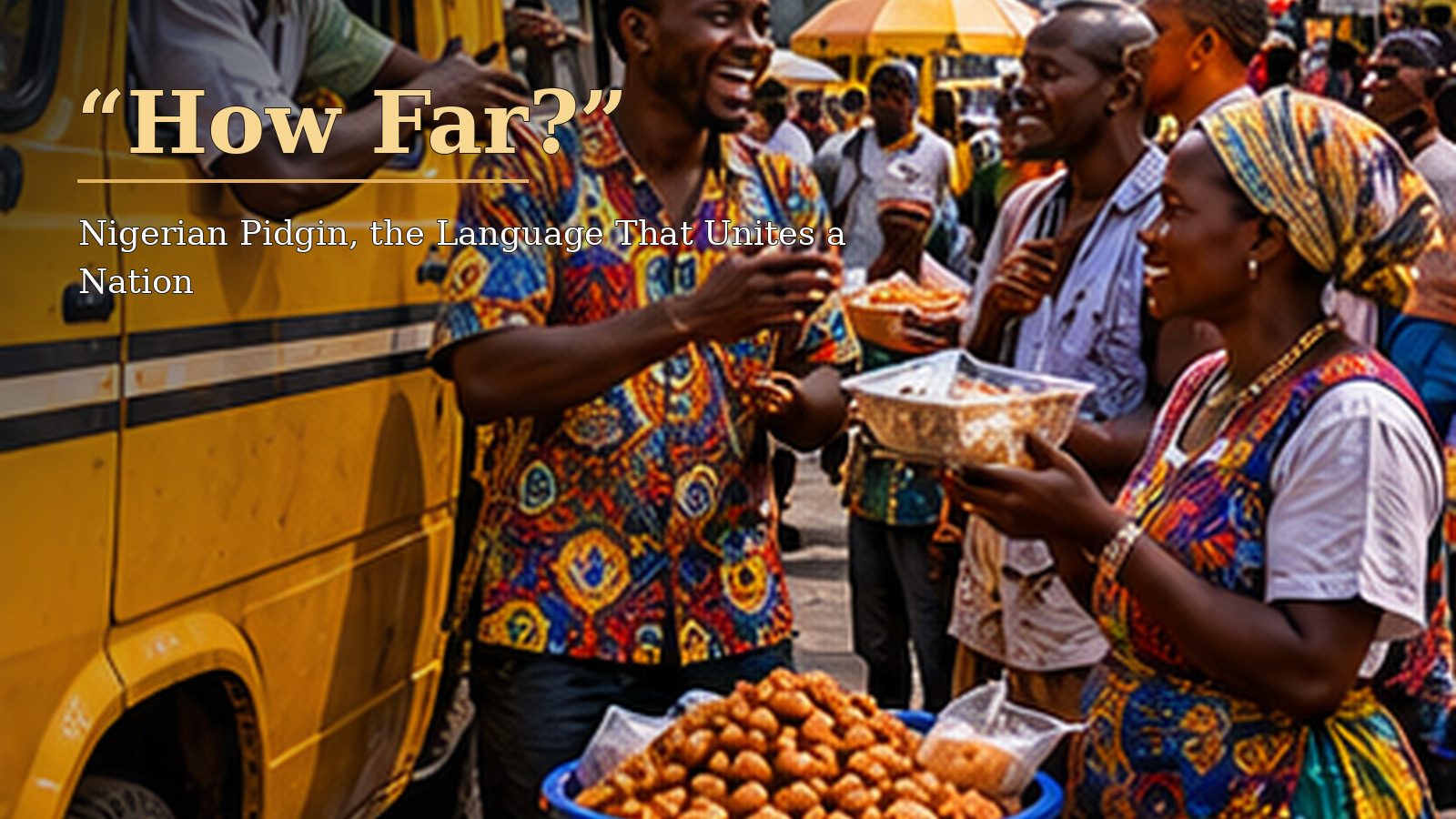
"How far?" In Nigeria, that is how countless conversations start — the equivalent of "Hi, how are you?" The answer might be "I dey" ("I'm fine," literally "I am here") or "We move" ("We keep going"). These words are not standard English, and they are not Yoruba, Hausa or Igbo. They are Nigerian Pidgin, also called Naijá — a language that has become one of the most widely spoken in Africa.
A language born of contact
Nigerian Pidgin developed along the West African coast from the 15th century onward, in contact between Africans and European traders — first Portuguese, then English and others. People who spoke many different languages needed a common way to communicate, and a pidgin — a simplified contact language — emerged, drawing most of its vocabulary from English but its grammar and sounds largely from African languages.
Over centuries, especially in the multi-ethnic cities of the south, such as Lagos, Port Harcourt, Warri and Benin City, it grew. Many children grew up speaking it as a first language, which linguists say makes it, in parts of Nigeria, a creole — a full, native language.
Who speaks it?
No census has counted Pidgin speakers precisely, but estimates suggest tens of millions use it, and some researchers put the total at well over 100 million across Nigeria and its diaspora. It is closely related to pidgins and creoles spoken in Ghana, Cameroon, Sierra Leone (Krio) and elsewhere.
In a country with more than 500 languages, Pidgin is valued as a neutral language: it belongs to no single ethnic group, so it brings people together in markets, universities, buses, army barracks and football stadiums.
How it works
Nigerian Pidgin has its own grammar, quite different from English. A few features:
- Dey marks ongoing action or location: "I dey come" = "I'm coming"; "She dey house" = "She is at home."
- Don marks completed action: "I don chop" = "I have eaten."
- Go marks the future: "I go call you" = "I will call you."
- No makes negatives: "I no know" = "I don't know."
- Wetin = "what": "Wetin dey happen?" = "What's happening?"
Its vocabulary includes words from many sources:
- Sabi ("to know") and pikin ("child") — from Portuguese saber and pequeno.
- Chop ("eat") — from English, with a local meaning.
- Abeg ("please") — from "I beg."
- Words from Yoruba, Igbo and other Nigerian languages, such as wahala ("trouble") and oya ("come on, let's go").
From "broken English" to pride
For a long time, Pidgin was looked down upon as "broken English" — not allowed in schools and associated with lack of education. That attitude has changed dramatically.
- Music — Fela Kuti sang in Pidgin to reach ordinary people, as described in our story on Fela and Afrobeat. Today, many of Nigeria's biggest Afrobeats stars sing in Pidgin, spreading its words worldwide.
- News — in 2017, the BBC launched BBC News Pidgin, publishing and broadcasting news in Pidgin for audiences across West Africa.
- Film and comedy — Nollywood films and Nigerian comedians use Pidgin to connect with audiences.
- Social media — Pidgin phrases spread across the internet, and words such as wahala are now understood far beyond Nigeria.
Linguists and writers have called for Pidgin to be recognised officially and taught in schools, and some universities study and teach it.
Why it matters
Nigerian Pidgin is the story of a language that grew from the needs of ordinary people to communicate — and became one of the great languages of Africa. It shows that "correct" language is not only what schools teach, but what people actually use to live, laugh and connect. So: how far? If you've read this far — we move.
Further reading
- BBC News Pidgin
- Nicholas Faraclas, Nigerian Pidgin (Routledge, 1996)