Ubuntu: The Southern African Idea That "I Am Because We Are"
Ubuntu teaches that a person becomes a person through other people. Here is where the idea comes from, what it means in daily life, and why it shaped a nation.
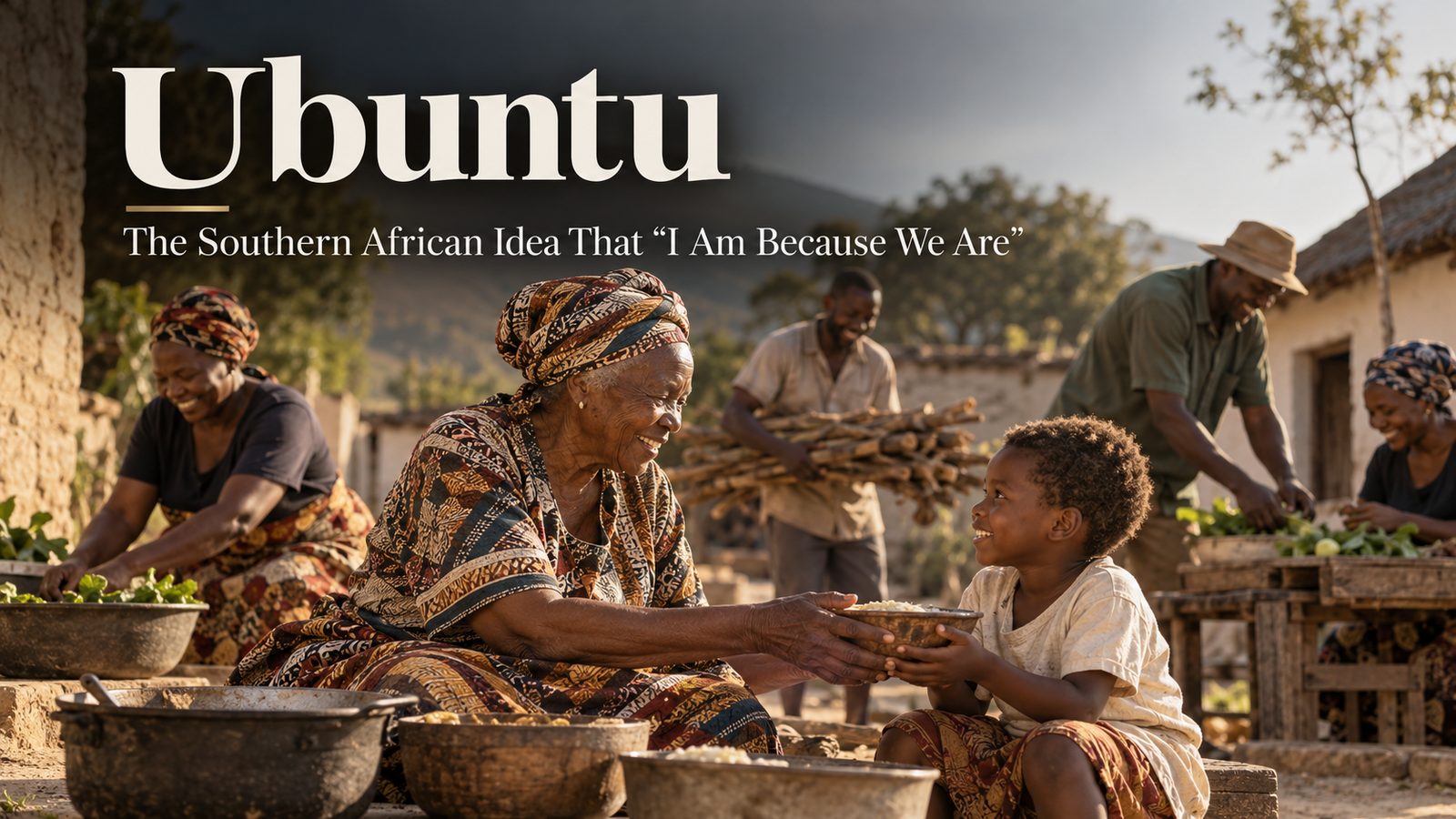
In much of southern Africa, a greeting is more than a hello. In isiZulu, people say Sawubona — literally, "I see you." The reply is often Ngikhona: "I am here." In those few words sits one of the continent's best-known ideas: ubuntu, the belief that we become fully human only through our relationships with others.
Where the word comes from
Ubuntu is a word from the Nguni family of languages, which includes isiZulu, isiXhosa, isiNdebele and siSwati. It is built from the root -ntu, "person" — the same root found in umuntu (a person) and abantu (people). In Sesotho and Setswana, the closely related concept is called botho. Similar ideas appear across Bantu-speaking Africa: hunhu in Shona, umunthu in Chichewa, and utu in Swahili.
The idea is most often summed up with a Nguni proverb:
Umuntu ngumuntu ngabantu — "A person is a person through other people."
In English, it is frequently paraphrased as "I am because we are."
What ubuntu means in practice
Ubuntu is less a formal philosophy than a way of living. People who describe it tend to point to everyday behaviour:
- Hospitality — feeding the visitor, making room for the stranger. (Ethiopia's coffee ceremony shows a similar spirit far to the north.)
- Sharing — the sense that a family's good fortune should reach the wider community.
- Dignity — treating every person as worthy of respect, including those who have done wrong.
- Responsibility — knowing that your actions reflect on, and affect, the people around you.
- Reconciliation — preferring to repair a broken relationship rather than simply punish.
A person who behaves generously and humanely is said to "have ubuntu." Someone who is cruel or selfish may be described as lacking it — as if they have forgotten what it means to be a person.
Ubuntu and the birth of a new South Africa
Ubuntu moved from village life to the centre of national politics during South Africa's transition from apartheid to democracy in the early 1990s.
The country's 1993 interim Constitution ended with a passage on national unity and reconciliation. It said there was "a need for understanding but not for vengeance, a need for reparation but not for retaliation, a need for ubuntu but not for victimisation." That line helped lay the foundation for the Truth and Reconciliation Commission, chaired by Archbishop Desmond Tutu, which invited victims and perpetrators of political violence to tell the truth in public.
Tutu became the idea's most famous voice. In his book No Future Without Forgiveness, he described a person with ubuntu as someone open and available to others, who does not feel threatened by others' abilities, because their own sense of self comes from belonging to a greater whole. Humiliation or oppression of anyone, in this view, diminishes everyone.
Ubuntu also appeared in South Africa's courts. In S v Makwanyane (1995), the case in which the new Constitutional Court ruled the death penalty unconstitutional, several judges discussed ubuntu as a value that emphasises respect for life and human dignity.
Ubuntu around the world
The idea has travelled far beyond southern Africa. It has been used in leadership training, in social work and nursing, in peace-building and in community development. Perhaps its most unexpected appearance is in technology: a widely used computer operating system, launched in 2004, took the name Ubuntu to reflect the spirit of software built and shared by a community.
Some honest questions
Scholars and southern Africans themselves have raised fair criticisms. Some say ubuntu is sometimes romanticised — presented as a timeless, uniform "African philosophy" when in fact it is lived differently in different places. Others worry that an emphasis on group harmony can be used to pressure individuals to stay quiet, or that the word has been turned into a slogan by companies and politicians who do not practise it.
These debates are part of what keeps ubuntu alive. It is not a museum piece; it is an argument people are still having about how to live well together.
Why it matters today
In a world that often celebrates the self-made individual, ubuntu offers a different starting point: that none of us is self-made. We are raised, taught, fed, corrected and forgiven by others. The next time someone looks at you and says "I see you," it may be worth answering the way so many people in southern Africa do — I am here — and meaning it.
Further reading
- Desmond Tutu, No Future Without Forgiveness (1999)
- Constitution of the Republic of South Africa, Act 200 of 1993 — postamble
- Constitutional Court of South Africa, S v Makwanyane (1995)