The Ethiopian Coffee Ceremony: Three Cups, One Community
In Ethiopia, coffee is roasted, ground and brewed in front of you, then served in three rounds. Here is how the buna ceremony works and why it matters.
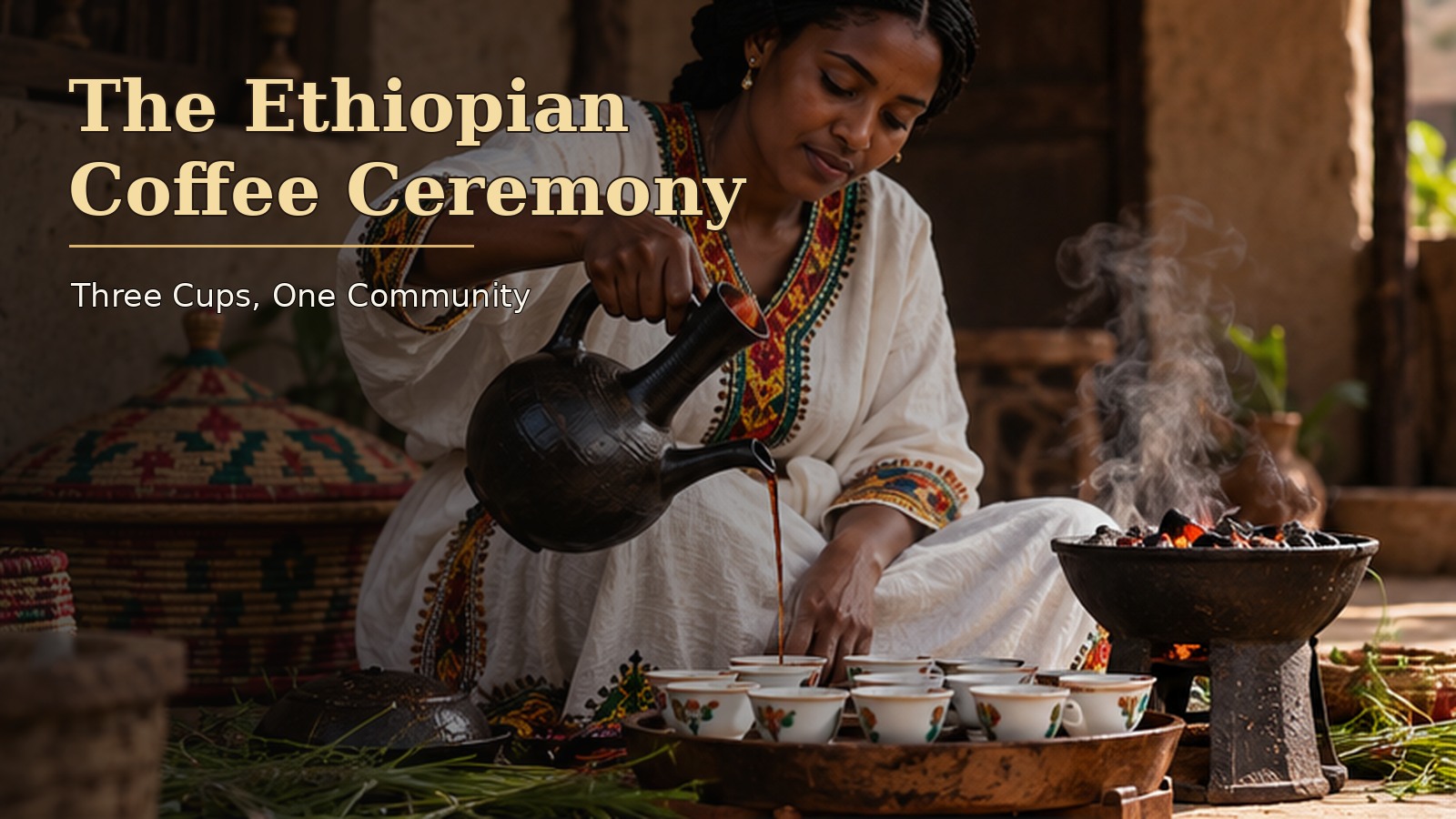
The first sign is the smell. Frankincense curls up from a small burner. Fresh grass has been scattered on the floor. A woman sits on a low stool beside a charcoal brazier, washing green coffee beans in a pan. Nobody is in a hurry. In Ethiopia, coffee is not a drink you grab on the way somewhere. It is a reason to stay.
The homeland of coffee
Ethiopia is widely recognised as the original home of Coffea arabica, the species behind most of the world's coffee. Wild arabica still grows in the forests of the southwest, and the old province of Kaffa is often suggested as one source of the word "coffee," although language historians debate this.
The most famous origin story involves a goatherd named Kaldi, who noticed his goats dancing with energy after eating red berries from a certain shrub. It is a charming legend — but historians note it was first written down in Europe in the 17th century, long after coffee had spread across the Red Sea to Yemen and beyond.
In Amharic — written in Ethiopia's own Ge'ez script — coffee is buna, and there is a well-known saying: Buna dabo naw — "coffee is our bread." It is that central to daily life.
Setting the scene
The coffee ceremony is usually led by a woman of the household, and it is a mark of respect and hospitality to be invited. Preparation often begins before guests arrive:
- Fresh grass or flowers are spread on the floor to welcome guests.
- Frankincense or other incense is lit, filling the room with fragrance.
- Small handleless cups called sini are arranged on a tray, sometimes on a low table called a rekebot.
- Snacks are prepared — often popcorn, roasted barley called kolo, or bread.
Roasting, grinding, brewing
Everything happens in front of the guests, from raw bean to finished cup.
1. Washing and roasting. Green coffee beans are rinsed, then roasted over charcoal in a long-handled flat pan. The host shakes and stirs constantly until the beans turn dark and glossy and begin to crackle.
2. Sharing the aroma. The host carries the smoking pan around the room so every guest can breathe in the smell. Guests often wave the smoke toward their faces and offer thanks or compliments.
3. Grinding. The roasted beans are pounded by hand in a wooden mortar with a metal or wooden pestle.
4. Brewing. The grounds go into a jebena — a round-bellied clay pot with a long neck and a spout. Water is added and the jebena is set on the coals until it boils. It is then rested so the grounds settle, and some hosts stuff the spout with a little horsehair or fibre to act as a filter.
5. Pouring. The host pours from a height in one continuous stream, moving from cup to cup without stopping — a skill that takes practice.
Three rounds
Coffee is served in three rounds, each with its own name, using the same grounds with fresh water added each time:
- Abol — the first and strongest cup.
- Tona — the second, a little lighter.
- Baraka (sometimes written bereka) — the third, meaning "blessing."
Leaving before the third cup can be seen as impolite, because the final round is thought to bless the gathering. The whole ceremony can easily take an hour or more.
Most people take their coffee with sugar. In some rural areas it may be served with salt, and in some communities a little butter or herbs such as rue are added.
More than a drink
The ceremony is where news is shared, plans are made, neighbours are welcomed and disagreements are talked through. Many families hold it daily, sometimes more than once. It is also common at holidays, after the birth of a child, and when mourning.
Neighbouring Eritrea shares a very similar coffee ceremony, and versions of the tradition can be found in Ethiopian and Eritrean communities from Washington, D.C. to Tel Aviv and Melbourne.
Why it matters today
Ethiopia is one of the world's leading coffee producers and Africa's largest, and its coffee is prized by roasters everywhere. Yet the most important thing about Ethiopian coffee may not be its flavour but its pace. In a world of paper cups and drive-throughs, the buna ceremony asks for an hour, three cups and your full attention — and gives back a sense of belonging in return.
Further reading
- Mark Pendergrast, Uncommon Grounds: The History of Coffee and How It Transformed Our World (rev. ed., 2010)
- International Coffee Organization — history of coffee