Rooibos: The "Red Bush" Tea That Grows in Only One Corner of the World
Rooibos grows wild only in a small region of South Africa's Western Cape. The Khoi and San knew it first; today it is drunk in dozens of countries.
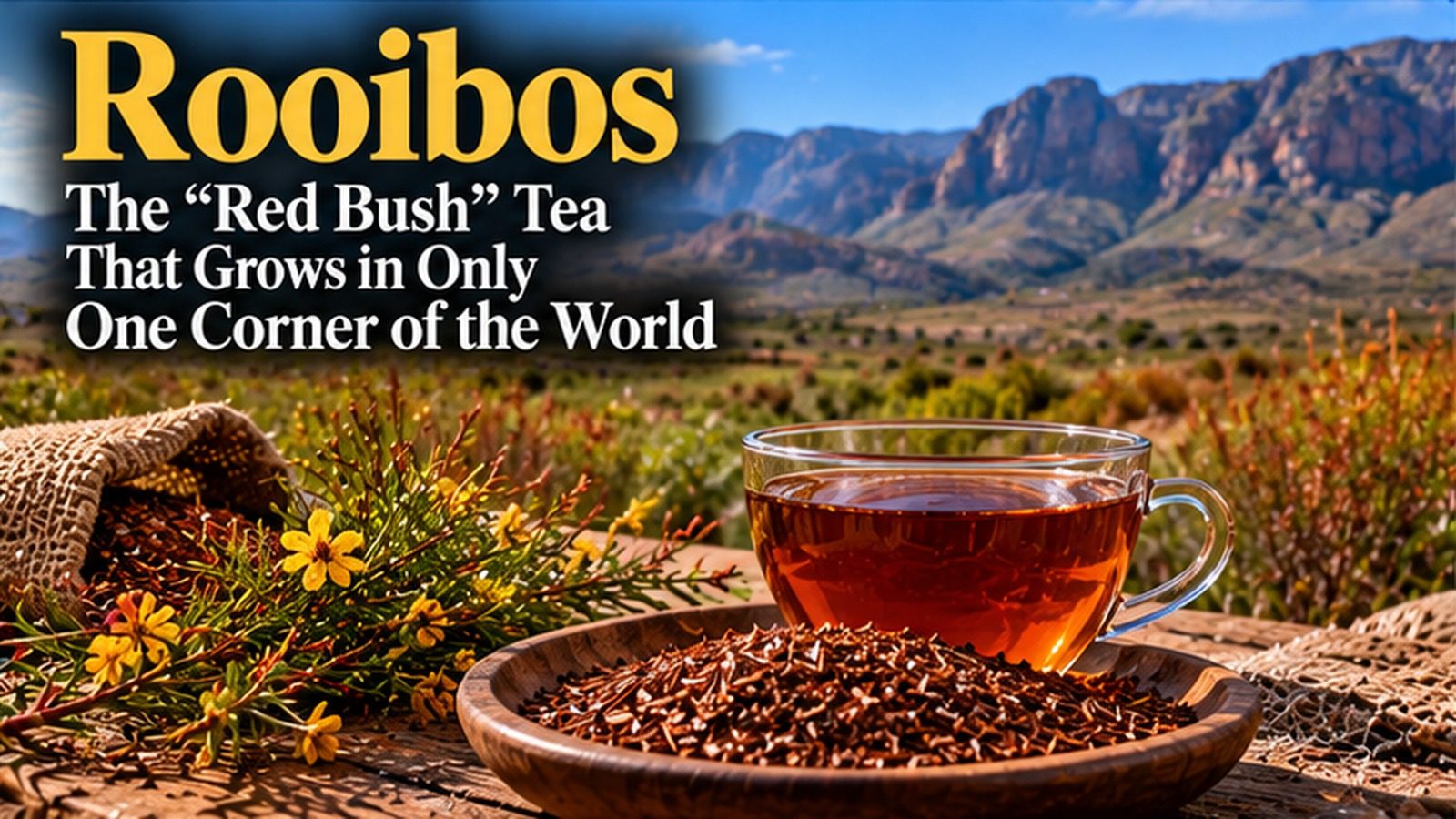
In the rugged Cederberg mountains, a few hours' drive north of Cape Town, the hillsides are covered in low, needle-leaved shrubs. In summer, farmworkers cut the green branches, chop them, bruise them, and pile them in heaps to ferment in the sun. Slowly, the green turns a deep reddish-brown, and the air fills with a sweet, woody smell. Dried and packed, those leaves become rooibos — "red bush" in Afrikaans — one of South Africa's best-known gifts to the world.
A plant with a tiny home
Rooibos comes from a single plant species, Aspalathus linearis, part of the legume family. It grows naturally in only a small area of South Africa's Western Cape and Northern Cape, especially around the Cederberg and the town of Clanwilliam. It is adapted to the region's unique fynbos ecosystem — sandy, acidic soils, hot dry summers and wet winters — and attempts to grow it commercially elsewhere in the world have largely failed.
Knowledge of the Khoi and San
Long before it was a commercial product, rooibos was known to the Khoi and San peoples of the region, who harvested the wild plant and prepared it as a drink and for medicinal uses. Their traditional knowledge is formally recognised today: in 2019, the rooibos industry signed a benefit-sharing agreement with representatives of Khoi and San communities, under which a levy on the industry is paid to community trusts — one of the first agreements of its kind in the world.
From wild plant to global drink
Some key moments in rooibos history:
- 1772 — the Swedish naturalist Carl Thunberg recorded the plant during his travels at the Cape.
- 1904 — a merchant named Benjamin Ginsberg, a Russian immigrant, began trading rooibos as a tea in the Clanwilliam area.
- Around 1930 — a local doctor and nature enthusiast, Pieter Le Fras Nortier, experimented with growing rooibos from seed. The seeds are hard to germinate; he found that scratching or weakening the seed coat helped. His work made it possible to farm rooibos rather than only harvest it from the wild.
- Later 20th century — rooibos became a national drink in South Africa and began to be exported.
- 2021 — the European Union registered "Rooibos" as a Protected Designation of Origin (PDO), meaning only rooibos grown in its home region of South Africa can be sold under that name in the EU — the first African food product to receive this protection.
Rooibos now reaches buyers in over fifty countries, and Germany, Japan, the Netherlands and the United Kingdom are among its biggest markets.
Red and green
Most rooibos is fermented (oxidised) after harvesting, which produces its red colour and sweet, slightly nutty taste. Green rooibos, which is not fermented, has a lighter, grassier flavour.
Rooibos is naturally caffeine-free and low in tannins, so it is less bitter than black tea and can be brewed for a long time. In South Africa, it is drunk with milk and sugar like ordinary tea, or with honey and lemon, and it is used in iced teas, lattes ("red cappuccinos"), cooking and cosmetics.
Pressures and change
Because it grows in such a small area, rooibos is vulnerable to drought and climate change. Farmers and scientists are working on sustainable farming practices and on protecting wild rooibos populations. Many rooibos workers and small-scale farmers, including communities descended from the Khoi and San, also campaign for fairer shares of the industry's profits.
A cup of rooibos is part of everyday South African life, much as Morocco's mint tea and the Sahel's ataya are part of daily rituals further north.
Why it matters
Rooibos is a story of a plant found nowhere else, of Indigenous knowledge that was eventually recognised, and of a small region whose red tea is now poured around the world. Next time you drink a cup, remember the Cederberg hillsides — and the Khoi and San who knew this plant first.