Ataya: The Three Glasses of Tea That Slow Down the Sahel
Brewed over charcoal, poured from a great height and served in three rounds, Sahelian green tea is less a drink than a ritual of conversation. Here is how ataya works.
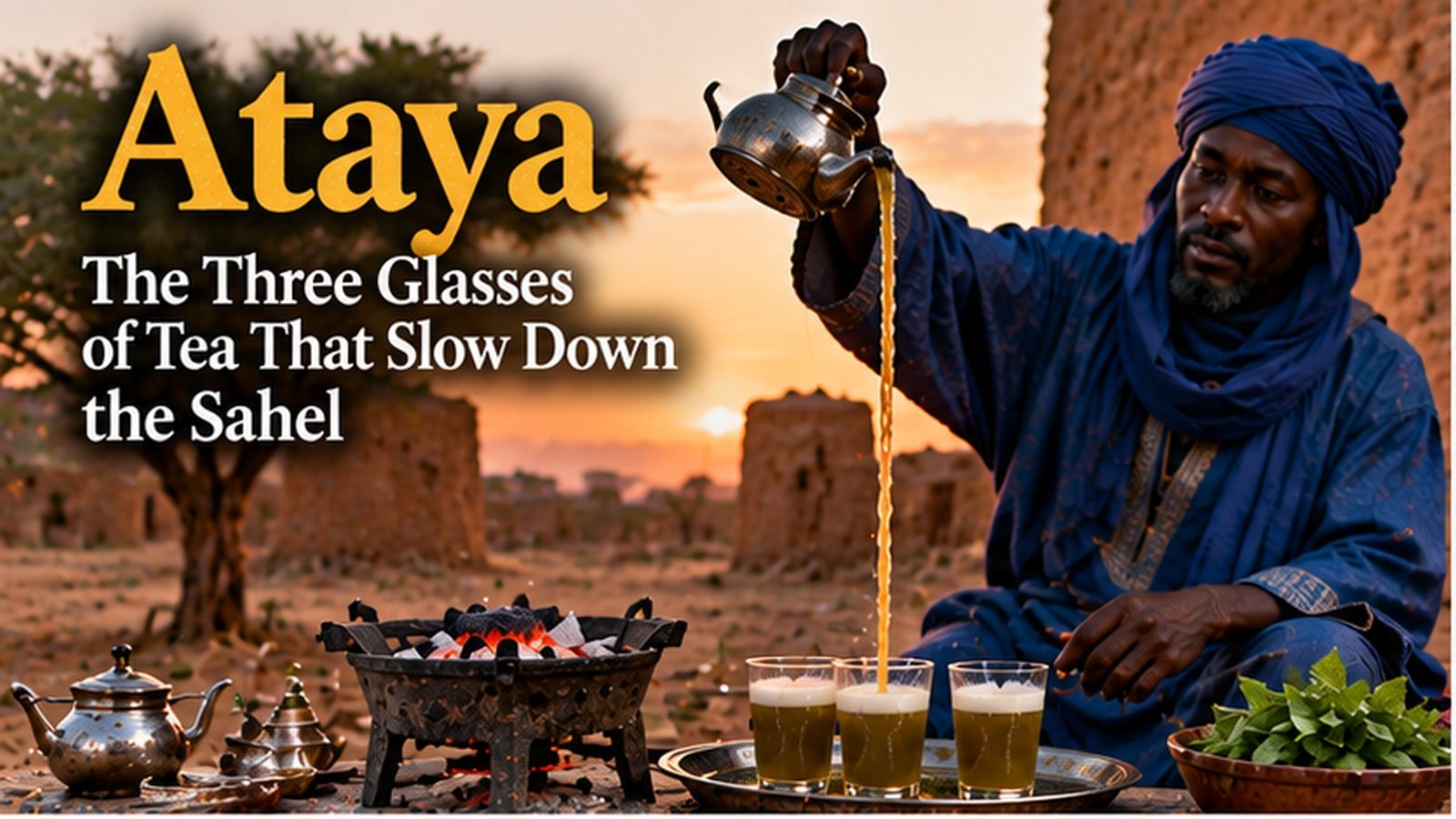
On a street corner in Dakar, outside a shop in Bamako or under a tent in the Mauritanian desert, the scene is the same. A small charcoal stove glows. On it sits a little enamel teapot. A young man pours dark green tea into a tiny glass, raising the pot higher and higher until the stream is half a metre long, then pours it back into the pot, and again into a glass, until the tea is crowned with a thick layer of foam. Then he hands you a glass. This is ataya (also attaya or atayé), the tea ritual of the Sahel and the western Sahara — and it cannot be rushed.
Three rounds
Ataya is traditionally served in three rounds, brewed from the same leaves with more water and sugar added each time:
- The first glass — strong and bitter.
- The second glass — sweeter and milder.
- The third glass — the sweetest of all.
A well-known saying, told in slightly different forms across the region, compares the three glasses to the stages of life or relationships: the first is bitter like life (or death), the second is sweet like love, and the third is gentle like friendship (or death, in some versions). The exact words vary, but the message is that the tea, like life, gets sweeter if you stay.
Leaving before the third glass is not forbidden — but it is noticed.
How it is made
- The tea — Chinese gunpowder green tea, rolled into tight little pellets.
- The pot — a small enamel or metal teapot, placed directly on a charcoal brazier.
- Sugar — lots of it. Sugar is often added in large chunks or broken from a cone.
- Mint — fresh mint (nana) is common in Senegal and the Gambia, and especially in Mauritania and the Maghreb.
- The foam — the long pour, back and forth between glasses and pot, cools the tea, mixes in the sugar and creates the foam that a good tea-maker is proud of.
Making ataya is a skill, often learned young. The person who brews is usually a young man of the group, and he will spend an hour or more preparing all three rounds while conversation flows.
A tea that crossed the desert
Green tea is not native to Africa. It arrived in Morocco through European trade, especially after the mid-19th century, when British merchants brought large quantities of Chinese tea to Moroccan ports. Moroccans developed their own mint tea, and the habit travelled south along the trans-Saharan trade routes with Moorish traders, Tuareg caravans and Islamic scholars. By the 20th century, it had become a staple across Mauritania, Senegal, the Gambia, Mali, Niger and beyond.
The real point: time
In much of the Sahel, ataya is above all a reason to sit together. Friends gather around the brewer in the afternoon or late evening; workers take a tea break; families brew it after lunch; guests are welcomed with it. The slowness is the point. Three rounds can take an hour or two, and during that time people talk, joke, argue politics and catch up on news.
In Senegal, ataya is an everyday expression of teranga, the country's culture of hospitality. A visitor who sits down is almost always offered a glass.
Why it matters
Ataya is a small ritual with a big meaning. In a fast world, it insists on patience: three rounds, no hurry, and company for as long as the tea lasts. Next time someone in Dakar or Nouakchott hands you a tiny glass of foamy green tea, accept it — and stay for the third.
Further reading
- Ghislaine Lydon, On Trans-Saharan Trails: Islamic Law, Trade Networks, and Cross-Cultural Exchange in Nineteenth-Century Western Africa (Cambridge University Press, 2009)
- Peace Corps — Finding teranga from Senegal to the streets of Paris