Nsibidi: The Secret Signs of Nigeria's Cross River Region
Long before colonial schools, people in southeastern Nigeria communicated with nsibidi, a system of signs guarded by the powerful Ekpe society. Here is what we know about it.
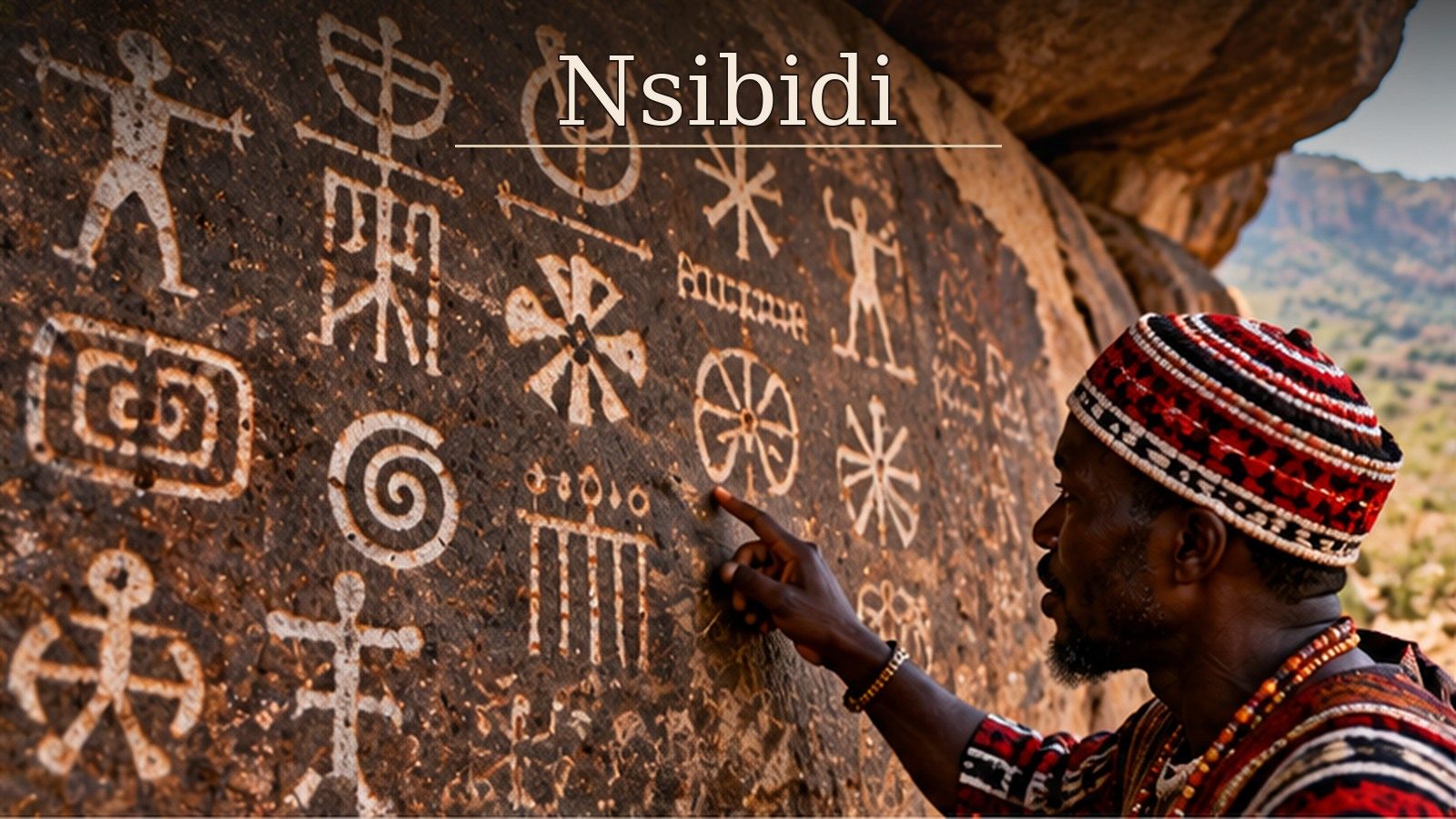
Carved on a calabash, painted on a wall, stamped onto cloth, or drawn quickly in the dust with a finger: in the forests and river towns of southeastern Nigeria and western Cameroon, people have long communicated with a set of signs called nsibidi. Some are simple enough for a child to read. Others were known only to initiated members of a powerful society, and revealing them to outsiders was forbidden.
Where nsibidi comes from
Nsibidi (also spelled nsibiri) is associated with the peoples of the Cross River region, which today straddles the border of Nigeria and Cameroon. It is especially linked to the Ejagham (also called Ekoi), and was used by the Efik, Ibibio, some Igbo communities and others nearby.
No one knows exactly how old it is. Pottery and other objects from the region carry markings that some researchers connect to nsibidi, suggesting a history of several centuries or more. The first detailed written descriptions by outsiders date from the early 1900s, when colonial officers in southern Nigeria recorded hundreds of signs.
What kind of writing is it?
Nsibidi is not an alphabet. It does not spell out the sounds of a language letter by letter. Instead, its signs stand for ideas, objects, actions and relationships — more like a system of symbols or ideograms. Because of this, people who speak different languages could share the same signs.
Commonly recorded examples include signs for:
- Love and marriage — two figures or curved shapes joined together; some signs indicate a husband and wife on good terms, others a couple quarrelling.
- Household objects — mirrors, drums, stools, spoons.
- Meetings and gatherings — a circle of marks around a central sign.
- Conflict and law — signs connected to disputes, judgments and punishments.
Some signs are also gestures: a form of nsibidi was performed with the hands and body, especially in ceremonies.
The Leopard Society
The most important keepers of nsibidi were members of the Ekpe (or Ngbe) society, often called the Leopard Society, after the animal that symbolises its power. Before colonial rule, Ekpe was a major institution in the Cross River region and the trading city of Calabar. It acted as a kind of government: making and enforcing laws, judging important cases, collecting debts and keeping order in the market.
Ekpe members used nsibidi to record court cases, messages, proverbs and society records. Certain signs were secret, taught step by step as a member rose through the society's grades. To reveal them to an uninitiated person was a serious offence.
Where you can see it
Nsibidi appears on:
- Ukara cloth — indigo-dyed cloth used by Ekpe, decorated with nsibidi signs alongside images of leopards and other powerful animals.
- Calabashes, masks and carvings.
- Walls and house fronts.
- The body, as tattoos or painted designs.
- The ground, drawn in chalk or charcoal during ceremonies.
Across the Atlantic
Many people from the Cross River region were taken to Cuba during the slave trade. There, they founded the Abakuá society, modelled on Ekpe, which still exists today. Abakuá members use a related set of signs called anaforuana, drawn in chalk during ceremonies — a direct descendant of nsibidi, preserved for two centuries across an ocean.
Nsibidi today
In recent years, Nigerian artists, designers and young people have taken a renewed interest in nsibidi, using its signs in paintings, fashion, logos and digital projects. It even appeared in the 2018 film Black Panther, where nsibidi-inspired symbols decorated costumes and sets. Some enthusiasts have proposed expanding it into a full writing system for modern use.
Like Ethiopia's Ge'ez script and the Meroitic writing of ancient Kush, nsibidi is evidence that Africa developed its own ways of putting ideas into visible form — long before anyone arrived with a Latin alphabet.
Why it matters
Nsibidi reminds us that "writing" can mean more than one thing. A sign drawn in the dust could settle a dispute, seal a marriage or carry a message that only the initiated could read. For the peoples of the Cross River, and for their descendants in Cuba, those signs have carried law, love and memory for centuries.
Further reading
- Michael C. Carlos Museum, Emory University — Odyssey Online: Nsibidi
- J.K. Macgregor, "Some Notes on Nsibidi," Journal of the Royal Anthropological Institute 39 (1909)
- Ivor L. Miller, Voice of the Leopard: African Secret Societies and Cuba (University Press of Mississippi, 2009)