Mafé: West Africa's Peanut Stew and the Story of the Groundnut
Rich, red and comforting, mafé is a stew of meat and vegetables simmered in a peanut sauce, loved from Senegal to Mali. Behind it lies a crop that reshaped the region's history.
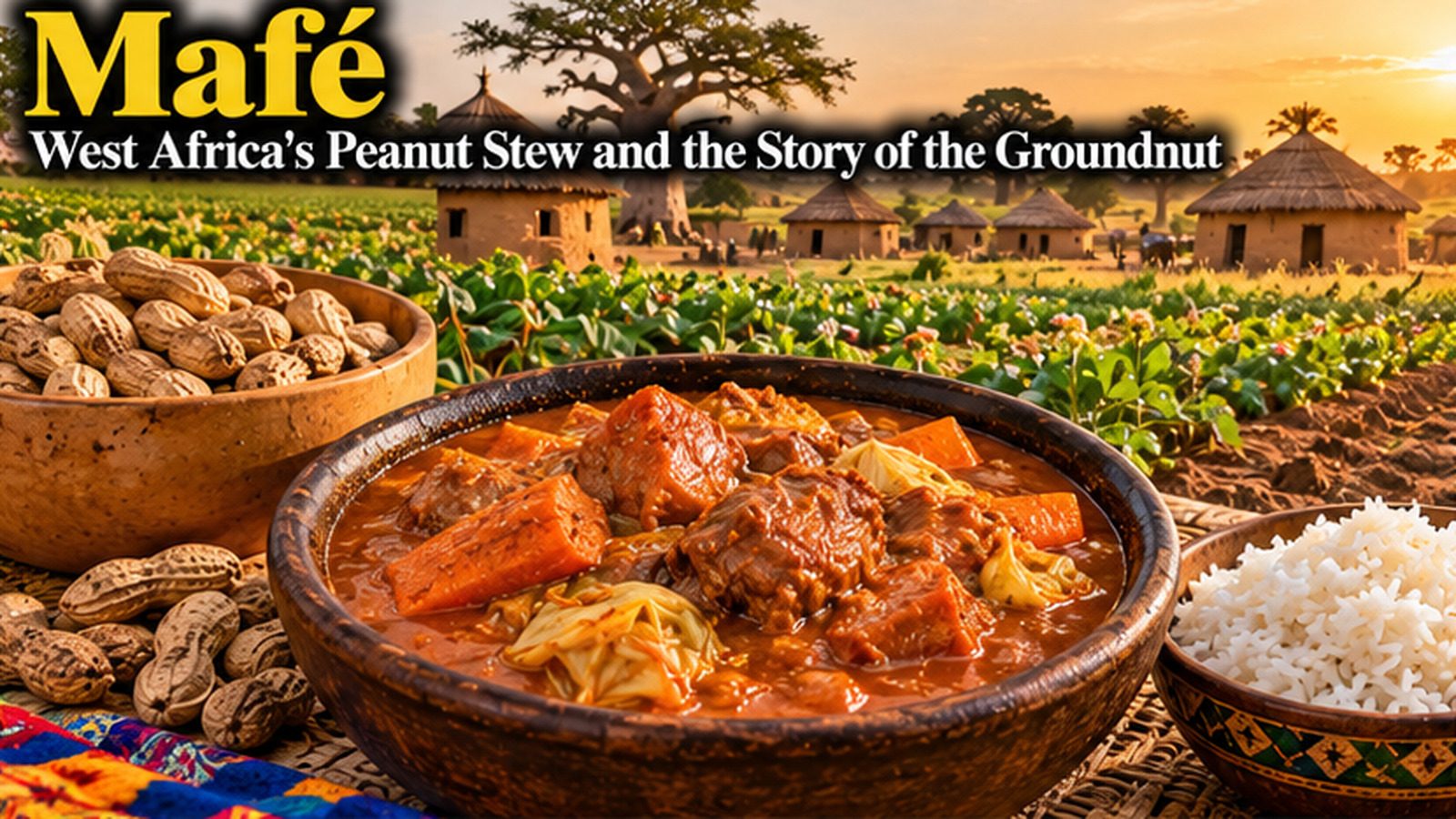
In a family courtyard in Bamako, a large pot sits over a charcoal fire. Inside, chunks of lamb or beef are simmering in a thick, reddish-brown sauce, together with carrots, cabbage, sweet potato and a whole hot pepper. The air smells of roasted peanuts, tomato and onion. When the stew is ready, it will be ladled over a mound of white rice, and the family will gather round the shared bowl. This is mafé, one of the best-loved dishes of West Africa, known in different places as tigadèguèna, domoda or simply groundnut stew.
One dish, many names
Mafé is eaten across a wide stretch of West Africa:
- In Senegal, it is usually called mafé (or maafe), a Wolof name that has become the most widely used internationally.
- In Mali, it is known as tigadèguèna, from Bambara words meaning "peanut sauce", and is often considered a Malian national dish; many people believe the dish has its roots among the Mandinka and Bambara peoples.
- In the Gambia, a similar stew is called domoda, and is one of the country's signature dishes.
- In Guinea, Côte d'Ivoire, Burkina Faso and further afield, versions of groundnut stew are cooked under many local names. Ghana's nkatenkwan (groundnut soup) is a close cousin.
How mafé is made
Recipes vary from household to household, but the basic method is similar:
- Brown the meat. Lamb, beef, goat or chicken is cut into pieces and browned in oil with onions.
- Build the sauce. Tomatoes or tomato paste, garlic and spices are added, and cooked down.
- Add the peanut paste. The key ingredient is ground roasted peanuts, often freshly pounded at home or bought as a paste in the market, diluted with water or stock and stirred into the pot.
- Simmer with vegetables. Root vegetables such as carrots, cassava, sweet potato or yam, along with cabbage or squash, are added, and the stew is left to simmer slowly until the sauce is thick and the oil rises to the surface.
- Season. Salt, a stock cube (very common in modern West African cooking) and a whole Scotch bonnet pepper, left intact for flavour or broken open for heat.
Mafé is usually served with rice, though in some areas it is eaten with fonio, millet couscous or fufu.
The groundnut: a crop from the Americas
Like chillies, tomatoes, maize and cassava, the peanut (or groundnut) is not originally African. It was domesticated in South America thousands of years ago. After the 15th century, Portuguese and other traders carried it across the Atlantic, and by the 16th and 17th centuries it was being grown in West Africa.
West African farmers already grew a similar crop, the Bambara groundnut, an indigenous legume, and cooked with ground seeds such as egusi. This may help explain why peanuts were adopted so readily and used in similar ways: pounded into sauces, roasted as snacks, pressed for oil.
Peanuts and colonial history
In the 19th century, peanuts became a major cash crop, especially in Senegal and the Gambia. European factories needed oils for soap, lubricants and food, and French and British merchants bought huge quantities of groundnuts from West African farmers.
In Senegal, a vast "groundnut basin" developed in the regions of Kajoor, Bawol and Sine-Saloum. Historian Martin Klein and others have shown how groundnuts transformed the economy and society. Many farmers grew them to pay taxes in cash; the Mouride Sufi brotherhood, led by Sheikh Amadou Bamba and his successors, organised followers to clear land and grow them; and a railway was built from Dakar to Saint-Louis partly to carry the crop. The focus on peanuts sometimes came at the cost of food crops and of soil fertility, and dependence on one export left farmers vulnerable to falling prices.
So when Senegalese families eat mafé, they are eating a dish made from a crop that shaped the country's modern history.
The shared bowl
Like many West African meals, mafé is traditionally eaten from a shared bowl. Family members and guests gather round, each eating from the section of the bowl in front of them, often with the right hand or a spoon. The best pieces of meat may be placed in front of the guest or distributed by the host. Sharing a meal in this way is an important expression of the hospitality that Senegal calls teranga, described in our story on teranga.
Mafé in the world
With West African migration, mafé has travelled to Paris, Brussels, New York and beyond, and is now found in African restaurants worldwide. Vegetarian versions, made with chickpeas, sweet potatoes and greens, have become popular, and food writers have adapted the stew for many kitchens.
Tips if you try it
- Use natural peanut butter without added sugar if you cannot get fresh peanut paste.
- Cook it slowly; the flavour improves with time and the sauce should be thick.
- Don't skip the whole pepper; it gives a fragrant heat.
- Like many stews, mafé tastes even better the next day.
Why it matters
Mafé is a comforting family dish, but it is also a history lesson in a bowl. It tells of crops that crossed oceans, of farmers who made them their own, of colonial economies built on a single export, and of a shared meal that brings people together. Whatever name it goes by, groundnut stew is one of West Africa's great contributions to the world's table.
Further reading
- Fran Osseo-Asare, Food Culture in Sub-Saharan Africa (Greenwood Press, 2005)
- Jessica B. Harris, The Africa Cookbook: Tastes of a Continent (Simon & Schuster, 1998)
- Martin A. Klein, Islam and Imperialism in Senegal: Sine-Saloum, 1847–1914 (Stanford University Press, 1968)