Lake of Stars: Music on the Shores of Lake Malawi
Sand underfoot, a lake as big as a sea, and a stage under the stars. Since 2004, the Lake of Stars festival has brought Malawian and international artists together on the beaches of Lake Malawi.
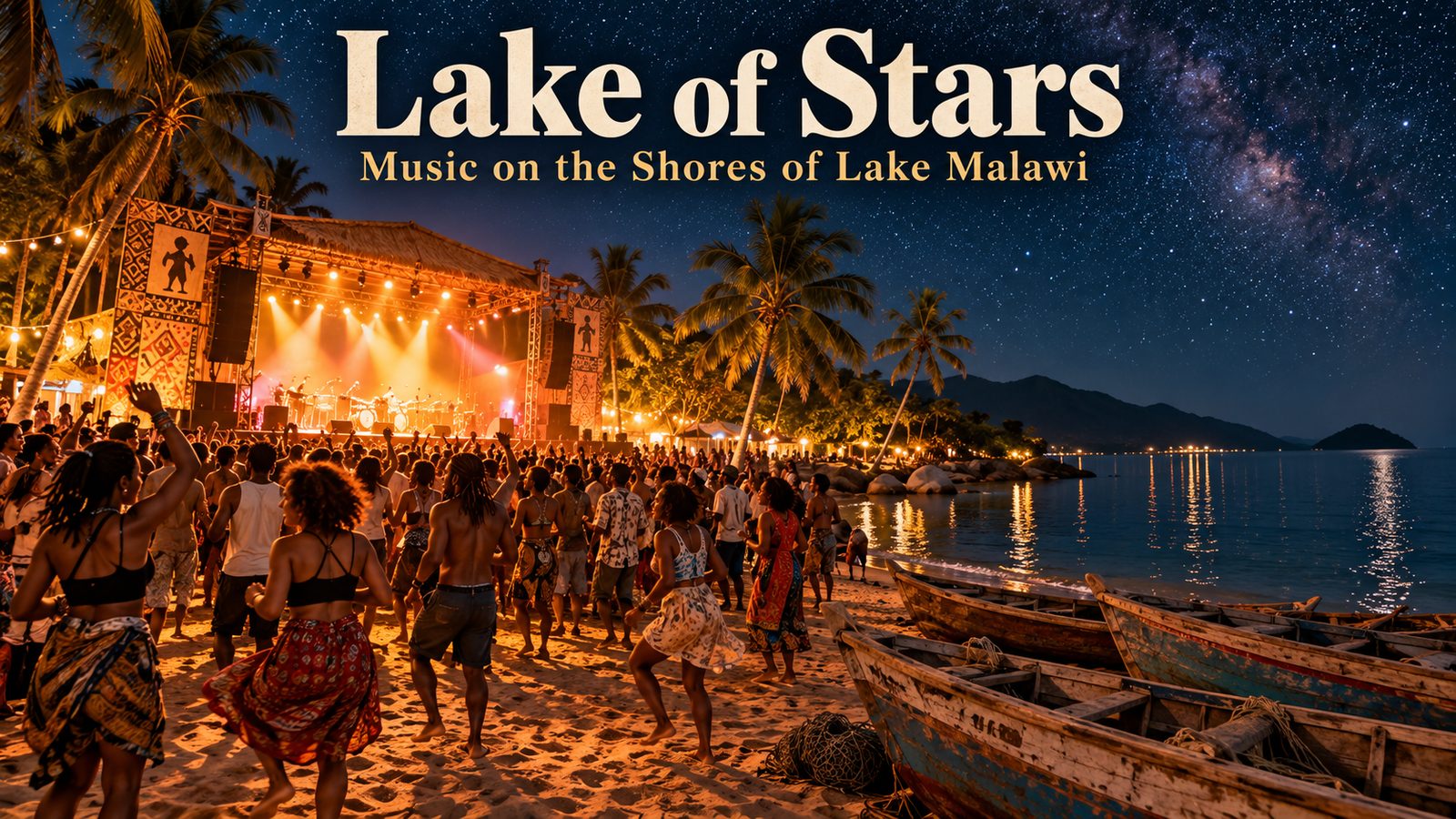
Imagine a beach of soft golden sand. In front of you stretches a body of fresh water so large that its far shore disappears into haze; fishing canoes drift past at dusk, and at night the lights of fishing boats glitter on the water like stars. Behind you, a stage is lit up and a crowd is dancing to a Malawian band, followed by a DJ from Johannesburg and a group from London. This is Lake of Stars, Malawi's best-known music and arts festival, held on the shores of Lake Malawi.
The lake of stars
The festival takes its name from a description of Lake Malawi often attributed to the Scottish missionary-explorer David Livingstone, who is said to have called it the "lake of stars" after the lanterns of fishermen glimmering on the water at night. Whether or not Livingstone used those exact words, the image has stuck.
Lake Malawi is one of Africa's great lakes, about 580 kilometres long, shared by Malawi, Mozambique and Tanzania. It holds more species of fish than any other lake on Earth, especially the brightly coloured cichlids, and its southern end is protected as Lake Malawi National Park, a UNESCO World Heritage Site. Its shores are lined with fishing villages, beaches and lodges.
How the festival began
Lake of Stars was started in 2004 by Will Jameson, a young Briton whose first stay in Malawi, volunteering in the year between school and university, left him determined to return. He returned with the idea of creating a festival that would showcase Malawi to the world, support local artists and bring visitors and income to the lakeshore. The first edition was small, at Chintheche in the north, but it grew quickly.
Since then, the festival has moved between several locations along the lake, including Nkhata Bay, Senga Bay near Salima, and Mangochi in the south. It is usually held over a long weekend around September or October, at the end of the dry season, when the weather is warm and the lake is calm. Like many events worldwide, it has had to pause or scale back in some years, including during the COVID-19 pandemic, before returning.
What happens at Lake of Stars
The festival combines:
- Music. Malawian artists, from established stars to rising young acts, share the bill with performers from elsewhere in Africa and from Europe. Genres range from Malawian reggae and afro-pop to traditional music, hip hop, electronic music and gospel.
- Traditional performance. Groups present dances such as Gule Wamkulu, the masked dance of the Chewa people, which UNESCO has recognised as part of the Intangible Cultural Heritage of Humanity, and other dances from across the country.
- Arts and ideas. Over the years the programme has included poetry, theatre, film screenings, visual art and talks.
- The lake. Between performances, festival-goers swim, take boat trips, eat fresh chambo (tilapia) grilled on the beach, and watch the sunrise over the water.
Malawian music on the world stage
Malawi's music scene is lively but less known internationally than those of Nigeria or South Africa. Lake of Stars has given Malawian musicians a platform to perform for international audiences, collaborate with foreign artists and gain experience. Organisers say alumni have gone on to play at festivals abroad, including Glastonbury in the UK.
Among the Malawian creatives associated with the festival over the years are the poet and musician Q Malewezi, the reggae artist Lucius Banda and the singer-guitarist Faith Mussa, whose music blends traditional instruments with modern production.
A boost for the economy
Tourism matters greatly to Malawi, one of the world's poorest countries. The festival's organisers estimate that a single successful weekend can bring hundreds of thousands, and in good years well over a million, US dollars into the economy, through lodges, transport, food, crafts and jobs. They also credit it with inspiring the growth of other festivals in the country.
Part of a festival map
Lake of Stars is part of a growing circuit of African festivals that combine music, culture and tourism, such as Sauti za Busara in Zanzibar, which we described in our story on Sauti za Busara, and Chale Wote in Accra. Each has its own character; Lake of Stars is distinguished by its setting.
"The warm heart of Africa"
Malawi markets itself as "the warm heart of Africa", a phrase meant to describe the friendliness of its people. Festival-goers often say that is what they remember most: not only the music and the lake, but the welcome.
Why it matters
Lake of Stars shows how a festival can celebrate a country's culture, connect local artists with the wider world and support communities. It turns a beach into a meeting place for musicians, dancers, poets and visitors from many countries. And it reminds everyone who attends of the beauty of one of Africa's most remarkable lakes, glittering, as the old name says, with stars.