Gadaa: The Oromo System of Self-Government Recognised by UNESCO
For centuries, the Oromo of Ethiopia and Kenya have governed themselves through Gadaa, a system of rotating leadership with eight-year terms, assemblies under sacred trees and checks on power.
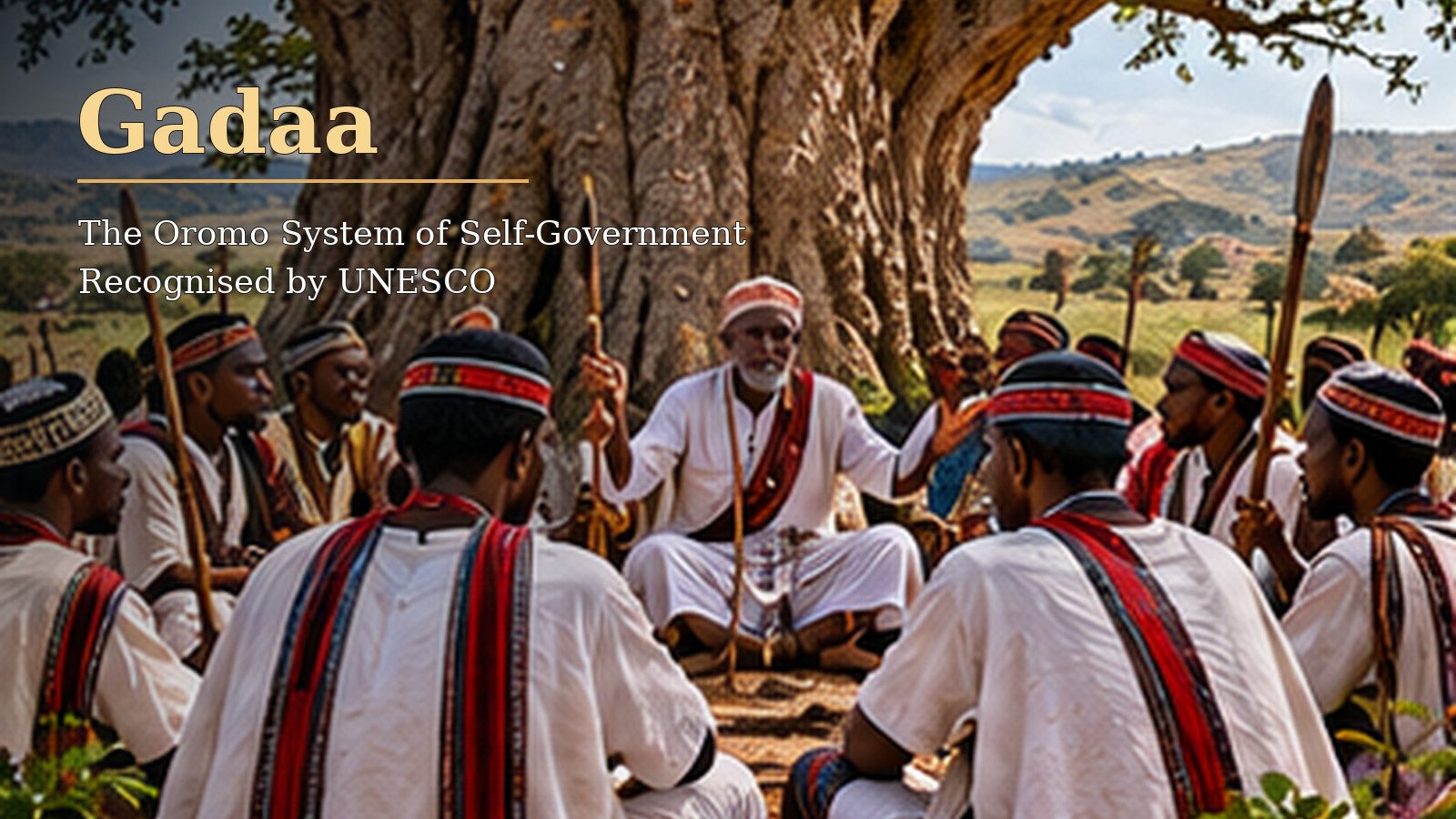
Under the wide branches of a great sycamore tree in southern Ethiopia, an assembly gathers. Elders and representatives sit in a circle; leaders who have served their term listen as the community debates laws, settles disputes and prepares to hand power to a new generation. The tree is an odaa, a sacred symbol of the Oromo people, and the system of government being practised beneath it is called Gadaa (also spelled Gada). In 2016, UNESCO added it to its list of the world's intangible cultural heritage, describing it as an indigenous democratic system of the Oromo.
The Oromo
The Oromo are one of the largest ethnic groups in the Horn of Africa, living mainly in Ethiopia, where they make up the largest population group, and in northern Kenya. They speak Afaan Oromoo, a Cushitic language. The Oromo include many regional groups — such as the Borana, Guji, Macha, Tulama and Arsi — and Gadaa has been practised in different forms among them, most fully preserved among the Borana in southern Ethiopia and northern Kenya.
How Gadaa works
Gadaa is complex, and scholars have spent careers studying it. In simple terms:
- Generation classes. Society is organised into five classes, called gadaa grades or luba. A man's class is determined by his father's class, not his age: sons enter the system a fixed number of grades after their fathers.
- Eight-year stages. Each class passes through a series of grades, each lasting eight years, with different rights and duties at each stage — from childhood and youth, through warriorhood and leadership, to elderhood and advisory roles.
- Rotating power. When a class reaches the ruling grade, it holds political, judicial and ritual leadership for eight years, led by an elected leader called the Abbaa Gadaa. Then it must hand over power to the next class in a formal ceremony.
- Assemblies. Major decisions are made by assemblies (caffee or gumii), held at traditional sites, often under sacred odaa trees. The great assembly can review and amend laws.
- Advisers and religious leaders. Retired leaders form councils that advise the ruling class, and the Qaalluu, a religious leader, plays a central role in rituals, including the transfer of power.
Checks on power
Several features of Gadaa are often highlighted as democratic:
- Fixed terms — no leader can rule for more than eight years.
- Peaceful transfer of power on a regular schedule.
- Election of leaders by their peers.
- Accountability — a leader who breaks the law can be removed from office before his term ends, through a process called buqisu.
- Separation of roles between political, ritual and advisory functions.
Women and Gadaa
Formal Gadaa offices were held by men. But Oromo women had their own powerful institution, siiqqee (siinqee), named after a special stick that married women carry. Through siiqqee, women organised collectively to protect their rights, resolve disputes and, when men violated women's rights, demand redress. Women were also consulted on important community decisions. Scholars debate how far Gadaa can be called fully democratic given its gender and age divisions, but many emphasise the significant role of siiqqee.
History and survival
Gadaa is centuries old. It shaped Oromo society during their great migrations and expansions in the 16th century and beyond. In the 19th and 20th centuries, the incorporation of Oromo lands into the Ethiopian empire, and later government policies, weakened the system in many areas. It survived most strongly among the Borana and Guji.
In recent decades, Gadaa has become a powerful symbol of Oromo identity and pride. Traditional power-transfer ceremonies draw huge crowds, and the Oromia regional government has promoted Gadaa as part of its cultural heritage.
Why it matters
Gadaa challenges the idea that democracy is a purely Western invention brought to Africa from outside. For centuries, the Oromo practised a system of term limits, elected leaders, assemblies and impeachment — under trees, not in parliaments. Like Southern Africa's ubuntu, it is an African idea about how people should live and govern together, and it offers lessons that modern societies, in Africa and beyond, are still discussing.
Further reading
- Horn Affairs — Briefing: What is Oromo's Gada system? (2016)
- Asmarom Legesse, Gada: Three Approaches to the Study of African Society (Free Press, 1973)
- UNESCO — Gada system, an indigenous democratic socio-political system of the Oromo (2016)