Fufu: One Dish, Many Countries, Endless Debate
Pounded, swallowed and never chewed, fufu is eaten from Ghana to Congo under many names. Here is what it is, how it is made, and the rules for eating it.
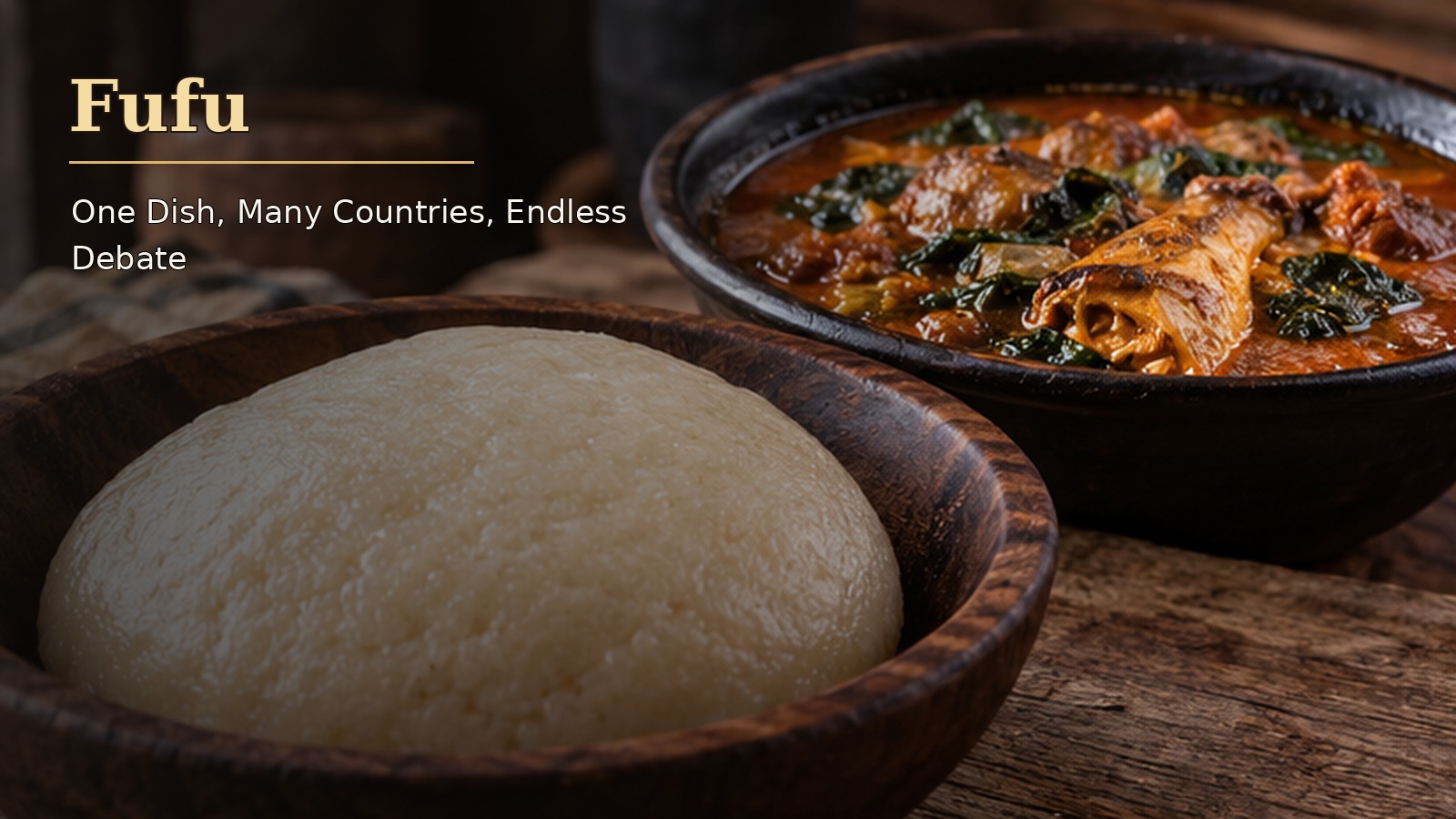
A rhythmic thud echoes from a courtyard: thump… thump… thump. One person raises and drops a long wooden pestle into a mortar, while another, between strokes, turns and folds the mixture inside with a wet hand. Timing is everything. The result is a smooth, stretchy, pale mound of fufu — a food so central to life in West and Central Africa that in several languages it is simply the word for "food."
What fufu is
Fufu is a soft, dough-like staple made by cooking starchy foods and pounding them until smooth and elastic. In Ghana, the classic version is made from boiled cassava and plantain, pounded together. Elsewhere, fufu may be made from cassava alone, from yam, from cocoyam (taro), or, in parts of Central Africa, from fermented cassava flour.
It is served as a smooth ball, usually in a bowl of soup or stew, and eaten by hand.
One idea, many names
Pounded or stirred starchy staples are found across the continent, and each region has its own version:
- Fufu (or fufuo) in Ghana, where it is eaten with soups such as light soup, groundnut soup or palm nut soup.
- Foufou in Côte d'Ivoire and foutou, often made with plantain and cassava or yam.
- Fufu, akpu and pounded yam in Nigeria, served with soups such as egusi (melon seed) or ogbono.
- Fufu in the Democratic Republic of the Congo and Congo-Brazzaville, usually made from cassava flour stirred into hot water, eaten with pondu (cassava leaves) or fish.
- Ugali in Kenya and Tanzania, nshima in Zambia and sadza in Zimbabwe — stiff maize-flour porridges that play the same role at the table.
Fufu also travelled with enslaved Africans to the Caribbean. Cuba has a dish called fufú de plátano, and versions survive in Puerto Rico and the Dominican Republic.
How it is made
Traditional fufu-making is physical work and usually a two-person job.
- Boil cassava and plantain (or yam) until soft.
- Pound in a large wooden mortar with a heavy pestle. One person pounds; the other turns the fufu with wet hands between strokes so it is evenly smooth — and keeps their fingers out of the way.
- Shape the finished fufu into a smooth ball, and serve it in a bowl of soup.
Today many families use fufu machines, electric mixers or instant fufu flour made from dried cassava, plantain or yam, which is stirred into hot water. Purists say nothing beats the pounded version — and the sound of pounding is still part of the soundscape of many towns.
How to eat fufu
Fufu comes with its own etiquette, and newcomers are often corrected:
- Wash your hands first. Fufu is eaten with the right hand.
- Pinch off a small piece, press a dent into it with your thumb to make a scoop, and dip it in the soup.
- Swallow, don't chew. This is the rule most visitors find hardest. Fufu is meant to be swallowed smoothly with the soup; chewing it is considered odd, and some say it spoils the experience.
- A knife and fork are unnecessary — and, to many hosts, slightly insulting to the fufu.
Fufu and the West African "jollof wars"
Just as West Africans argue over who makes the best jollof rice, they argue over fufu: which starch is best, whether pounded or stirred is "real" fufu, and which soup it should be served with. The debates are mostly good-humoured, and the only way to settle them is to eat.
Why it matters
Fufu is more than filling food. It represents a way of cooking and eating built on shared labour — the pounding — and shared bowls. It links Ghana to Congo to Cuba, and it carries the memory of the crops, especially cassava, that became African staples after arriving from the Americas centuries ago. The next time you hear that rhythmic thud of pestle on mortar, you are hearing one of the continent's oldest sounds of home.
Further reading
- Fran Osseo-Asare, Food Culture in Sub-Saharan Africa (Greenwood, 2005)
- James C. McCann, Stirring the Pot: A History of African Cuisine (Ohio University Press, 2009)
- Food and Agriculture Organization (FAO) — cassava and plantain resources