Aboakyer: The Winneba Festival Where Hunters Catch a Live Deer by Hand
Tomorrow, two rival warrior companies in Winneba, Ghana, will race into the bush armed only with sticks to catch a live antelope for their god. Here is the story of Aboakyer.
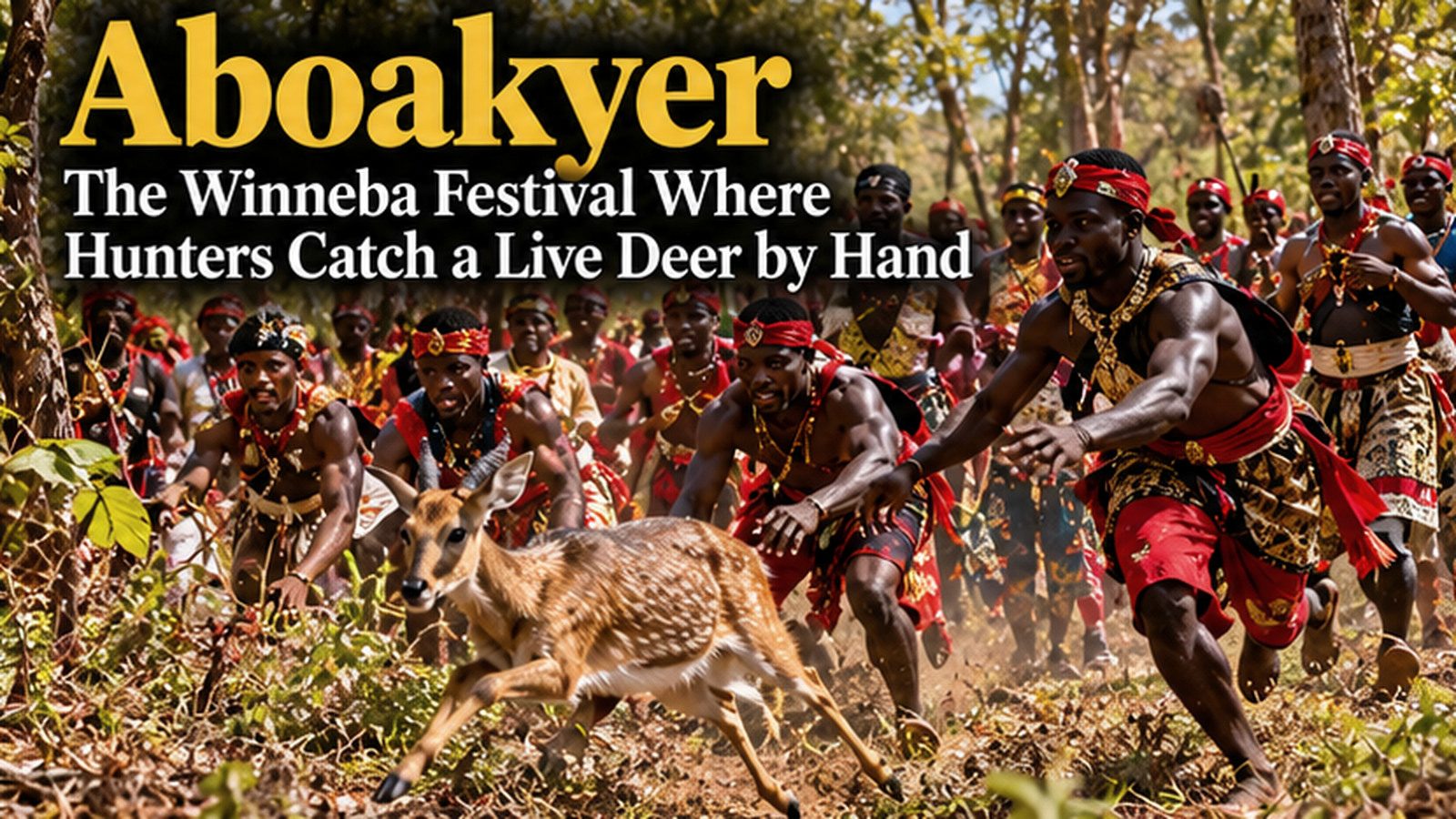
Before dawn on the first Saturday of May, the coastal town of Winneba in Ghana's Central Region is already awake. Two groups of young men, dressed in the colours of their companies and singing war songs, march out of town towards the bush. They carry no guns and no traps — only sticks and clubs. Their mission is to find a wild antelope and catch it alive, then carry it back through cheering crowds to their chief. The first company to succeed wins the honour of the year. This is Aboakyer, one of Ghana's oldest and most dramatic festivals, and this year it takes place tomorrow.
The people of Winneba
Winneba is home to the Effutu (also written Efutu or Simpafo), one of the coastal peoples of Ghana. In Fante, the language widely spoken in the area, Aboakyer means roughly "hunting for a live animal" or "catching game." The festival is the most important event in the Effutu year, drawing people home from across Ghana and abroad.
A legend of migration and a demanding god
According to Effutu tradition, the people migrated long ago from the north — accounts often link their origins to the region of the old western Sudanese empires — and eventually settled on the coast at Winneba. They believed they had been guided and protected by a powerful god called Penkye Otu.
The god, the story goes, demanded a yearly human sacrifice, said to have been chosen from among the young people of the ruling family. The people pleaded with the god, through its priest, to accept something else. A wild cat — usually described as a leopard — was offered instead, but capturing a live leopard with bare hands cost many lives. The people pleaded again, and the god finally agreed to accept a bushbuck (a type of antelope, commonly called a "deer" in Ghana). The festival has been held in this form ever since, as a thanksgiving to Penkye Otu for protecting the Effutu, for a good harvest, and to cleanse the community.
Two rival companies
The hunt is carried out by the town's two Asafo companies — traditional warrior organisations found in many Fante and coastal communities. Asafo companies historically served as local militias and still play important roles in community life, ceremonies and public works. Each has its own flags, shrines, songs, colours and fierce sense of pride.
In Winneba, the two companies are commonly known as No. 1 and No. 2 (often referred to as Tuafo and Dentsefo). Their rivalry is centuries old and intensely felt. On the morning of the hunt, each company goes to its own hunting ground.
The rules of the hunt
The rules are strict:
- The animal must be caught alive.
- Hunters may use only sticks and clubs — no guns, nets or traps.
- The animal must be a bushbuck, the type accepted by the god.
The first company to return with its catch presents it to the Omanhene (paramount chief) of the Effutu, who steps over the animal three times. That company is declared the winner, and its members dance and sing triumphantly through the town. The captured animal is taken to the shrine of Penkye Otu and sacrificed the following day. Priests may also read signs from how the hunt went to predict the community's fortunes for the coming year.
The days around the hunt
Aboakyer is not just one morning. It is a season of preparation and celebration that includes:
- Purification rites and a period of quiet before the festival.
- Processions of chiefs, priests and Asafo companies in full regalia.
- Drumming, dancing and singing, with the Asafo companies performing their distinctive war songs.
- Durbars, at which chiefs sit in state and the community honours them.
- Family reunions and feasting.
Tradition and the modern world
As towns have grown and forests have shrunk, bushbuck have become scarcer around Winneba, and some years the hunt takes longer. Wildlife officials and traditional leaders have discussed how to keep the custom sustainable. The rivalry between the Asafo companies has occasionally led to clashes, prompting calls for peace and stronger organisation. At the same time, the festival has become a major cultural and tourist event, celebrated with pride by the Effutu at home and abroad.
Aboakyer is one of many Ghanaian festivals tied to history and the land — like the Ga people's Homowo, which remembers famine and celebrates harvest in nearby Accra.
Why it matters
Aboakyer keeps alive a story of migration, sacrifice and negotiation with the divine — a community that, according to its own tradition, persuaded its god to accept an animal instead of a human life. It also keeps alive the Asafo companies, the energy of the hunt, and the bonds of a town that gathers once a year to tell its story again. If you are in Winneba tomorrow, follow the songs into the bush — and stand back when the winners come running home.
Further reading
- Ghana Tourism Authority — Aboakyer Festival
- Ghana Business News — Asafo warriors capture two deers to climax 2023 Aboakyer Festival
- Ansu Datta and R. Porter, "The Asafo System in Historical Perspective," Journal of African History 12 (1971)