Suya: Nigeria's Smoky, Spicy Street Food After Dark
Thin slices of beef on skewers, coated in a fiery peanut spice and grilled over open coals: suya is Nigeria's favourite night-time snack. Here is its story.
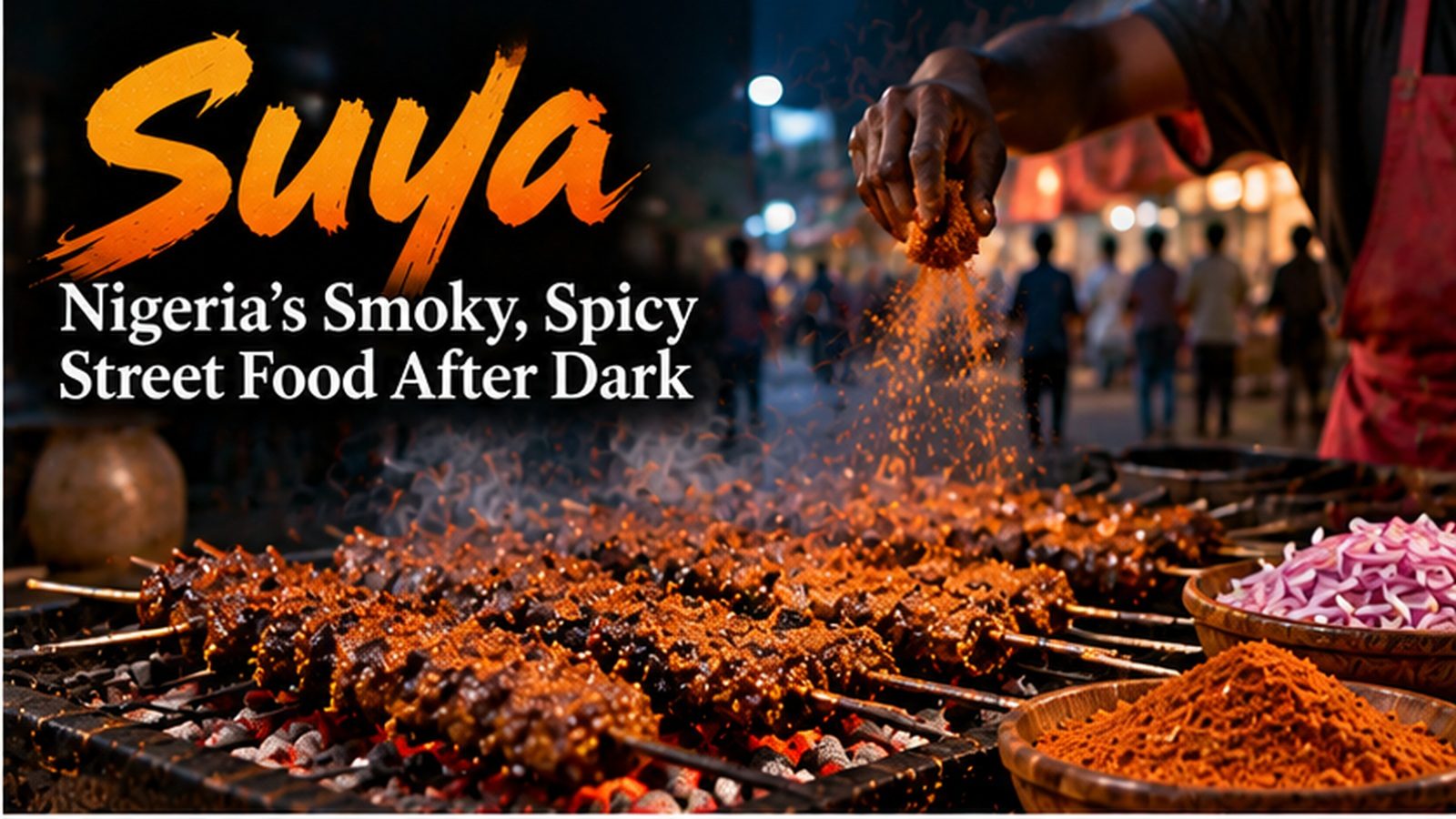
As darkness falls in Lagos, Abuja or Kano, smoke rises from roadside grills. Under a bare bulb, a vendor in a long robe slices beef paper-thin, threads it onto sticks, dusts it heavily with a reddish-brown powder and lays it over glowing charcoal. The smell is impossible to ignore. Within minutes, customers are queuing. When their order is ready, it comes wrapped in newspaper, with sliced raw onions, tomatoes and an extra pile of spice on the side. This is suya — and for many Nigerians, a night out is not complete without it.
A Hausa tradition
Suya comes from the Hausa and other peoples of northern Nigeria and the wider Sahel, where cattle herding and grilling meat over open fires are old traditions. Suya-making is a skilled trade, traditionally practised by Hausa men known as mai suya ("suya owners" or "suya sellers"), many of whom learned the craft from relatives.
From the north, suya spread to every corner of Nigeria — and to Ghana, Cameroon, Niger and beyond. In the southern cities, many suya spots are still run by vendors from the north, and the stalls are a meeting point of communities from across the country.
The spice: yaji
The secret of suya is the spice mix, often called yaji (or simply "suya spice"). Recipes vary from vendor to vendor and are closely guarded, but most include:
- Ground roasted peanuts, often in the form of kuli-kuli — a crunchy peanut snack made by pressing out the oil from peanut paste, which is then ground into powder.
- Dried chilli pepper — lots of it.
- Ginger, garlic and onion powder.
- Salt and stock cubes.
- Sometimes other spices such as grains of selim or alligator pepper.
The peanut base gives suya its nutty depth and slightly gritty coating, while the chilli brings serious heat.
How it is made
- Slicing. Beef (or sometimes ram, chicken, liver, kidney or goat) is sliced very thin and wide, almost like sheets.
- Seasoning. The meat is coated with oil and plenty of yaji, and sometimes left to marinate.
- Skewering. The slices are threaded onto thin wooden skewers.
- Grilling. The skewers are laid over hot coals on a wide grill, turned and basted, until the edges are crisp and slightly charred.
- Serving. The meat is pushed off the skewers, chopped if needed, and wrapped with fresh onions, tomatoes, sometimes cabbage, and more spice.
Cousins of suya
Northern Nigeria has other famous grilled and dried meats:
- Kilishi — thin sheets of beef coated in a peanut-spice paste and sun-dried, then lightly grilled, similar to jerky. It keeps for weeks and is popular as a gift.
- Balangu — larger chunks of meat roasted over an open fire, often sold near markets.
- Tsire — a term sometimes used for skewered suya specifically.
Suya and social life
Suya is the classic night food. People buy it on the way home from work, at bars and parties, during football matches and at weddings. In many neighbourhoods, the suya spot is a social hub, where people stand and chat while they wait. Suya is also served at celebrations in Nigeria and the diaspora — and suya-flavoured snacks, burgers and pizzas now appear in restaurants from London to Houston.
Like the kola nut, another northern Nigerian staple carried far along trade routes, suya shows how foods from the Hausa world have travelled across West Africa.
Why it matters
Suya is street food at its finest: simple ingredients, expert hands and a recipe passed from vendor to vendor. It brings together the herding traditions of the north and the busy nights of Nigeria's cities, and it is shared by people of every region and religion. Wherever there is smoke rising from a roadside grill after dark, there is likely to be a queue — and a suya man with a secret spice blend.
Further reading
- Kitchen Butterfly (Ozoz Sokoh) — Nigerian food writing
- Yemisi Aribisala, Longthroat Memoirs: Soups, Sex and Nigerian Taste Buds (Cassava Republic Press, 2016)
- BBC Travel — Nigerian street food coverage