Biltong: Southern Africa's Dried Meat Tradition
Strips of beef or game, cured in vinegar and coriander and air-dried until dark and chewy. Biltong is South Africa's favourite snack, with roots in older African and settler traditions.
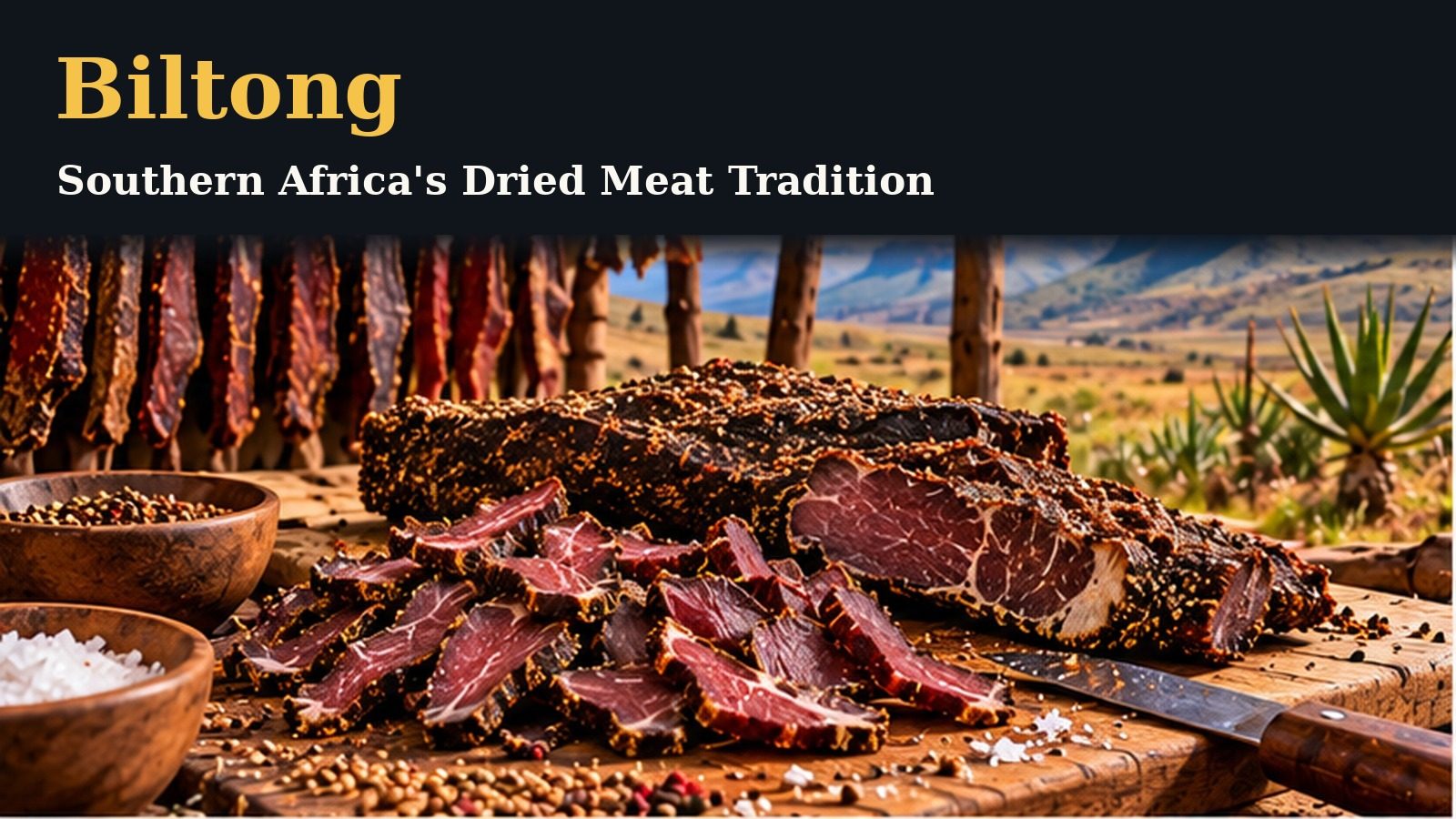
At a rugby match in Pretoria, on a road trip through the Karoo, or at a braai in a Johannesburg back garden, there is a snack you will almost always find: biltong. Strips of dried meat, dark red on the outside, sometimes pink in the middle, sliced thin and eaten with the fingers. It is salty, savoury and fragrant with coriander and pepper. For many South Africans, Namibians and Zimbabweans, at home or abroad, biltong is more than a snack. It is a taste of home.
What is biltong?
Biltong is cured, air-dried meat. It is usually made from beef, but traditionally also from game such as kudu, springbok, eland, impala and ostrich. The meat is cut into strips, marinated briefly in vinegar, then coated in a spice mixture of salt, coarsely ground coriander seed, black pepper and sometimes brown sugar or other spices, and hung to dry in cool, circulating air for several days.
Unlike American jerky, which is usually cut thin, marinated in sweet or smoky sauces and cooked or smoked, biltong is not cooked. It is cured by the salt and vinegar and dried by the air. It can be dried until hard, or left "wet" (moist and pink inside), depending on taste.
Where does the name come from?
The word biltong is Afrikaans (from Dutch). It is usually explained as coming from bil, meaning "buttock" or rump, and tong, meaning "strip" or "tongue". So biltong means something like "rump strip", a reference to the cut of meat often used.
Roots in older traditions
Drying meat to preserve it is an ancient practice in southern Africa. Long before European settlement, the Khoikhoi and San peoples, and Bantu-speaking peoples, dried strips of meat in the sun and wind to preserve it, a necessity in a hot climate without refrigeration.
When Dutch settlers arrived at the Cape from the 17th century, they adapted these practices, adding vinegar, salt and spices such as coriander, which were available through the Dutch East India Company's spice trade with Asia. Biltong became especially important during the Great Trek of the 1830s, when Voortrekker families travelled into the interior with ox wagons, needing food that would last for weeks or months. Dried meat was ideal.
How biltong is made
The basic method:
- Cut the meat with the grain into thick strips, often from the silverside or topside of beef.
- Soak the strips briefly in vinegar (often brown grape or apple cider vinegar), which helps preserve the meat and adds flavour.
- Season with coarse salt, roasted and crushed coriander seeds, black pepper and other spices.
- Hang the strips to dry in a cool, dry, airy place, or in a biltong box, a wooden or metal cabinet with a light bulb or fan to circulate warm air.
- Dry for three to seven days, depending on thickness and how moist you like it.
- Slice thinly and enjoy.
Droëwors and other relatives
Biltong has a close relative: droëwors (Afrikaans for "dry sausage"), a thin sausage of beef or game, flavoured with coriander and other spices, and air-dried like biltong. It is sold alongside biltong in butcheries and shops.
Across Africa, other peoples have their own dried meat traditions, such as kilishi, the spicy dried meat of northern Nigeria, related to suya, and nyama kavu in East Africa.
A national snack
Biltong is sold everywhere in South Africa: in butcheries, supermarkets, petrol stations, airports and specialist biltong shops. It is eaten:
- At sports events, especially rugby and cricket.
- On road trips and hunting trips.
- With a cold drink at a braai, the South African barbecue described in our story on the braai.
- As a gift for friends and family abroad.
In the diaspora, in the UK, Australia, New Zealand, Canada and the United States, South Africans have opened biltong shops and businesses, and biltong has become popular with people with no South African connection, attracted by its high protein content.
Biltong and identity
Biltong is often associated with Afrikaner culture, but today it is enjoyed by South Africans of all backgrounds, as well as in Namibia, Zimbabwe, Botswana, Zambia and elsewhere. It is one of the foods that South Africans of many communities share, a reminder that food traditions often cross boundaries that history tried to draw.
Why it matters
Biltong shows how a simple technique, drying meat in the air, can become a national icon. It combines ancient African methods of preservation with spices from the Indian Ocean trade and the needs of travellers in a vast country. Today, a strip of biltong is a snack, a gift, and for many people far from home, a reminder of the open skies of southern Africa.
Further reading
- Lannice Snyman, Rainbow Cuisine: A Culinary Journey Through South Africa (Southern Book Publishers / Snyman, 1998)
- Brand South Africa — Biltong, a South African institution