Yaa Asantewaa: The Queen Mother Who Went to War for the Golden Stool
In 1900, when a British governor demanded to sit on the sacred Golden Stool of the Asante, a queen mother in her sixties rallied an army. For International Women's Day, her story.
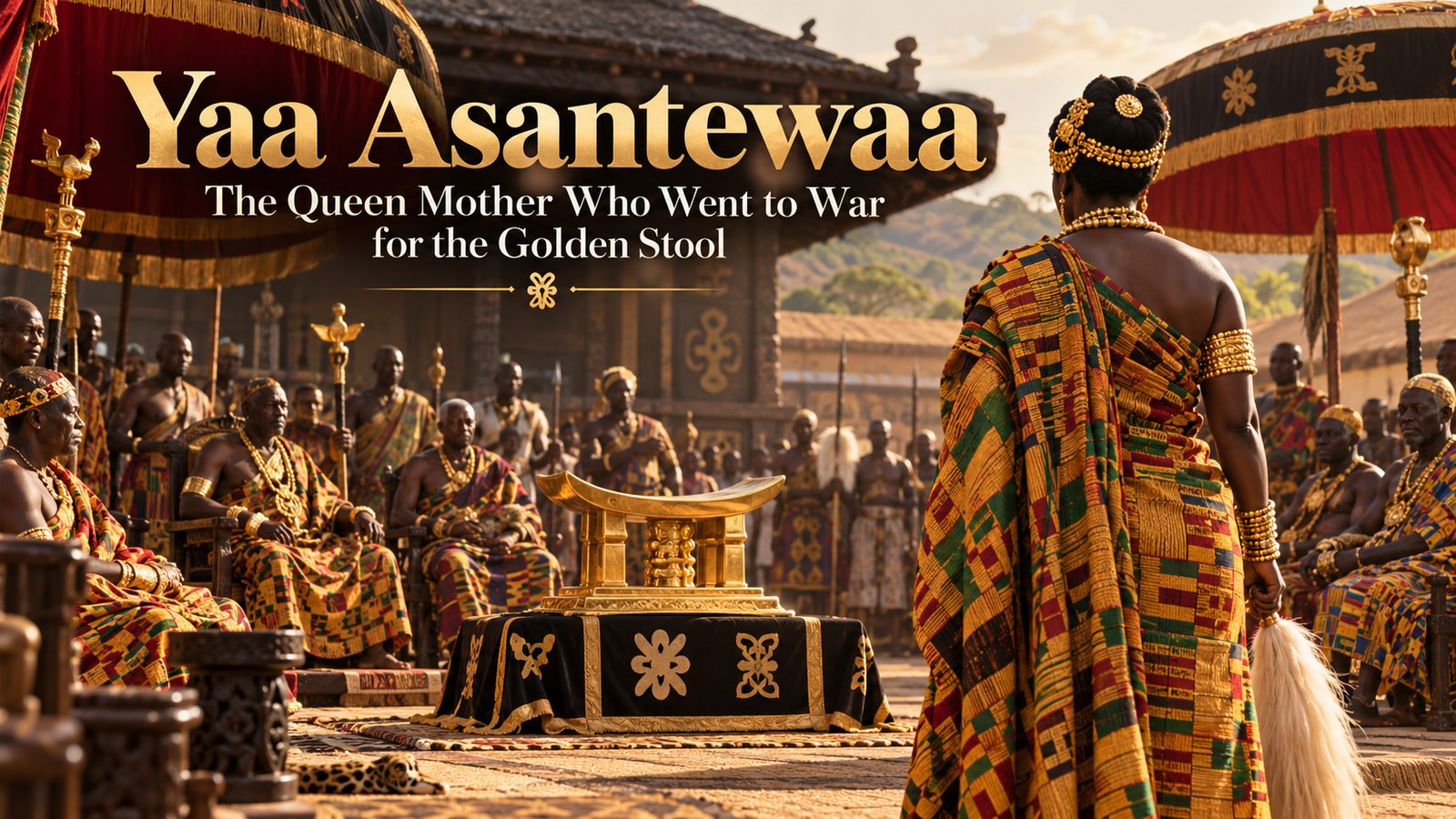
On 28 March 1900, the British governor of the Gold Coast, Sir Frederic Hodgson, addressed the chiefs of the Asante in Kumasi. He demanded money owed to Britain, and then he asked a question that would start a war: Where is the Golden Stool? Why am I not sitting on it at this moment?
To the Asante, the question was an outrage. And one of the people who heard about it was Yaa Asantewaa, the queen mother of Ejisu (Edweso), a woman in her sixties. Within days, she had helped launch the last great Asante war of resistance against British rule. On International Women's Day, her story is worth telling.
The Golden Stool
The Golden Stool (Sika Dwa Kofi) is the most sacred object of the Asante people of Ghana. According to tradition, it was brought down from the sky around the end of the 17th century by the priest Okomfo Anokye, and landed on the lap of Osei Tutu, the first Asantehene (king of Asante). It is believed to contain the soul (sunsum) of the Asante nation — its unity, its past and its future.
No one sits on the Golden Stool — not even the king. It has its own throne and is brought out only on the most important occasions. For a foreign governor to demand to sit on it was, in Asante eyes, a demand to own the soul of the nation.
A kingdom under pressure
By 1900, the once-mighty Asante kingdom had been weakened by decades of conflict with Britain. In 1896, British forces had occupied Kumasi and arrested the Asantehene, Prempeh I, along with other leaders, including Yaa Asantewaa's grandson, the chief of Ejisu. They were eventually exiled to the Seychelles, in the Indian Ocean. As queen mother, Yaa Asantewaa became one of the leading figures left in Ejisu.
"If you the men will not go forward…"
After Hodgson's speech, Asante leaders met in secret to decide what to do. Some hesitated. According to the account most often told, Yaa Asantewaa stood up and challenged them: if the men of Asante would not go forward to fight, then the women would. Whether the words were exactly these or not, her role is clear: she was chosen as war leader of the Asante forces — an extraordinary position for a woman — and helped persuade others to fight.
The War of the Golden Stool
The war began within days. Asante forces besieged the British fort in Kumasi, trapping the governor, his party and hundreds of others inside for months. Hodgson eventually broke out and escaped. Britain sent large reinforcements, and fierce fighting continued for months. By late 1900, superior British firepower had prevailed.
Yaa Asantewaa was captured and, in 1901, exiled to the Seychelles, joining Prempeh I and other Asante leaders. She died there on 17 October 1921. Britain formally annexed Asante as a crown colony in 1902.
The stool was never taken
The British won the war, but they never got the Golden Stool. Asante guardians had hidden it, and it remained hidden for years. When it was later accidentally found by labourers in 1921 and some of its gold ornaments stolen, the Asante themselves tried the thieves. The British, by then, had learned to treat the stool with respect. In 1924, Prempeh I was allowed to return home, and the Golden Stool is still the heart of Asante royal ceremonies today.
The stool's survival is often seen as the real victory of 1900: the soul of the nation was not handed over.
Legacy
Yaa Asantewaa is one of Ghana's great national heroines. The Yaa Asantewaa Girls' Senior High School in Kumasi bears her name, and her life is commemorated in Ejisu and in Ghana's history books. She is celebrated far beyond Ghana as a symbol of women's leadership and anti-colonial resistance, in the same tradition as rulers such as Angola's Queen Nzinga.
Why it matters
Yaa Asantewaa's story challenges the image of colonial history as something done to passive African societies. When the soul of her nation was threatened, a queen mother in her sixties stood up when others hesitated — and helped make sure that, whatever else was lost, the Golden Stool would never belong to anyone but the Asante.
Further reading
- BlackPast — The Golden Stool
- Ghana Remembers — The War of the Golden Stool
- A. Adu Boahen, Yaa Asantewaa and the Asante–British War of 1900–1 (Sub-Saharan Publishers, 2003)