The Songhai Empire: West Africa's Largest State and Its Sudden Fall
From its capital at Gao on the Niger River, Songhai ruled a vast empire in the 15th and 16th centuries, until a Moroccan army with firearms crossed the Sahara in 1591.
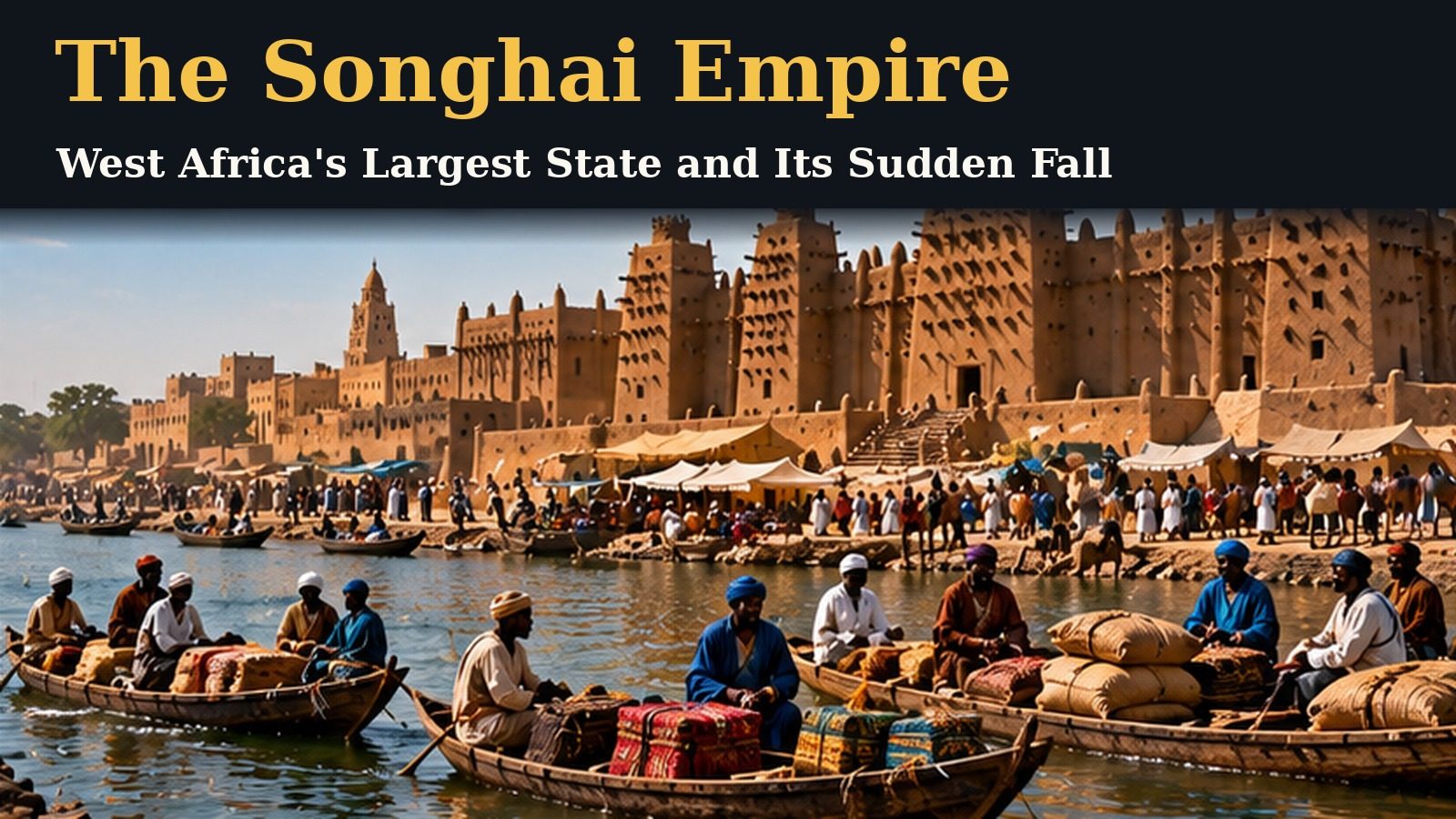
On the banks of the Niger River in the town of Gao, in eastern Mali, stands a strange and impressive building: a tall, pyramid-shaped tower of mud brick, bristling with wooden beams, rising above a mosque and a courtyard. It is the Tomb of Askia, built at the end of the 15th century for one of the most powerful rulers in African history. It is the most visible monument of the Songhai Empire, which at its height was the largest state West Africa had ever seen.
From river people to empire
The Songhai people lived along the middle Niger River, around Gao, for many centuries, as fishermen, farmers and traders. Gao was an important trading city from early times, linked by caravan routes to North Africa. For a period in the 14th century, it was under the control of the Mali Empire, whose most famous ruler, Mansa Musa, passed through its region.
As Mali weakened in the 15th century, Songhai rose.
Sonni Ali: the conqueror
The architect of the Songhai Empire was Sonni Ali (also called Sunni Ali Ber, "the Great"), who ruled from about 1464 to 1492. A brilliant military commander, he built a powerful army and a river fleet on the Niger, and conquered a series of key cities, including Timbuktu (around 1468) and the trading and learning centre of Djenné.
Sonni Ali is remembered in two very different ways. In Songhai oral tradition, he is a great hero and magician-king. In the chronicles written by Muslim scholars of Timbuktu, he is often portrayed harshly, because he clashed with the city's scholars and was seen as only nominally Muslim.
Askia Muhammad: the organiser
After Sonni Ali's death, power passed to a general, Muhammad Touré, who took the title Askia and founded a new dynasty. Askia Muhammad (Askia the Great), who ruled from 1493 to 1528, turned conquest into a well-organised state:
- He expanded the empire to its greatest extent, from the Atlantic region in the west to the Hausa lands in the east and deep into the Sahara.
- He created a system of provincial governors, a professional army, and officials responsible for finance, agriculture, fisheries and justice.
- He supported Islamic scholarship and made Timbuktu, Gao and Djenné flourish as centres of learning.
- In 1496–97, he made the pilgrimage to Mecca, returning with the title of caliph's deputy for West Africa.
His tomb in Gao, built at the end of the 15th century, was listed by UNESCO as a World Heritage Site in 2004.
Trade and learning
Songhai's wealth came from trade: gold from the southern forests, salt from the Sahara, and goods from North Africa and beyond passed through its cities. Timbuktu's scholars produced books and manuscripts, many of which survive today in the family libraries that were saved in 2012, as described in our story on the Timbuktu manuscripts.
The fall: Tondibi, 1591
By the late 16th century, Songhai was weakened by succession disputes among the Askias. Meanwhile, to the north, the Sultan of Morocco, Ahmad al-Mansur, wanted control of West Africa's gold.
In 1590–91, he sent an army of several thousand soldiers, many armed with firearms, across the Sahara under the command of Judar Pasha — an extraordinary march that cost many lives. At the Battle of Tondibi in 1591, near Gao, the Moroccan musketeers defeated the much larger Songhai army, whose cavalry and archers could not match the guns.
The Moroccans occupied Gao and Timbuktu, but they could not control the whole empire. Songhai broke into smaller states, and resistance continued for years. The great empire was gone.
Why it matters
Songhai was the last and largest of the great medieval empires of the West African savanna, following Ghana and Mali. It showed the power of African statecraft, trade and learning — and its sudden fall to an army with firearms foreshadowed how new military technology would reshape Africa. The tomb at Gao still stands, a reminder of an empire that once stretched across the Sahel.
Further reading
- UNESCO World Heritage Centre — Tomb of Askia
- John O. Hunwick, Timbuktu and the Songhay Empire: Al-Sa'di's Ta'rikh al-Sudan down to 1613 (Brill, 1999)
- Nehemia Levtzion, "The Western Maghrib and Sudan," in The Cambridge History of Africa, Vol. 3 (Cambridge University Press, 1977)