Gnawa: Morocco's Trance Music With Roots South of the Sahara
With a three-stringed bass lute, iron castanets and all-night ceremonies, Gnawa music carries the memory of people brought across the Sahara into Morocco.
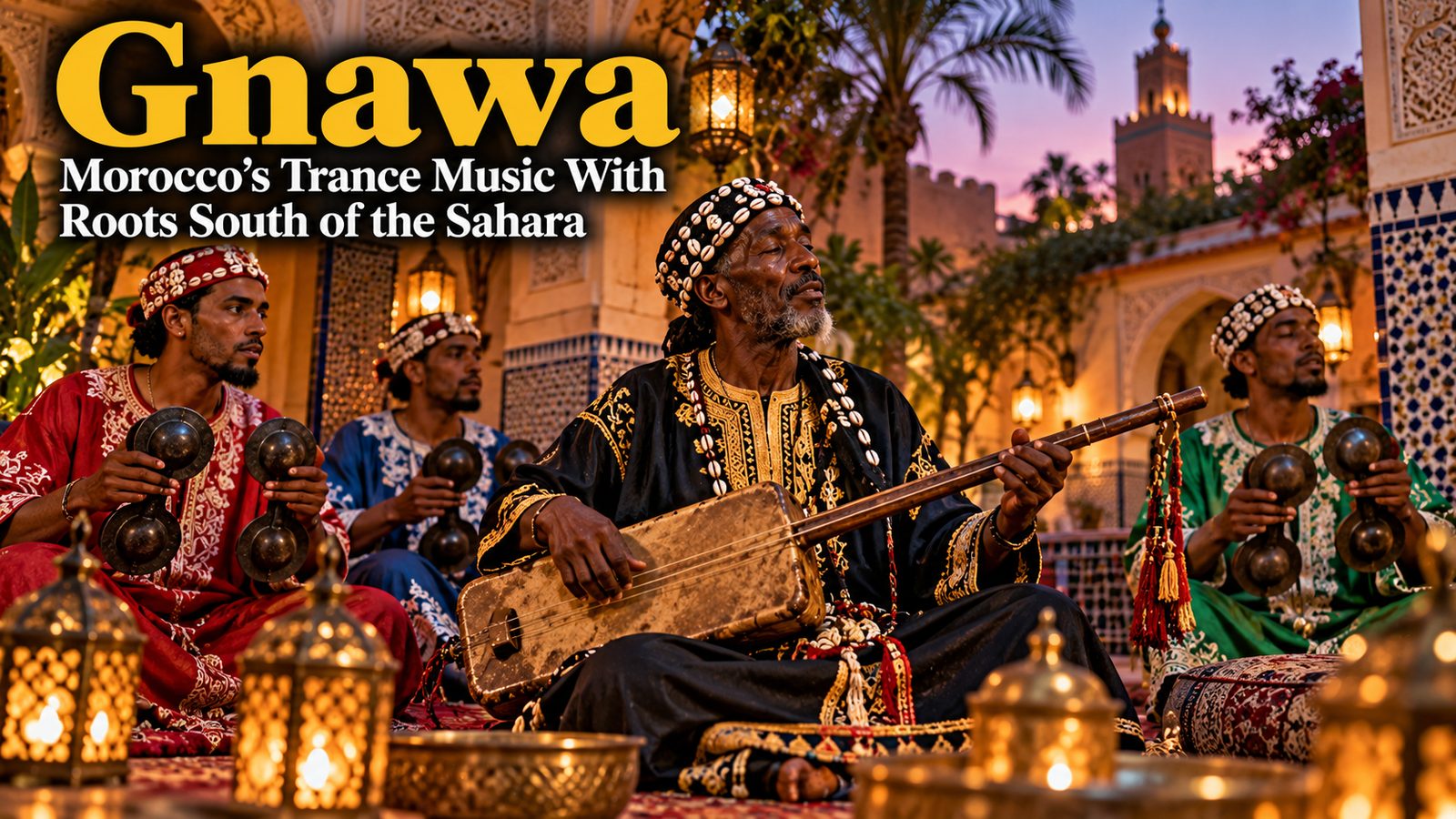
Late at night in a Moroccan house, the lights are low and the air smells of incense. A man cradles a long, boxy lute and plucks a deep, rolling bass line. Around him, others clap heavy iron castanets in a driving rhythm and answer his song in chorus. One by one, people rise to dance, some falling into trance. This is a lila, the night-long ceremony at the heart of Gnawa music.
Who are the Gnawa?
The Gnawa are a community in Morocco whose ancestors came largely from West Africa and the Sahel — regions that, centuries ago, were connected to Morocco by trans-Saharan trade. Many were brought north as enslaved people, soldiers or labourers between roughly the 16th and 19th centuries. Over generations, their descendants formed brotherhoods that blended African spiritual traditions with Islam, especially Sufi practices.
The name "Gnawa" itself is often linked to the word "Guinea" or to a Berber term for Black Africans — a reminder of where the community's roots lie. Gnawa songs still mention places and peoples of the Sahel, and some words in their repertoire come from West African languages.
Gnawa music shares this trans-Saharan history with the Amazigh traditions of the region — the same communities that celebrate Yennayer each January.
The instruments
Gnawa music uses only a few instruments, but they create a powerful sound.
- The guembri (also gimbri or sintir) — a three-stringed bass lute with a wooden body covered in camel skin. The player, called the maalem (master), plucks it with the fingers and also taps its body like a drum.
- The qraqeb (or krakeb) — pairs of large iron castanets, clapped together in fast, interlocking rhythms. Their metallic clatter is instantly recognisable.
- The tbel — a large drum, used in processions and the opening parts of a ceremony.
Over this, the maalem leads call-and-response singing with the other musicians, in Arabic and in older words whose meanings are sometimes no longer fully known.
The lila: a night of healing
The lila (from the Arabic for "night") is a ritual that can last until dawn. It is often held to heal someone, to give thanks, or to fulfil a vow. It moves through a sequence of sections, each associated with a particular spirit, or mluk, and marked by its own colour, incense and songs. Dancers wear cloths in the colour of the spirit being invoked — white, blue, red, green, black and others.
As the music intensifies, participants may enter a trance, which is understood as the spirit's presence. A ritual leader, often a woman known as the moqaddema, guides the ceremony and cares for those in trance. For the Gnawa, trance is not a performance; it is a form of healing and of connection to the sacred.
From ritual to world stage
In the 20th century, Gnawa music began to reach audiences beyond the ceremonies. Jazz and rock musicians from Europe and the Americas, drawn by its hypnotic bass lines and rhythms, collaborated with Gnawa masters. Since 1998, the Gnaoua World Music Festival in the coastal city of Essaouira has brought maalems together with musicians from around the world, attracting huge crowds every year.
In 2019, UNESCO inscribed Gnawa on its Representative List of the Intangible Cultural Heritage of Humanity, recognising both the music and the ritual, social and healing practices around it.
Some Gnawa worry that festivals and recordings have separated the music from its spiritual meaning. Others argue that the attention has helped younger people take pride in a tradition once looked down upon.
Why it matters
Gnawa is a living record of the trans-Saharan world — of people taken far from home who kept their spirits alive through music, and whose descendants turned suffering into one of North Africa's most powerful art forms. The guembri's deep pulse is a reminder that the Sahara was never a wall. It was a road, and the people who travelled it brought their music with them.
Further reading
- UNESCO — Gnawa, Representative List of the Intangible Cultural Heritage of Humanity (2019)
- Museu de la Música de Barcelona — Lila Gnawa: music and spirituality of the Maghreb
- Deborah Kapchan, Traveling Spirit Masters: Moroccan Gnawa Trance and Music in the Global Marketplace (Wesleyan University Press, 2007)