"Ghana Is Free Forever": The Midnight That Changed Africa
On 6 March 1957, Ghana became the first sub-Saharan African colony to win independence. Here is the story of that night, and why it inspired a continent.
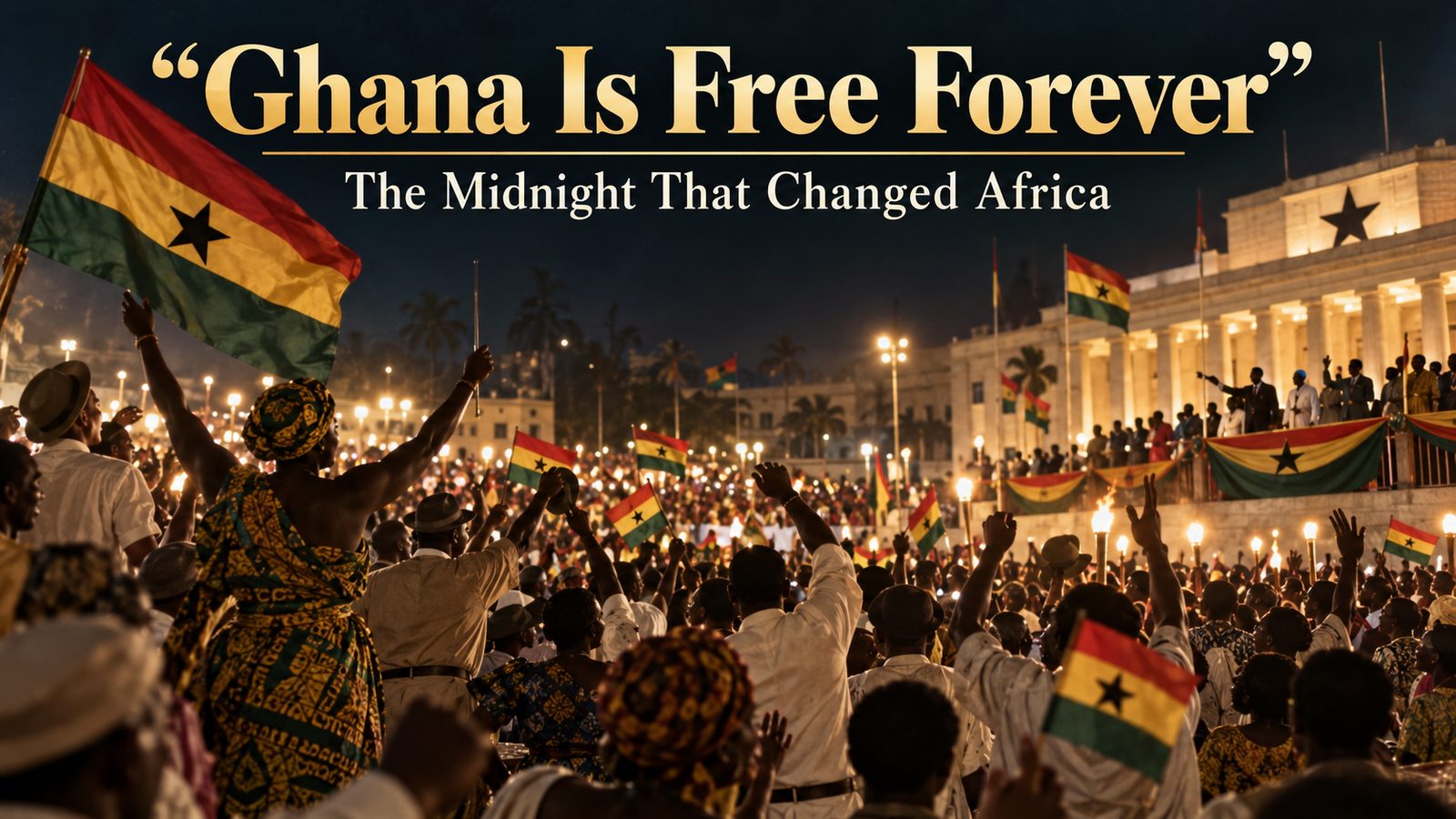
Just before midnight on 5 March 1957, a huge crowd packed the Old Polo Ground in Accra. At the stroke of twelve, the British Union Jack came down and a new flag of red, gold and green with a black star rose in its place. A slim man in a traditional northern smock climbed onto a platform with his colleagues, and, with tears in his eyes, shouted to the crowd: "At long last, the battle has ended! And thus Ghana, your beloved country, is free forever!"
The man was Kwame Nkrumah, and the country was Ghana — the first colony in sub-Saharan Africa to win independence from European rule. Today, 6 March is Ghana's Independence Day.
From Gold Coast to Ghana
For about a century, the territory had been the British colony of the Gold Coast, named for the gold that had drawn European traders since the 15th century. It included the coastal colony, the conquered Asante kingdom in the interior, the Northern Territories and, after a 1956 vote, British-administered Togoland.
At independence, the new nation took the name Ghana, after the ancient Empire of Ghana (also known as Wagadu), a powerful West African state that flourished roughly a thousand years ago in what is now southern Mauritania and western Mali. The new Ghana was not in the same place, but the name was a deliberate statement: Africa had a long history of great states, and the colonial period was an interruption, not the beginning.
The road to freedom
Ghana's independence came after decades of activism by lawyers, journalists, chiefs, farmers, war veterans and market women. In 1948, protests by ex-servicemen and riots in Accra shook British rule. Nkrumah, who had studied in the United States and Britain and been deeply influenced by Pan-Africanist thinkers such as Marcus Garvey and W.E.B. Du Bois, returned home and in 1949 founded the Convention People's Party (CPP), with the slogan "Self-Government Now."
He was jailed by the colonial authorities, but his party won elections while he was in prison, and in 1951 he was released to lead government business. After further elections, Britain agreed to independence.
The midnight speech
Nkrumah's speech that night is one of the most famous in African history. He thanked the people, honoured those who had struggled, and called on Ghanaians to work hard to build the new nation. Then he said the line that would echo across the continent: that Ghana's independence would be meaningless unless it was linked up with the total liberation of Africa.
Among the guests were the American civil rights leader Martin Luther King Jr. and his wife Coretta Scott King, and US Vice-President Richard Nixon. King later preached about what he had witnessed, comparing it to the Exodus.
The idea of declaring freedom at the stroke of midnight — borrowed from India's independence in 1947 — became a tradition repeated by many African countries in the years that followed.
Symbols of a new nation
- The flag — red for the blood of those who died for independence, gold for the country's mineral wealth, green for its forests and farms, and a black star for African freedom. It was designed by Theodosia Okoh.
- The Black Star — inspired in part by Marcus Garvey's Black Star shipping line. It appears on the flag, in Black Star Square, and in the nickname of the national football team, the Black Stars.
- Highlife — the music of the moment, which Nkrumah promoted as a national sound.
What came next
Ghana's independence opened a floodgate. By 1960, the "Year of Africa," seventeen African countries had become independent. Nkrumah hosted Pan-African conferences, supported liberation movements and helped found the Organisation of African Unity in 1963. His own rule became increasingly authoritarian, and he was overthrown in a military coup in 1966 — a reminder that independence was the beginning of a difficult journey, not the end. But his vision of African unity remains influential, and he is honoured today as Ghana's founding father.
The soundtrack of those years was highlife, the music that filled Accra's dance halls on independence night.
Why it matters
6 March 1957 proved that colonial rule in Africa could end — peacefully, through organisation and determination. It gave hope to millions across the continent and the diaspora. And it set a challenge that Africa is still working on: to make freedom mean not just a new flag, but a better life for every citizen.
Further reading
- The Conversation — How Kwame Nkrumah's midnight speech set a tradition for marking the moment of liberation
- Kwame Nkrumah, Ghana: The Autobiography of Kwame Nkrumah (Thomas Nelson, 1957)
- Jean Marie Allman, The Quills of the Porcupine: Asante Nationalism in an Emergent Ghana (University of Wisconsin Press, 1993)