Ghana's Fantasy Coffins: Going to the Ancestors in Style
A fisherman buried in a giant fish, a pilot in an aeroplane, a cocoa farmer in a cocoa pod: among the Ga of Ghana, coffins are sculptures that celebrate a life.
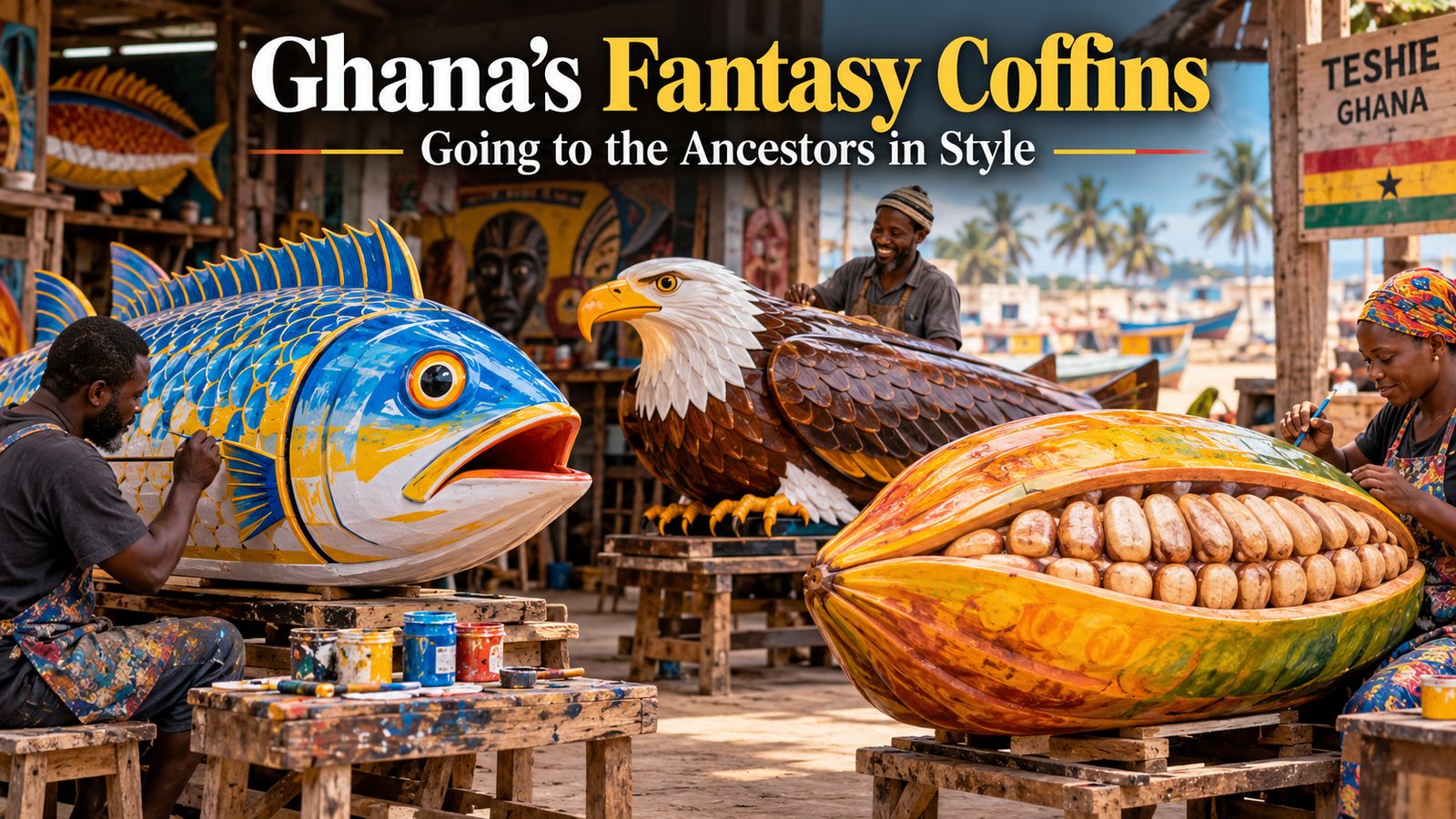
In a workshop near the beach in Accra, carpenters are finishing an unusual commission: a life-size fish, carved from wood and painted silver and blue, its mouth open, its scales carefully detailed. Next to it stands a giant red chilli pepper, and beyond that, a Coca-Cola bottle taller than a man. These are not sculptures for a gallery — or not only. They are coffins. Among the Ga people of Ghana's coast, the dead are often buried in "fantasy coffins" that celebrate who they were in life.
Proverb boxes
In the Ga language, these coffins are called abebuu adekai, roughly "proverb boxes." The shape of a coffin is chosen to say something about the person who has died:
- A fish or canoe for a fisherman.
- A cocoa pod for a cocoa farmer.
- An aeroplane for someone who loved to travel — or always wanted to.
- A car — a Mercedes-Benz is a classic — for a wealthy or successful person.
- A Bible for a devout Christian.
- A sewing machine, camera, pen or hammer for someone's profession.
- A lion, eagle or leopard — powerful animals associated with chiefs and family clans, often reserved for leaders.
Some shapes carry proverbs or clan symbols, and families think carefully about what is appropriate.
Where it began
The tradition is usually traced to the 1950s, in the Ga coastal towns near Accra such as Teshie. A carpenter named Seth Kane Kwei is widely credited with its rise. According to the story most often told, he built a decorated, cocoa-pod-shaped palanquin — a carrying chair — for a chief, who died before he could use it and was buried in it instead. Kane Kwei later built an aeroplane-shaped coffin for his grandmother, who had always dreamed of flying. Other families saw it and began asking for coffins of their own.
Scholars point out that the tradition built on older Ga practices, especially the figurative palanquins in which chiefs were carried at festivals, decorated with animals and symbols of their clans.
Death as a journey
Among the Ga, as in many Ghanaian cultures, funerals are among the most important events in life. The dead are believed to continue their existence as ancestors, able to influence the fortunes of the living. A funeral is a celebration of the person's life and a send-off on their journey, and families spend a great deal — on music, food, cloth and the coffin itself — to honour them properly. A fantasy coffin shows respect and ensures the deceased arrives among the ancestors with the dignity — and the identity — they had in life.
Funerals are also community events, with drumming, dancing and large gatherings — much as the Ga's harvest festival, Homowo, brings families together every year.
From workshop to museum
In 1989, fantasy coffins by Kane Kwei were shown in Paris in a landmark exhibition of contemporary art from around the world, and international museums began to collect them. Since then, coffins by Ga workshops have been exhibited in Europe, North America and Asia, and are held by major museums including the British Museum and the Brooklyn Museum.
Kane Kwei trained many apprentices. His nephew Paa Joe became one of the most celebrated coffin makers in the world, and Kane Kwei's grandson Eric Adjetey Anang continues the family workshop today. Each coffin can take weeks to make, and those made for export as artworks can cost several times more than those made for local funerals.
Why it matters
Fantasy coffins turn grief into art. They show a culture that faces death not by hiding from it, but by celebrating the person who has gone — their work, their dreams, their sense of humour. Few things say more about how a people see life than how they say goodbye. On the coast of Ghana, they do it with a giant painted fish.
Further reading
- East West News Service — Fantasy coffins of Ghana: a folk art's evolution
- Art History Project — Paa Joe
- Regula Tschumi, Concealed Art: The Figurative Palanquins and Coffins of Ghana (Till Schaap Edition, 2014)

