The Cliff of Bandiagara: Life in the Land of the Dogon
Along a sandstone cliff in Mali, the Dogon built villages, granaries and shrines that seem to grow from the rock. Here is what makes the Land of the Dogon unique.
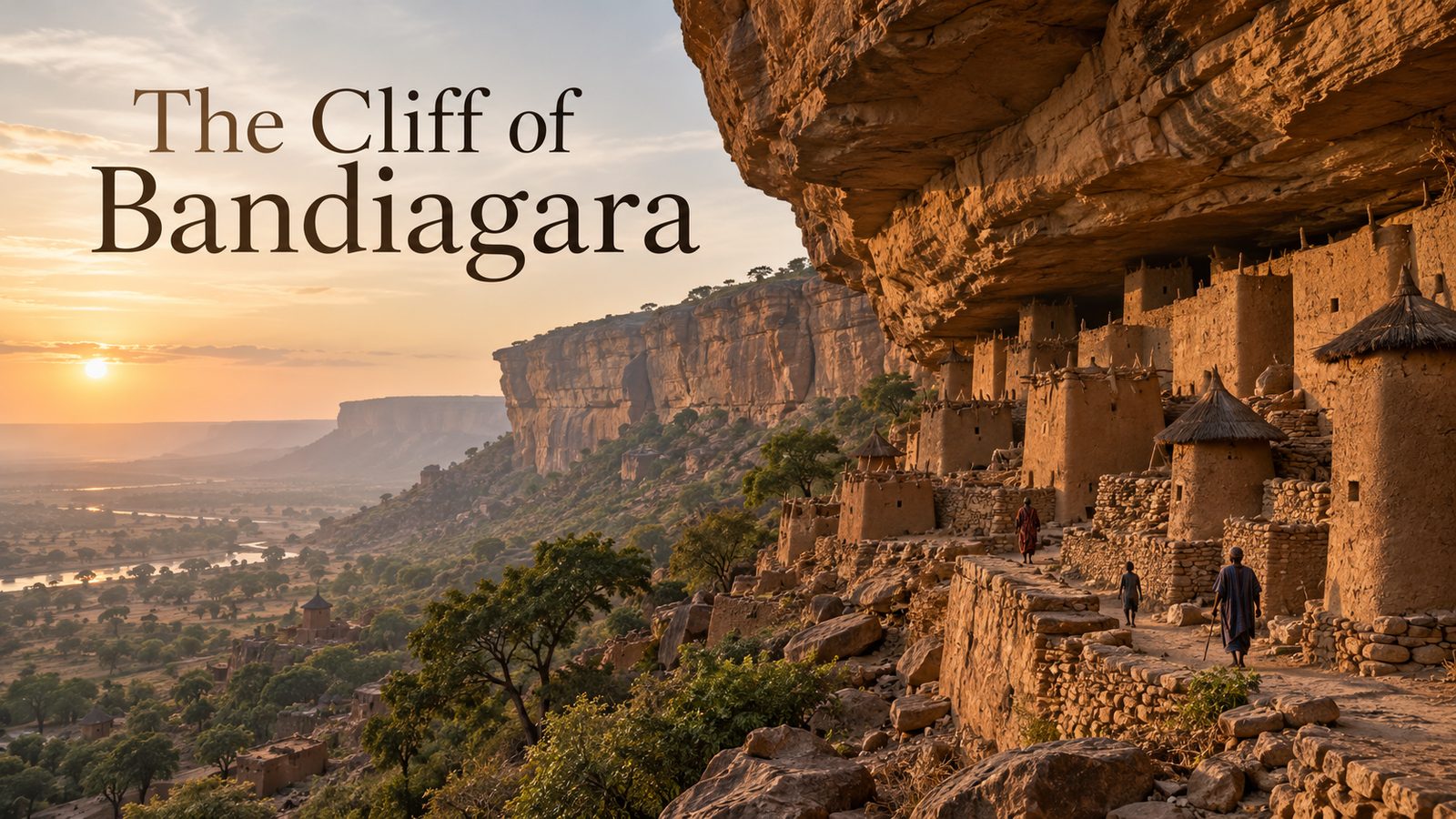
From the plain below, the cliff seems to go on forever: a wall of sandstone rising hundreds of metres, stretching far into the distance. Look closer and you see that the cliff face is dotted with tiny buildings — square houses, round granaries with pointed straw hats, little mud towers tucked into ledges and caves. At the foot of the cliff, villages spill out onto the sand. This is the Cliff of Bandiagara, home of the Dogon people of Mali.
The escarpment
The Bandiagara Escarpment stretches for roughly 150 kilometres across central Mali, south of the bend of the Niger River. It divides a high sandstone plateau from the flat Séno-Gondo plain below. UNESCO listed the area, which includes hundreds of villages, as a World Heritage Site in 1989, recognising both its landscape and its culture.
The Tellem before the Dogon
Long before the Dogon arrived, the cliffs were inhabited by people now known as the Tellem. Their small houses and storage buildings, built in caves and crevices high on the cliff face, can still be seen — some seemingly impossible to reach. Archaeologists have found that the Tellem buried their dead in these caves, along with textiles, headrests and other objects, some dating back about a thousand years.
The Dogon settled along the escarpment from roughly the 14th or 15th century onward. According to their own traditions, they came from the west, possibly fleeing the expansion of powerful states and the pressure to convert to Islam. The steep cliff offered protection from raiders and invaders. Over time, the Dogon also used some of the old Tellem caves for their own burials.
Architecture made from the land
Dogon villages are built from stone, mud, wood and straw, and they fit the landscape remarkably well. Among the most distinctive buildings:
- Granaries — tall, square mud towers with pointed thatched roofs, used to store millet. Men's and women's granaries are different, and women's granaries hold personal possessions as well as food.
- The ginna — the large family house of a lineage head, often with a façade of small niches.
- The toguna — a low, open shelter with a thick roof of millet stalks resting on carved wooden pillars. It is where the village's men meet to discuss problems and settle disputes. Its roof is so low that no one can stand up straight inside — a popular explanation says this is to stop arguments turning into fights.
- Shrines (binu) — sanctuaries for ancestors and spirits, sometimes painted with symbols.
Masks and ceremonies
The Dogon are famous for their masks, carved from wood and decorated with fibre, shells and paint. More than 70 types have been documented, representing animals, people and spirits. The best-known, the kanaga, has a double cross shape and is danced with sweeping movements of the head.
Masks appear in ceremonies such as the dama, a funeral rite that guides the souls of the dead to the world of the ancestors. Every 60 years, the Dogon hold the Sigui, a great ceremony that travels from village to village over several years, marking the renewal of the world and of generations. The last cycle began in the late 1960s; a new cycle is anticipated in the late 2020s.
The Dogon are also known for their complex cosmology and knowledge of the stars, which has attracted both serious scholarship and many sensational claims by outsiders — some of which anthropologists have since challenged.
A landscape under threat
Life on the escarpment has become harder. Drought and desertification threaten the millet harvests and onion gardens on which villages depend. Since 2012, conflict and insecurity in central Mali have caused deep suffering, displaced many people and largely stopped tourism, which had been an important source of income. UNESCO has expressed concern about damage to villages and traditions.
Bandiagara is not far from other great sites of Mali's heritage, including the city of Djenné and the mud cloth workshops where bògòlanfini is made.
Why it matters
The Land of the Dogon is one of the most remarkable cultural landscapes on Earth: a place where people have lived on and beneath a cliff for centuries, building homes, granaries and shrines from the land itself, and keeping alive ceremonies that last for years. It is also a reminder that heritage is fragile — and that the people who live it need peace and security above all.
Further reading
- UNESCO World Heritage Centre — Cliff of Bandiagara (Land of the Dogons)
- Cultural Heritage Online — Bandiagara Escarpment
- Walter E.A. van Beek, Dogon: Africa's People of the Cliffs (Harry N. Abrams, 2001)